
Welcome to a new Sitcom Tuesday! This week, I’m starting my coverage of Happy Endings (2011-2013, ABC), which is currently available on DVD/Blu-ray and streaming!

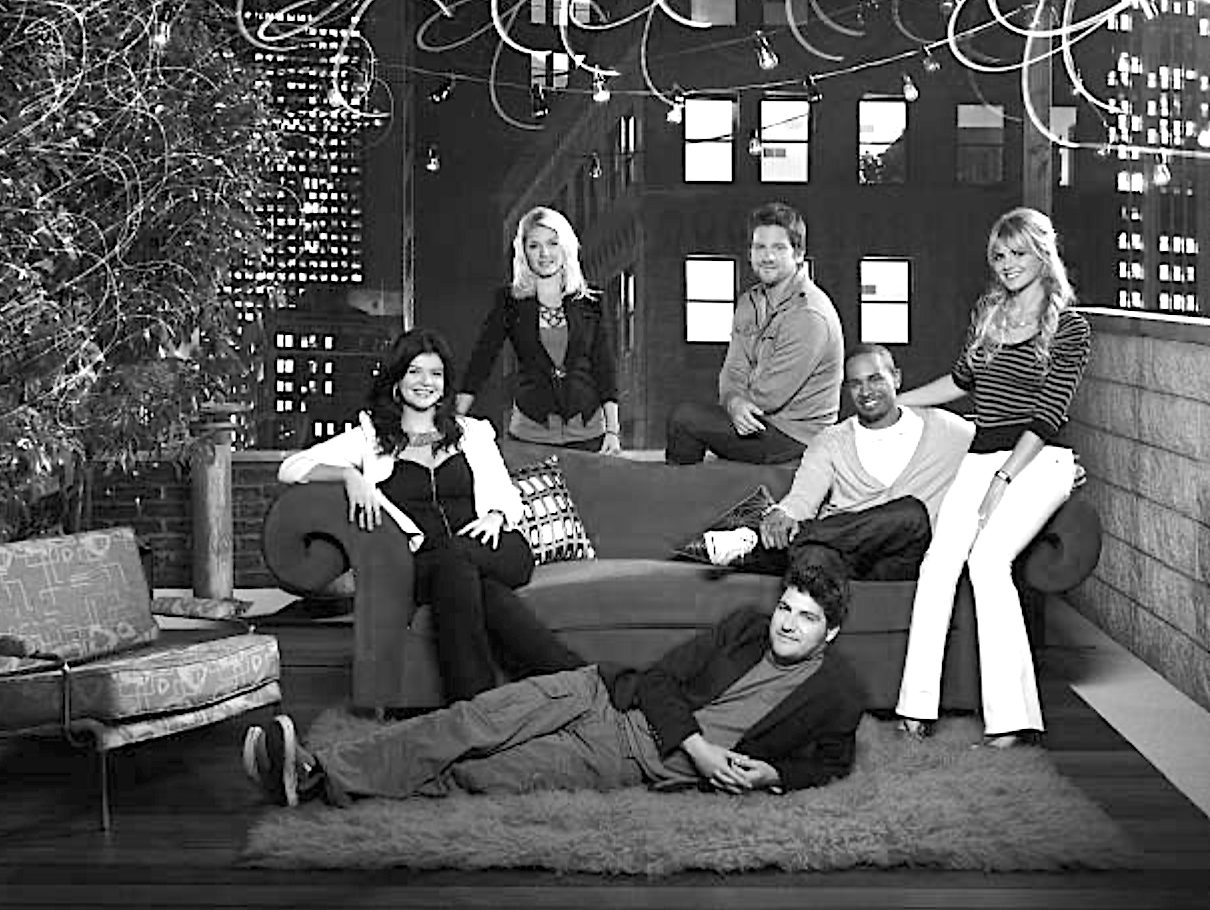
ELIZA COUPE as Jane, ELISHA CUTHBERT as Alex, ZACHARY KNIGHTON as Dave, ADAM PALLY as Max, DAMON WAYANS JR. as Brad, and CASEY WILSON as Penny.
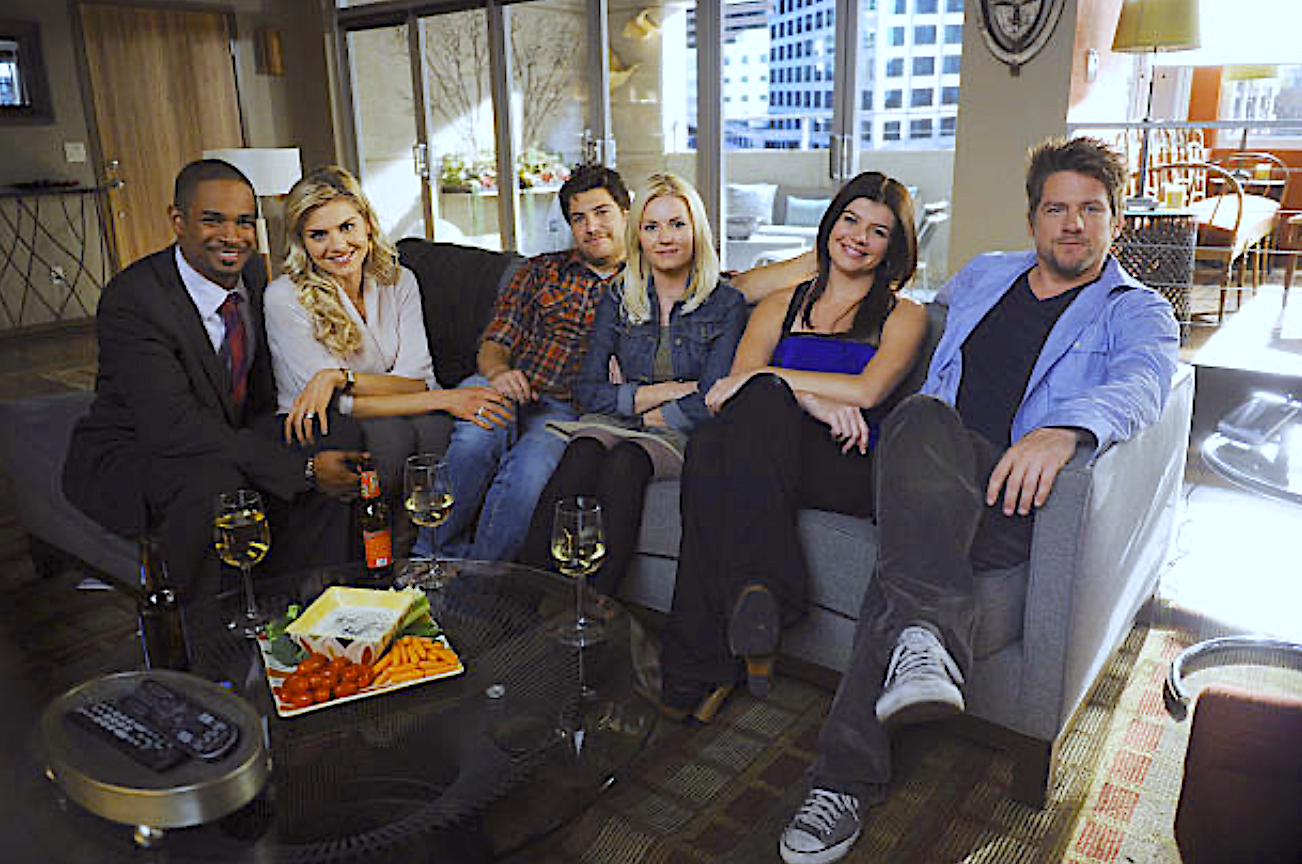
I’ll level with you. Happy Endings isn’t a top-tier classic sitcom that has to be included in any critical survey of the genre. The series doesn’t cover new ground; it’s seldom episodically exceptional relative to its era; and it’s not really a key influence on other shows. Frankly, it’s a better Wildcard Wednesday subject: an affable, somewhat short-lived effort that amassed a cult following because it’s, I’d argue, a solid “not-flop but not-hit” example of the sitcom in the bountiful early half of the Peak TV decade. In fact, it’s exactly the kind of title that often slips through the cracks in sitcom histories because it’s neither a major success nor a wacky one-off. And while, qualitatively, that would make it more akin to Wildcard Wednesday fodder for me, I’ve elevated it to Sitcom Tuesdays because… well, I can pick full lists of episodic favorites based on the series’ own standards. And I personally do enjoy the series, as a lover of the situation comedy art form and its history. For instance, I consider Happy Endings one of the better wannabe Friends of the early 2010s, reflecting an attempt to move the low-concept ensemble hangout “singles-in-the-city” rom-com into a new decade with new sensibilities.

Look at Friends’ more immediate descendants from the 2000s, like How I Met Your Mother and eventually, The Big Bang Theory — which became more of a hangout rom-com once it went fully co-ed in 2010-2011. Like Friends, those were shot using a multi-camera format. Going into the 2010s, that setup already affiliated them with an increasingly retro aesthetic, at least as far as the industry and its tastemakers were concerned. Meaning, single-cams were already becoming a more critically lauded and thus respected style of sitcom. That would remain true throughout the ensuing decade (with multi-cams often framed as nostalgic). We’ve talked a lot about why this shift occurred – e.g., the rise of cable and streaming bringing notions of “prestige” that pushed TV more cinematic and less theatrical (and eventually, more dramatic and less comedic, not to mention more story-driven than situation or character-based). But also, in 2010, the best examples of this genre, for a change, simply were single-cams. So, Happy Endings was smart to take the Friends subgenre — with a similar situation and basic ensemble configuration — and progress it stylistically in accordance with the critical mores of a new, emergent era.
Now, to be fair, it certainly wasn’t the first to do this. Wildcard Wednesdays have already observed many single-cam rom-coms from the late 2000s and early 2010s. And one could argue that Friends had single-cam contemporaries with a shared focus on urbanites pursuing romance. I’m thinking, namely, of Sex And The City, a half-hour HBO comedy that by the end of its run had traded its initially rebellious crassness and cynicism for an attitude more reminiscent of a traditional Friends-ian rom-com, where character evolution became dependent on all the leads finding happy romantic pairings. But that was pay cable, and different enough from Friends to not be seen as derivative. And, obviously, it wasn’t a successor, as so many network sitcoms in this same subgenre would be considered in the decade following Friends‘ finale. To that point, there still really hadn’t been a long-running single-cam version of Friends. At least… not until FOX’s New Girl, which premiered in 2011-2012. Speaking of that show — which is slated for coverage following Happy Endings — I also thought it would be fun to feature Happy Endings as a companion, for while it obviously didn’t last as long, it’s thematically adjacent to New Girl in a way that could make for comparisons (particularly once we get to the latter).

In the meantime, if Happy Endings interests me because it’s an example of a popular subgenre adapting itself for a new era’s critical ethos, I like watching it because of something more fundamental. It’s successful on elemental terms: it uses its situation well for comedy. In particular, it’s a low-concept show with funny characters. Again, no one is totally never-before-seen, but I appreciate the clear comedic and narrative opportunities offered by Eliza Coupe’s Jane — the group’s Type-A control freak in the Monica Geller vein. She’s a strong, easy-to-understand figure who pairs well against her sister. (You’ll note that this is another show that puts two siblings in the main ensemble.) That sister is Elisha Cuthbert’s Alex, who by sheer contrast with Jane, is a lot messier, dumber, and less put together. That’s also made plain by her actions in the pilot, when Alex leaves her fiancé at the altar, thereby creating a new status quo for this pre-established group of Chicagoans that still includes both exes. Once more, I can’t say this is something we’ve never seen before – Friends, Mother, Big Bang all had moments where their ensembles had to navigate intra-group breakups. But it is unique as a formal and explicit wrinkle in the situation — the hook that sets up everything to follow, or at least in this first season, where stories naturally address interpersonal tensions as a result of this new arrangement.

The guy that Alex leaves at the altar is Zachary Knighton’s Dave. He and Jane’s husband Brad, played by Damon Wayans Jr., are probably the least comedically strong members of the cast at first, largely because their characters are less precisely defined. However, the premised dynamic between Alex and Dave gives him some color that’s reiterated throughout the run — namely, he’s the loser of the group, the down-on-his-luck one most conducive to screwing up and being mocked. As for Brad, because Jane is so aggressively dominating, he ends up being whipped and diminutive by contrast, ultimately emerging alongside his wife as one of the show’s funniest leads because of their dynamic. In that regard, the relationships here help give shape to the characters, making it so their narrative usage is at least clearer and more distinct than their actual personalities. Speaking of distinct personalities though, two of the show’s biggest laugh-getters are the remaining leads – Adam Pally as Max, and Casey Wilson as Penny. Max, notably, is gay – another way that Happy Endings represents a social adjustment towards the 2010s when gay regulars were starting to become more prominent (see: Modern Family) and no longer the totally novel and therefore premise-explicit hooks that they often were in the Will & Grace era. And to that point, Max is deliberately designed to buck clichés — rejecting gay stereotypes to such an extent that this becomes a large part of his comedic identity. It makes for a funny dynamic between him and the Grace to his Will — Penny, played by SNL alum Casey Wilson.

Penny, who dated Max in college, is truly like a Grace Adler in that she’s the quintessential single girl — the plucky, somewhat un-self-aware goofball who gets to be unlucky in love on a regular basis. And for a show that’s all about interpersonal relationships, and especially the romances being pursued by most of the ensemble, that makes her basically the most narratively fruitful character. The one who gets the most stories and laughs that represent the series’ core intentions. She’s thus an ambassador for the series stylistically. Unsurprisingly, Wilson later married the show’s creator, David Caspe, and their private fusion mirrors the way in which her personal tenor feels tied to Happy Endings’. For instance, quirk-laden Wilson plays the quirk-laden Penny in a manner that feels broadly applicable to the show at large, including all the regulars. Regardless of how strong and clear their personalities are (Jane probably is the most, Dave probably is the least), every single one of them is a collection of quirks. And that’s reflected in the writing itself, which is led by both Caspe and former Conan O’Brien scribe Jonathan Groff, who surely helped instill in this series its special rhythms, and, most notably, its reputation for being filled to the brim with jokes, running through hahas quickly, with accordant stories about weird people while every lead is somewhat weird as well.

Now, I think this has been a trend in this genre since the mid-2000s, as sitcoms have moved away from mere personality comedy and towards a more detail-based collection of oddness, where everyone is essentially the wildcard kook. The Kramer. We’ve seen some of this on Community, Parks And Rec, 30 Rock, and even The Office. At times, it feels like vaguer situation comedy, for the continuity of a lead’s depiction is less centralized than the immediately weird, often unexpected, joke. And, in general, there’s also a focus on comic ideas here that, à la Seinfeld, also corroborates an idea-driven ethos more broadly. As such, I would say that Happy Endings leans more to the idea-driven school of sitcommery. (Heck, its idea-driven rapid-fire jokiness fully becomes its calling card by Season Two!) However, when comic details accrue and can then be referred back to in a way that creates and then plays upon expectations, this is situation comedy – i.e., laughs predicated on our understanding of some regular element, be it character or even tone. Accordingly, I think Happy Endings is a solid example of this kind of idea-driven comedic writing with strong characters in implicit support. And in that regard, Happy Endings is a true reflection of its era in sitcommery, not necessarily creating its own trends but encapsulating them. I can’t lie and say I prefer it to any of the aforementioned. But I do enjoy it as a reliably amusing three-season cult classic, somewhere between a flop and a hit. A valiant attempt to update a tried-and-true subgenre for an evidently new decade — with funny characters inside an idea-driven apparatus that prioritizes big laughs.
01) Episode 2: “The Quicksand Girlfriend” (Aired: 04/13/11)
Dave gets trapped in a new relationship while Penny seeks a new gay husband.
Written by Josh Bycel | Directed by Jeff Melman

After a solid premise-establishing pilot, Happy Endings immediately aired one of its stronger early-produced entries. “The Quicksand Girlfriend” is a character-clarifying half hour with several funny ideas, most notably the thought of Dave falling in “chicksand.” That’s a self-labeled social phenomenon reminiscent of the kind of fare seen on Seinfeld, and it speaks to the idea-driven bent of this series, which spotlights amusing jokey notions as a mode of distinction (since the situation and subject matter are already so familiar). Also, I appreciate this episode because sisters Alex and Jane are well-contrasted in their subplot, while the relationship between Penny and Max is also explored in a story that highlights how Max is not as stereotypically gay as most characters in this genre have heretofore been. Indeed, contrasting Max against the flamboyant Derrick (Stephen Guarino), introduced here, is a great way to help delineate Max.
02) Episode 4: “Mein Coming Out” (Aired: 04/20/11)
Max continues to hide his sexual orientation from his visiting parents.
Written by Gail Lerner | Directed by Jeff Melman

This installment’s A-story is a familiar farce in which Max tries to keep up the charade that he’s straight to his visiting parents, to whom he has yet to come out of the proverbial closet. Ordinarily, ex-girlfriend Penny would be his beard, but she’s busy in her own comical subplot — dating a man named Doug Hitler. It’s another Seinfeld-ian logline — remember when Elaine dated a Joel Rifkin? — that I count as more idea-driven than character-driven. The joke is just his surname, and Penny’s reaction is not really individualized to her character, as most people would have difficulty dating someone with such an unusual affiliation to someone so awful and infamous. Nevertheless, that makes it a great representation of Happy Endings’ emerging narrative and comic sensibilities, and I appreciate how it dovetails with Max’s primary story, which also involves Dave, Alex, and Jane before culminating in a real happy ending, as Max finally tells the truth. As usual, this isn’t new narrative ground — it’s very Will & Grace, frankly — but, again, it’s such an accurate encapsulation of this show right now that it’s probably the best selection I can make from this list to be this year’s MVE (Most Valuable Episode).
03) Episode 6: “Of Mice & Jazz-Kwon Do” (Aired: 05/04/11)
Dave temporarily moves back into Alex’s place while Brad tries to fix up Max.
Written by Rob Kerkovich & Todd Waldman | Directed by Troy Miller

All three of the main storylines work in this entry — a somewhat unusual feat for this series (and for the similarly designed Friends, to be fair). While Jane and Penny get a funny, physical comedy-filled subplot that again does a great job of emphasizing Jane’s rigidly aggressive and thus crystal-clear character, Alex and Dave are still dealing with their premised past together in a fairly unique story where he temporarily moves back into her apartment and they both prolong the arrangement because it’s mutually beneficial. That’s a great play to the situation. Additionally, there’s another Seinfeld-like story for Max and Brad, as Max accuses Brad of being “gay-cist” for thoughtlessly assuming that just because two men are gay they’ll naturally be compatible.
04) Episode 7: “Dave Of The Dead” (Aired: 05/04/11)
Dave considers big changes in his life while Penny tries to keep up with her hipster boyfriend.
Written by Leila Strachan | Directed by Randall Einhorn

As one of the least precise characters in the ensemble, Dave is benefited by an episode like this, which calls attention to his aimlessness that he hopes to correct by pinpointing and pursuing a dream. It’s the start of some crystallization for him, and it’s introduced well through an overarching “zombie” theme that also ties together a subplot for Max and the uber-competitive Jane, who once again has her strong characterization spotlighted. Meanwhile, many of this entry’s biggest laughs come from Penny’s subplot — as she struggles to adjust to her new “hipster” beau, whose overly cool sensibility is a direct contrast to her natural and frenetic over-enthusiasm, making this a challenge that effortlessly emphasizes her own personality in the process and is thus one of her finest showings here in Season One.
05) Episode 12: “The Shershow Redemption” (Aired: 05/25/11)
The group attends their old friend’s wedding, where Alex is a suspected jinx.
Written by Todd Linden, Sierra Teller Ornelas, Steve Basilone, & Annie Mebane | Directed by Lee Shallat Chemel

Although one extra entry was held and eventually run in late August, this is ostensibly Season One’s finale — bookending the pilot by bringing the six leads back to a wedding. This time, it’s the union of their friend Shershow (T.J. Miller) and his soon-to-be-wife (June Diane Raphael), who is nervous about having them there because she remembers what happened at Alex and Dave’s wedding and considers Alex to be a jinx. That’s an amusing reminder of the show’s premised status quo. Similarly, Alex and Dave’s relationship finds some welcome evolution as she operates as his wingman at the wedding, while Penny again brings in some big laughs when she drunkenly tries to pass off the returning Derrick as her new fiancé — a quintessentially farcical act of desperation that plays up her ethos and the show’s overall.
Other notable entries include: “Like Father, Like Gun,” where Damon Wayans Sr. guests as Brad’s dad and Penny has an amusing idea-driven subplot where she can only speak Italian when drunk, “The Girl With The David Tattoo,” which claims one of the best Dave/Alex premise-related stories of the year, and “Barefoot Pedaler,” an early-filmed entry that takes the entire group to a concert where Penny seeks the validating attention of her musician ex.

*** The MVE Award for the Best Episode from Season One of Happy Endings goes to…
“Mein Coming Out”

Come back next week for Season Two! And stay tuned tomorrow for a new Wildcard!