
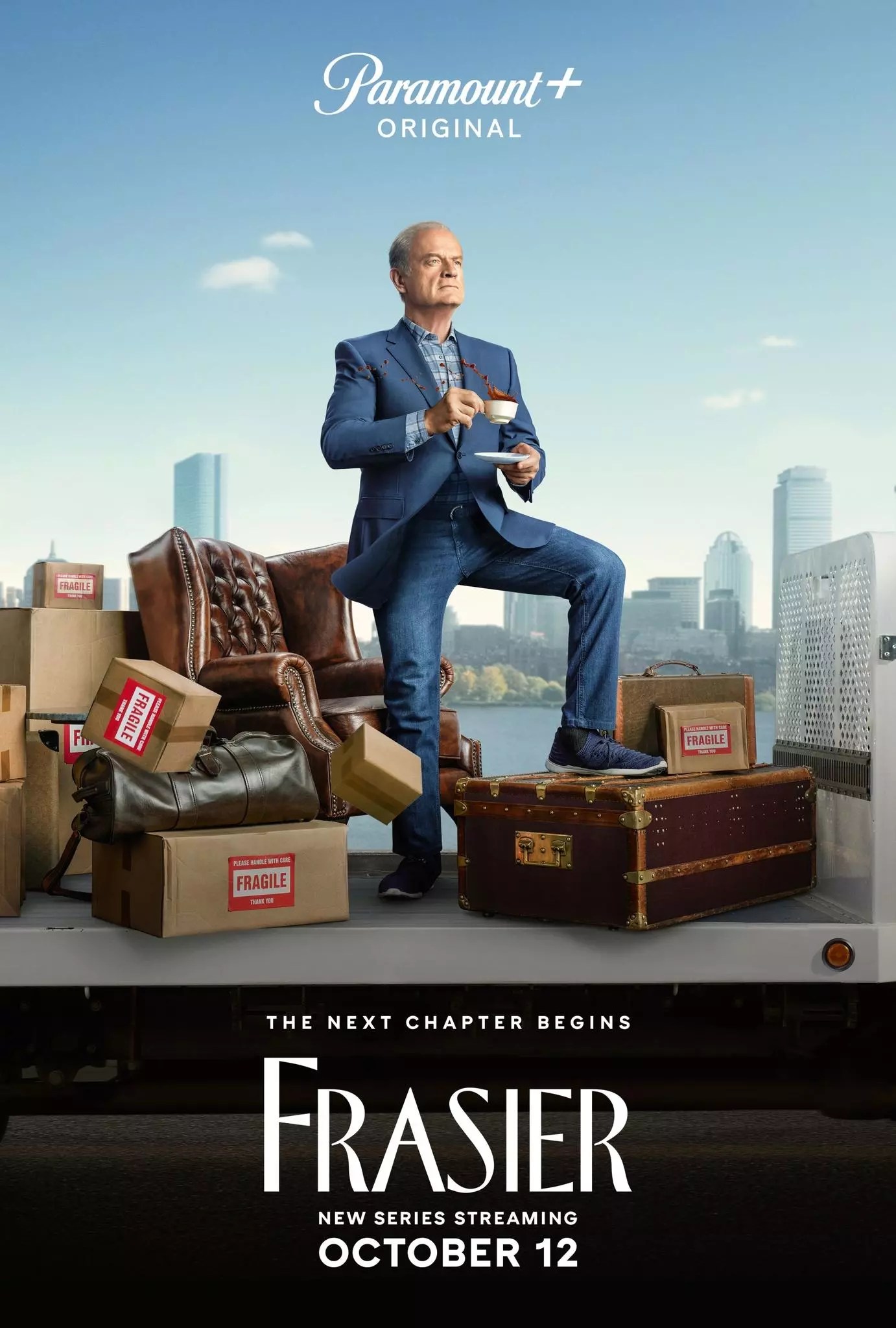
Welcome to a new Sitcom Tuesday! This week, we’re covering the first season of Paramount Plus’ 2023 revival of Frasier, which is currently available on… Paramount Plus!

Frasier stars KELSEY GRAMMER as Frasier, JACK CUTMORE-SCOTT as Freddy, TOKS OLAGUNDOYE as Olivia, JESS SALGUEIRO as Eve, ANDERS KEITH as David, and NICHOLAS LYNDHURST as Alan.

Of all the reboots, or revivals (as I prefer to call them), of the last ten years, this is the one that I was most wishing wouldn’t come to fruition. That’s because I consider the original Frasier to be a terrific sample of great sitcommery, and though I’ve always been able to separate these secondary continuations from their iconic predecessors, I couldn’t bear to think of its legacy being tarnished for others by a likely inferior postscript — “likely inferior” because it’s always incredibly difficult to repeat success, especially this success, which was already lucky to follow Cheers’. So, I was braced for disappointment, and now that I’ve seen all ten episodes from what will probably be this revival’s first of a few seasons… I’m only partially assuaged. That is, as these nostalgic cash-grabs go, 2023’s Frasier is one of the better examples. It doesn’t manage to quite match the tone or style of the original (only one script is written by a former scribe — the rest are by folks new to Frasier Crane, led by a pair from How I Met Your Mother and Life In Pieces, respectively), but it’s solid enough — and anchored by a character who himself is solid enough — to make for a perfectly decent sitcom, based on this blog’s definition of the form. It just doesn’t come close — anywhere near close — to the quality of the 1993 classic. Beyond the sheer way it’s written, I believe there are four major issues that keep it from matching the prior’s excellence. The first is structural — although, I have to say, the premise itself is clever, about Frasier Crane returning to Boston and moving in with his estranged firefighter son, while taking a teaching job at the elite Harvard alongside his old college chum. It’s maybe a bit expected — the parallelism of the original’s father/son dynamic is very on the nose — but it’s a fine, simple, relationship-forward design, both for the Frasier character and for any multi-camera sitcom, as it boasts a classic MTM-esque work-and-home setup. And, actually, I think the college setting is maybe more fruitful for story than 1993’s radio station, primarily because there’s at least one regular there with whom Frasier has a long (pre-Cheers) history — Nicholas Lyndhurst’s Alan, a crusty Brit who’s good for laughs and seems to have (untapped) story potential.

The problem, particularly in this comparative context, resides at home, where Frasier lives with his son, Freddy — the blue-collar rebuttal to the highfalutin lead, just like Martin in the original series. Indeed, this estranged “odd couple” pairing explicitly mirrors the initial Frasier vs. Martin conflict — and it’s a familiar sitcom tension… However, the 1993 Frasier had an extra ingredient that this series lacks — and it’s the very thing that elevated the original to brilliance: Niles, a polarizing force who was so far opposite from Martin that he pushed Frasier more to the middle, where Frasier could still clash with his father over their obvious differences but also center the show as its relatable, less contrary emotional core. This then allowed the spin-off to reconcile traits that made Frasier a distinct comic figure on Cheers with the more everyman sensibility that he developed in that setting merely as a long-term barfly, essentially restoring his rarified boldness, but now with more humanity, given his juxtaposition against Niles, who embodied an extreme with which his brother could alternatively align and contrast. In 2023, there’s no longer a need to bridge the gap between different variations of Frasier’s depiction — only to extend it. But 1993’s inclusion of another, bolder Crane who had a similar relationship with Frasier’s opposite also helped all family stories be more multi-faceted, with additional conflicts arising from individual bonds inside this expanded nuclear construct. The new Frasier simply is without the same opportunity — all it has is the basic Frasier/Martin drama, with the ages reversed (but Frasier still, as ever, the more selfish), and that renders it inherently less smart, less productive than the original. Oh sure, there’s stuff to explore with father and son alone… but this is where some of the other problems come in, like my second issue, which is that not all the regulars on Paramount Plus’ Frasier are well-defined.

I’m referring specifically now to Freddy, who is essentially premised as the opposite of Frasier in every way… and yet in practice, this makes him basically just the straight man to a hyper Frasier, for Frasier has nobody centralizing his crazy (as Niles did), with few to no character traits of Freddy’s own that could actually be conducive to comedy. In other words, there’s nothing unique to Freddy that allows him to push laughs and story, beyond the structural givens: his relationship with his dad, his job as a firefighter, and his inevitable romance with the aspiring actress across the hall, Eve, who has comedic shape but is perhaps a bit too obvious of a device. I’ll be shocked if we get to a third season without their coupling… But Freddy’s not the only weak regular — there’s also David, Niles and Daphne’s geeky son, now studying at Harvard. He’s clearly meant to be a proxy for Niles, yet he doesn’t play the same vital role against Frasier within the ensemble, and quite frankly, it’s a casting matter too, for Anders Keith is simply not able to rival David Hyde Pierce’s genius work, no matter how hard scripts try to set him up well. Everything about David as a presence on the series feels not well-integrated into Frasier’s life or his primary relationships at both the office and at home, and with the actor just not as artful at bringing the same comic energy that he’s evidently supposed to supply as a virtual Niles stand-in, it’s a letdown. To that point, I think the places where Frasier 2.0 is most directly comparable to Frasier 1.0 is where we’re most left wanting — with David as a replacement Niles and Freddy as a replacement Martin. Neither have even a fraction of the complexity. And this brings me to the third reason this revival isn’t positioned for greatness — the fact that it only has ten episodes in its first season (and will probably never get an order that’s much bigger).
While structural inferiority is only allayed with big change, character weaknesses can be quietly fixed. As we know, every sitcom has the potential to develop its regulars over time, reaching an understanding of how to best utilize them by exploration within story. Original Frasier had 24 episodes a season to do so; this Frasier doesn’t even have half that — which means, it has far fewer chances to discover who these folks are, or to iron out kinks in their depictions through their repeated use within narrative. This limitation is plaguing most TV series these days, but primarily comedies, which rely on time and repetition to build familiarity. New Frasier will never have the same time and repetition, and although it’s ahead of most freshman comedies because we already know some of these characters and their relationships, all room for trial and error has been weeded out. Now, every episode is supposed to be a winner… and I’m afraid it’s not. In fact, there’s nothing great here. Most of the excursions are good — but they’re predictable, with many entries predicating their worth purely on nostalgic references to Frasier’s history, and by default, his past series. Okay, fans of the old show are precisely this new show’s audience, so it’s just doing what will easily satisfy the crowd… But nostalgia is the final issue — something that Frasier 1.0, with regard to Cheers, deliberately minimized. This show does the opposite — it sets up its premiere (which is tonally all over the place) in direct relation to what we knew about Frasier and Freddy from the last series, and then probes their bond in a handful of stories (episodes #2, #4, #9, and #10) that draw explicit, intentional nods to the old Frasier/Martin conflict it’s designed to mirror. And this is, well, worrisome, for if so much of the value derived requires our attachment to another show, then we’re really not watching Frasier 2.0 for Frasier 2.0., and that means this show will probably never be able to create the kind of new value that’ll actually allow it to sustain itself for a healthy run… Of course, with only ten episodes per season, perhaps it doesn’t have to sustain itself — at least, not for very long.

But in terms of situation comedy, we want a situation filled with well-defined characters whose distinct relationships can generate many laughs and lots of stories. A rich, well-acknowledged past definitely helps, but the novelty of nostalgia will wear sooner rather than later, and honestly, it’s often an impediment to comedy, especially when it’s as sentimental as it is here, largely hinged around the off-camera death of Martin (and John Mahoney). That’s sweet, but tedious… Heck, the only references to the past that are truly comedic come in the form of narrative notions, like a wink at the first Frasier’s reputation for farces (episode #6) and his character’s reputation for terrible dinner parties (episode #10), or in the token guest appearance of the reliable Lilith (episode #7), a star who transcends Frasier and has a rapport with the lead that is intrinsically fun and complicated, largely due to their shared battle scars. As you can see, that’s most of the season, dominated by stories that heavily involve something related to another show, and the three remaining entries (#3, #5, and #8) — all about Frasier’s new career — are hit-and-miss, because they don’t do enough with either of the premise’s core relationships (Frasier/Freddy or even Frasier/Alan). This leaves little room for greatness, and while I think a second season could improve on a first by moving away from the old series and developing these new regulars, I also worry that an over-reliance on nostalgia and such limited episode orders will never let this Frasier ameliorate its structural shortcomings and character weaknesses. And I don’t foresee this show ever truly finding its own way to equal the magic of the original. At best, it can try to replicate it — just as it tries to do in the three episodes I have chosen as this year’s best: the only ones that maybe manage to delight like Frasier Crane is used to doing.
01) Episode 6: “Blind Date” (Released: 11/09/23)
Frasier and Freddy think the same woman is their own blind date.
Written by Joe Cristalli | Directed by Kelly Park

In its only real attempt at a classic Joe Keenan farce from the original, the revival’s first season is able to concoct a funny half hour that both utilizes the central Frasier vs. Freddy tension while also providing big laughs from a narrative construct that’s familiar to lovers of the Frasier ethos, and actually feels like a successful extension of it — employing these new ingredients to deliver a similarly tasty recipe. It’s not as sublime as the gems from the initial series, but it’s a good showing for Frasier and his 2023 return, where we’re longing for bold, loud, memorable hahas. And since it engages a sensibility inspired by Frasier himself, it’s the one that I think most indicates how the series can exist and be likable going forward. (June Diane Raphael guests.)
02) Episode 7: “Freddy’s Birthday” (Released: 11/16/23)
Frasier and Lilith compete with each other on Freddy’s birthday.
Written by Sasha Stroman | Directed by Kelsey Grammer

Bebe Neuwirth reprises her role here as Frasier’s ex, Lilith, introduced in a 1986 episode of Cheers and an important figure on both that series and the original Frasier. As noted above, her long, complex history with Frasier makes any story that pairs them a guaranteed winner, and even though I’ve seen some fans complain about the continuity of their rapport (namely that it’s more acrimonious than it was in 2003), it’s a synthesis of their dynamic as it existed on the first Frasier, and in focusing on them — two characters who are well-defined and well-matched — it obviously works. Certainly, the new Frasier can’t traffic in this kind of nostalgia every week, but when it features Lilith, there’s little chance of me not highlighting her work.
03) Episode 10: “Reindeer Games” (Released: 12/07/23)
Freddy tries to cheer up Frasier by helping him throw a Christmas party.
Written by Janene Lin & Jenna Martin & Naima Pearce | Directed by Kelsey Grammer

The first season of the new Frasier is very conscious of its premised central bond between Frasier and Freddy, and of how the impetus for their reconnection was Martin’s death — with Frasier and Martin’s old relationship deliberately mirrored. So, there’s already a lot of inherent nostalgia in this concluding entry (which seeks to say that some kind of arc has occurred), but it’s also accentuated by the running joke of Frasier being a frantic mess at parties, along with the return of Peri Gilpin’s Roz, whose appearance I think is gratuitous, yet nevertheless evidence for my point about the show relying too much on reminders of the past. I hope a second season keeps this outing’s relationship-focus but with less genuflecting to the prior series.
Other notable episodes that merit mention include: “Moving In,” the sophomore entry, which focuses on Frasier and Freddy as new roommates in a way that’s very reminiscent of early segments of the first Frasier with Frasier and Martin, “Trivial Pursuits,” which was penned by former scribe Bob Daily and involves Frasier’s feelings about Freddy’s career — another notion that feels like a parallel to the original (I wish it didn’t try to force so much emotion), and “The Fix Is In,” which is the most explicit about how Frasier and Freddy are like Frasier and Martin.

*** The MVE Award for the Best Episode from Season One of the Frasier Revival goes to…
“Blind Date”

Come back next week for more sitcom fun and another Wildcard Wednesday!
Jackson, hi. I was wondering what you thought about the longer length of episodes. Anything over 20 minutes is an improvement. However, there were a number of times I thought editing weaker material to come in at 24 or 25 minutes could have helped.
Also, for a second season do you think letting some of the supporting characters go in favor of using Frederick’s fellow fire fighters more might be a good idea. Thanks
Hi, Paul! Thanks for reading and commenting.
When you’ve been conditioned by several decades of sitcoms to expect an episode to run somewhere between 22 and 25 minutes, anything less feels short and anything more feels long. Several of these FRASIER episodes felt long — particularly the first and last. But that’s common for streaming shows.
As for the firefighters, if they could be better integrated into the ensemble — and around Frasier himself, specifically — I wouldn’t mind their increased usage. Otherwise, no, I don’t think it makes sense, based on the premise, to elevate them and Freddy’s workplace at the expense of elements that are present to help centralize Frasier in his reliable work-and-home setup.
Do you think these reboots would be better served if they took a more dramatic approach (without abandoning all humour of course), due to the ages of the returning actors? What if instead of ‘Frasier’ being a mutli-camera sitcom with a laugh track, it was a single-camera show with the senior Kelsey Grammar taking a more mature look at the senior character of Frasier? Would this approach allow for more elevated (better) writing?
I especially have this thought while watching the ‘Night Court’ reboot. I feel like it was a missed opportunity not to explore an older, wiser, Dan Fielding and better utilize such a great actor as John Larroquette.
Hi, Greg! Thanks for reading and commenting.
I think a single-camera setup with a more dramatic approach would certainly feel more contemporary and adherent to current trends, which would probably give the show more credibility with modern critics and award-voters. But a large part of any reboot’s commercial appeal is nostalgia – this FRASIER knowingly leans into it (too much, in fact) – and the maintained multi-camera format is indeed a symbolic hook to indulge the feel-good sensibility on which the studio is intentionally banking. So, it would be a trade-off. (The same goes for NIGHT COURT.)
As for the quality of the text, drama is much easier to write than comedy because drama has less to consider. Story and long-term narrative ideas matter most in drama and are its primary textual concerns, as opposed to the consistent display of well-designed characters who must support both the initial and then maintained cultivation of a fairly stable but fruitful “situation” that *then* must also encourage story and long-term narrative ideas. In other words, comedies require more support from character — conceptually and episodically. Oh, and comedically, of course. Now, to be fair, a single-camera move by itself wouldn’t necessarily have to mean a total pivot away from comedy (there are many hilarious single-cams!), but given FRASIER’s history, it would likely imply, and thus accompany, a shift towards drama anyway – just as the rise of the single-cam aesthetic in the 2000s/2010s naturally indicated an accelerating malleability within the sitcom genre, for better and/or for worse.
To that point, I am personally against the trend of sitcoms becoming more like dramas because it reinforces our ancient bias that comedy alone is lesser than and that this genre is inferior if “only” funny. Of course, as a lover of sitcoms, I don’t subscribe at all to this belief, for the goal of every situation comedy is to be predominantly comedic, so any corrupting influences to the contrary inherently undermine the artistic value of this specific (and very challenging) form. In fact, I resent how cable and streaming have taken their notions of “prestige TV” and infiltrated the situation comedy over the past twenty years (nay, thirty) by diluting what it means to be a genuinely good sitcom (read: FUNNY!), thereby perpetuating this anti-comedy bias because fewer half hours now are indeed successfully comedic enough to meaningfully defend the genre. And with a show like FRASIER – a great argument for the sitcom as an artistic venue – any concession to drama like this would be, for comedy lovers everywhere, devastating.
(Thanks for the great question! I have flagged your comment and my response for possible use in one of my forthcoming Q&A entries!)