
Welcome to a new Sitcom Tuesday! This week, we’re continuing our coverage of Curb Your Enthusiasm (2000-2011; 2017-2024, HBO), which is currently available on DVD and MAX.

Curb Your Enthusiasm stars LARRY DAVID as Larry David. With JEFF GARLIN as Jeff Greene, SUSIE ESSMAN as Susie Greene, and JB SMOOVE as Leon Black.

Initially my plan was to study the first eight seasons of Curb this year and then look at the “revival” sometime in the future. But when it was announced that Twelve would be the last, I opted to discuss everything all together, disrupted production continuity be darned. Oh, I still believe breaking a reliable pattern is inherently against the promise of series television, and especially the sitcom, which hinges on expectations of regularity. However, it is the same program, with the same basic premise and characters, and all 12 seasons, united under the same title, will ultimately constitute an individual legacy. Also, most of what I observe in this revival was already showing up in the original run, so there is, for me, analytical flow. It’s just that a gap as wide as six years is major and makes these changes more obvious, for so much time has passed that Curb is different now, re-calibrating its identity based on the updated cultural landscape — evolved from the mid-2000s to the mid-2010s — along with the collective view of self that had calcified over the long hiatus where it seemed like Curb was done and therefore appraisable in a rear-view mirror. I find that this self-conscious perspective — where the show thinks it knows what it’s supposed to be, and, incidentally, has Season Eight as top of mind as, say, Four — actually obstructs some of its ability to still be the best version of itself, for in the revival’s efforts to fall back in step but stay on top, it feels like Larry and his crew are doing Curb Your Enthusiasm, instead of being it. That is, it’s sometimes a parody of the old show — a good, earnest parody, but a parody nonetheless: hitting the marks, only bigger and louder. This criticism started to be applicable in the latter half of the 2000s, but it’s more extreme now. For example, the show’s understanding of Larry has further caricatured — he’s the rudest, pettiest troublemaker he’s ever been, with no social grace and a habit of picking problems in every circumstance, even when believability is stretched beyond the standard previously established. This broader depiction is used to enable more of the bold ideas for which the show has been celebrated, and which has indeed been its raison d’être. As such, every episode in Nine is filled with funny notions of every size — some small, some big… some so big, in fact, that they’re not always believable and/or motivated, and not always well-connected to Larry.

In general, there’s a lack of personalization to many of Nine’s ideas — they’re not as unique to Larry or his world; any social discomfort that the show can mine, it’ll mine now, with less discernment. And the situation, as a whole, is less relevant. Yes, the series is still centralizing Larry David, or the heightened version described above, but it’s rarer now for these final years’ overarching seasonal narratives or their individual episodic stories to directly utilize the showbiz trappings that once accentuated in Curb a compelling sense of metatheatricality, contextualizing his character and justifying the single-cam veritas look that informed so much of how the series first predicated its identity, both internally and externally. That’s why, in general, the show feels less like itself now — it’s so fixated on boasting BIG-laugh ideas to maintain the end result of its excellent comedic reputation that it’s less mindful of how it once was excellent: conceiving those ideas inside the situation, where the implications of a broken fourth wall helped focus the depiction of Larry, granting the series a specificity beyond just the generalities of being funny and having an increasingly bold curmudgeon. This loosening tends to happen on most sitcoms, especially ones that consume lots of ideas and predicate value solely on them; eventually, good ideas get harder to conjure as novelty dwindles, and something about the situation — e.g., the characters — has to change (or broaden) in order to keep the creativity flowing. More support, like from other well-defined leads, would have thus been beneficial. (Larry does have sidekicks, but their capacities are limited.) Although, Curb would probably argue that Larry has become so well-established that he alone is enough of a situation. That’s a character-driven thought I could appreciate, if this wasn’t such a fundamentally idea-driven show, maneuvering its lead for its idea-driven aims — the tail wagging the dog, as it were, thereby creating a dog that knows how it’s expected to move but does so unnaturally, chasing ideas he shouldn’t fetch… Bad metaphors aside, Curb’s efforts to offer what it was remembered for offering zeroes in on results, taking less care in how they’re earned. This is the product of a show that’s both too big-picture about itself and also overextended — a trend that accelerated every time it took a little break but is extremely pronounced and pinpointable now after six years off for self-reflection.
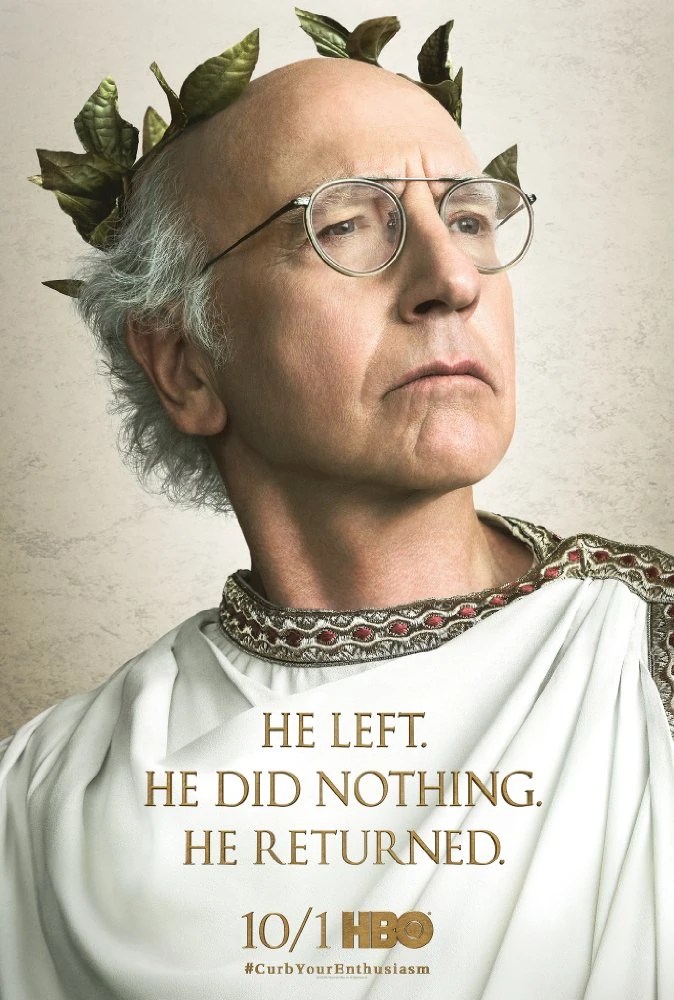
Okay, in terms of its minimized metatheatricality — to be fair — I’m sure the show knew this sensibility was no longer fresh. By 2017, there’d been a whole generation of sitcoms that followed in Curb’s footsteps as winking single-cams with premised fourth walls, either via a mockumentary format (like The Office) or a similar showbiz setting where real people played versions of themselves (like 30 Rock). None of that could uniquely excite in the late 2010s, so even if it’s always been part of Curb’s identity, it couldn’t stay part of its special appeal anymore. The genre had changed since 2000 — what once was cutting-edge became dime-a-dozen. However, the show isn’t just playing catch up to its own influence; it’s actively chosen to evolve its look closer to what we could find on any ol’ single-cam from the late 2010s — more formal in visual texture, with less of the verite that suggested something rawer and more privileged in its vantage point. This also partly explains Curb’s reduced meta — and the dilution of the situation that justified it — for with a style now evidenced in all kinds of generic shows (even those without fourth walls or showbiz trappings), both the Larry David persona and the series’ chosen storytelling are less situated in a “meta” frame where a curated sense of realism is cultivated around the notion that we’re peeking behind an implied curtain, and instead filtered through a lens more familiar yet less precise, where any broadening of character or story has less to which it must answer. In that regard, Curb has helped itself become less unique — an adherent to trends rather than a leader of them. And while it may distinguish itself with rich comedic ideas, the mise en scene undercuts it with truth: Curb has become more like the kind of show it influenced and is no longer the influential show it once was… That said, it’s still above most contemporaries, mostly because of its maintained prioritization of comedy, which was not common for cable sitcoms in the 2010s, due to the now-dominant single-cam aesthetic and the attitudes of “prestige TV,” where viewer interest is sought through narrative serialization and higher emotional stakes, and therefore a more story-based, dramatic tension that makes half-hour “comedies” less situation-oriented and much less funny.

Fortunately, Curb remains funny and tries to project a situation via Larry, despite an idea-driven focus and the caricaturing of character discussed above. Instead, the 2010s’ corrupting hand is felt elsewhere — see: this season’s longer runtimes, which tend to make episodes drag, for, as always, this just means more story beats, which in turn emphasize how little spontaneity there’s left in Curb’s performance style, as its “retroscripting” is too loaded with plot points or vital information to sound in corroboration of the broken-fourth-wall naturalism once premised, especially now that the show is so aware of what it’s supposed to be that even its improv feels too-perfect. This sensibility, as the show increasingly becomes both more traditional and, by proxy, too seemingly written, is the most elemental rejection of situation that’s observable throughout the run of the show. So, now, with less of the situation as an undercurrent through everything it does, Curb truly lives and dies — more than ever — on its individual comedic ideas… How does Season Nine fare here? Well, its overarching story — of Larry getting a Fatwa put on his head by the Ayatollah of Iran after making jokes in preparation for a musical — is, on paper, amusing: another person whom he has offended. And I like that it begins and ends with reminders of his character’s showbiz-based world — such trappings are always welcome. However, this is a bigger and less believable story than any of the past arcs, which were more rooted in Larry’s everyday situation — the Seinfeld reunion, Richard’s kidney transplant, even the restaurant — and thus had more intrinsic support from the show itself. Without as much substantive aid from what Curb has established, the Fatwa idea isn’t fruitful for episodic story and instead feels like one drawn-out joke — something that, frankly, is true of all the arcs in the final stretch: they’re designed for a punch line. This is… not wonderful, but also not terrible, for Curb is almost always successful on the comedic front, even in these last four seasons, which aren’t enough of a comedown to hurt the series’ reputation, but aren’t great enough to help it either. And while the show’s baseline quality continues to gradually erode — disrupted only by Ten having better, more enjoyable ideas than Nine — every season is capable of funny moments. That’s what Curb wants to offer and, no matter the era, it does.
01) Episode 81: “Foisted!” (Aired: 10/01/17)
Larry tries to foist his terrible assistant onto Susie and ends up getting a Fatwa on his head.
Directed by Jeff Schaffer | Story by Larry David & Jeff Schaffer

Curb breaks its long hiatus with a season premiere that’s stuffed with funny ideas — like Larry insulting a lesbian couple and “foisting” a limping assistant who’s terrible at her job onto Susie — indicating the revival’s renewed understanding of Larry’s characterization as a magnet for every socially discomforting observation that can be made comedic, and the show’s widening aperture with regard to how it satisfies its identity through comic notions. Naturally, this opener also sets up the year’s arc — Larry is planning a musical that results in a Fatwa on his head, placed there by the Ayatollah of Iran after some jokes made on Jimmy Kimmel’s show. This storyline is one of Curb’s worst — it’s a high-concept hard-to-believe plot that’s too far removed from elements more tangible and specific to Larry David’s regular world — but I appreciate that its setup is attached to showbiz, which is situation-corroborating. In fact, this debut for Curb’s return season is a very deliberate ambassador — a window into this new era’s strengths… and weaknesses. (Among its other guests are Carrie Brownstein, Andy Buckley, and Nasim Pedrad.)
02) Episode 83: “A Disturbance In The Kitchen” (Aired: 10/15/17)
Larry seeks advice about the Fatwa from Salman Rushdie.
Directed by Jeff Schaffer | Story by Larry David & Jeff Schaffer

I considered highlighting one of the season’s final outings, which restore the unideal Fatwa arc back to its showbiz roots when Larry produces a thematically relevant musical. But I just don’t think their episodic ideas are funny and/or situation-backed enough to champion. Instead, I’m selecting this installment — which guest stars Salman Rushdie as himself, a fellow Fatwa’d individual who gives Larry advice that both liberates the show from having to keep its lead in disguise all season, and also invites a memorable appearance by Elizabeth Banks as herself. Her interplay with Larry — whom she sees as a rebel for his willingness to go out in public despite the Fatwa — makes the half hour, and with these notable celebrities playing versions of themselves, the premise’s initially implied meta is capably invoked in support. (Other guests include Stephen Rannazzisi, Gary Anthony Williams, and Damon Wayans Jr.)
03) Episode 86: “The Accidental Text On Purpose” (Aired: 11/05/17)
Larry helps his friends in romantic dilemmas, advocating for the accidental text on purpose.
Directed by Larry Charles | Story by Larry David & Jeff Schaffer & Jon Hayman

My pick for this season’s Most Valuable Episode (MVE), “The Accidental Text On Purpose” is the year’s funniest showing — one of the most laugh-filled offerings from the entirety of this series’ post-hiatus run, with uproarious centerpieces and strong comic ideas that are both fresh and ideal for Curb’s ethos. In particular, the plane sequence, where Larry is stuck in the middle seat after trading with a lady (June Diane Raphael) who claims to have a bladder condition, is classic Curb — a relatable annoyance heightened by the Larry David character — and the dinner at Marty Funkhouser’s house, where Larry goes up against Marty’s wife (Elizabeth Perkins) over her choice in water, is a riot, with great performances by all. In addition to having strong comic ideas though, the storytelling is also adroit — smartly intertwining beats via the eponymous notion of the “accidental text on purpose,” a quintessential Larry scheme that’s both consistent with his depiction and tailored for a 2010s culture whose social rules have updated based on the way communication has updated. Oh, like everything this season, the excursion is a little longer than it needs to be, but it’s still a well-plotted idea-driven triumph — the closest Nine comes to past glories, proving that Curb’s ability to produce more genuinely worthwhile comedy is reason enough for its return. (Ed Begley Jr. and Andrea Savage also appear.)
04) Episode 87: “Namaste” (Aired: 11/12/17)
Larry dates a woman whose kid has Asperger’s and quarrels with an Uber driver.
Directed by Jessie Nelson | Story by Larry David & Jeff Schaffer

Lauren Graham makes her first of three appearances here as Larry’s latest girlfriend, who has a son with Asperger’s — a diagnosis sometimes associated with social difficulty, and a sensitive, touchy subject that’s therefore doubly ripe for examination by the Larry David of HBO’s irreverent Curb, as Larry realizes that he can feign having Asperger’s in interactions where he wants to be given grace for his otherwise bad behavior. It’s nothing we haven’t seen before, but it’s an ideal narrative setup, and it doesn’t disappoint. Meanwhile, I also appreciate Larry’s quarrel with a Romanian Uber driver, and the whole story of him receiving a poor rating as a rider, for this is an up-to-date 2010s cultural consideration that directly involves human interaction and, theoretically, the quantifiable measurement of agreeableness — something that naturally causes a problem for Larry, and particularly, the hyper-aware understanding of him that exists in Curb’s revival. (Will Sasso and Joel Murray are also among this installment’s guests.)
Other entries in contention for my list include the last three, more arc-driven episodes of the season, “Never Wait For Seconds!,” which is very self-aware about Larry’s history in a way that’s amusing but emphasizes the self-conscious nature of the show’s projection of its identity post-hiatus, “The Shucker,” which, like a lot of Nine, has several ideas that simply feel derivative of prior Curb triumphs, but it gains points for boasting Lin-Manuel Miranda, who plays himself in a showbiz story that validates the original situation, and “Fatwa!,” the climactic but somewhat tired finale that attempts to use Hamilton for a winking comic centerpiece — just like the show did, with less labor, in Four’s closer featuring Mel Brooks and The Producers. (Also, I should note that I’m NOT a fan of the mini-arc about Larry leading to the downfall and death of Marty’s nephew; I like the comedic logline of Larry being responsible for someone’s undoing — it feels right for his character and also utilizes Marty, a funny element within the regular situation — but the episodes themselves are clichéd and contrived; terrible!)

*** The MVE Award for the Best Episode from Season Nine of Curb Your Enthusiasm goes to…
“The Accidental Text On Purpose”

Come back next week for Season Ten! And stay tuned for a new Wildcard Wednesday!
I don’t mind the final seasons even if they arent the best. This “Fatwah” stuff wasnt my favorite storyline but there are some funny episodes. Next season is my favorite of the new seasons so I look forward to see your picks! I enjoy your analysis even when I dont agree! But I like it best when we agree!!
Hi, Benjy! Thanks for reading and commenting.
I appreciate your kind words — glad you enjoy these posts!
Certainly a fall in quality compared to the best seasons from before. Season 10, out of all of the recent ones, feels the most like classic “Curb” with the whole Mocha Joe storyline, which is so delightful. But I remember it was just exciting in 2017 after many years away to see the show come back at all in ANY shape or form. Every episode was special.
I didn’t like the final season or Season 11 all that much honestly, but I will always enjoy Larry David. From “Seinfeld” to “Curb” he just makes me weak from laughing!
Also next week has one of my favorites, “Elizabeth, Margaret, & Larry”. I’m hoping you include it or at least mention it!
Hi, Nat! Thanks for reading and commenting.
Yes, one of your favorites is one of my favorites as well — stay tuned!
I also like the “Accidental text on Purpose” episode and Elizabeth Perkins was great as Marty Funkhauser’s wife. They should have used her more. Anybody who bothers Larry that much is a good one to have around.
What did you think of Cheryl and Ted Danson hooking up?
Hi, Toby! Thanks for reading and commenting.
I think pairing Cheryl and Ted was a convenient way to keep them both in the recurring ensemble, but neither has a well-defined personality on CURB, so it’s not particularly fruitful for story or comedy, even in the Season Ten arc where Larry and Cheryl begin hooking up again.