
Welcome to a new Sitcom Tuesday, on a Wednesday! This week, we’re starting coverage of Arrested Development (2003-2006, FOX; 2013, 2018-2019, Netflix)!

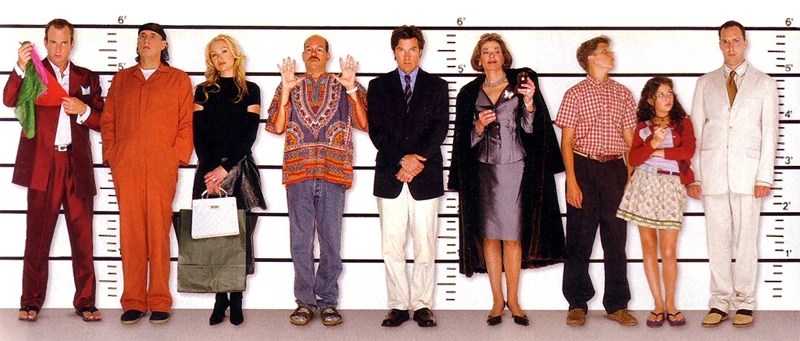
Arrested Development stars JASON BATEMAN as Michael, PORTIA DE ROSSI as Lindsay, WILL ARNETT as Gob, TONY HALE as Buster, DAVID CROSS as Tobias, MICHAEL CERA as George Michael, ALIA SHAWKAT as Maeby, JESSICA WALTER as Lucille, and JEFFREY TAMBOR as George. With RON HOWARD as the Narrator.
When it became inevitable that I would cover sitcoms that premiered in the 21st century, it also became inevitable that I would highlight Arrested Development, for this wickedly funny, well-cast, one-of-a-kind cult classic is easily among the most comedically satisfying shows of the 2000s decade, with a handful of episodic samples that simply must appear in any study that seeks to track excellence from this particular era. Despite also counting within its legacy two additional revival seasons first produced for Netflix in the 2010s that ultimately failed to recapture the magic of the original three-year FOX run, the show’s reputation for comedic supremacy has mostly maintained, and in fact, continued to grow, largely because it’s proven to be such an accurate but favorable ambassador for the sitcom genre’s 2000s evolution, boasting a single-cam setup with an inventive and somewhat mockumentary style of production that was inspired by reality TV, along with a fast-paced storytelling that’s loaded with plot but nevertheless joke-filled, rewarding long-term viewership with layers of self-referential gags that imply smarts, both for the writers and the audience. All this helped make Arrested Development a critical darling even at the time – earning glowing reviews and golden statuettes – but it was both blessed and cursed to exist in the mid-‘00s on FOX. The latecomer network still tended to champion rebellious comedies and theoretically offered more creative leeway than the Big Three, but long runs were less likely there due to limitations with both ratings and budgets. What’s more, although single-cams had already developed a cachet and certainly weren’t foreign to the airwaves (particularly on FOX), the multi-cam was still a popular standard, making Arrested an obvious dissenter, bucking then-mainstream tastes. (Here I want to remind that “single-cams” does not always mean shows shot with a literal single camera – it means the inverse of “multi-cams,” shows that are staged presentationally and usually shot in front of an audience. Single-cams remove those theatrical associations for a production process more cinematic – that is, camera-focused.)

Of course, things were changing in 2003-2004. Of the seven sitcoms that made the annual Nielsen Top 30 at the end of the season – all multi-cams — only one, freshman Two And A Half Men, would still be around in five years, once all turn-of-the-century titans bowed out, replaced by efforts (like Men), that never became as critically well-regarded, or frankly, as creatively remarkable. And with the slow rise of terrific single-cam alternatives – Arrested Development among them – this style became more and more embraced, if not popular. I say “if not popular” because multi-cams remained, by viewership, the preferred choice for the biggest chunk of the audience throughout the 2000s and 2010s, even as trends in the industry, thanks to critics, award-givers, creators, programmers, and the public discourse at large, moved away from them, creating a new dominant aesthetic mostly developed in response to cable and streaming. That’s why some have liked to call FOX’s Arrested Development “ahead of its time” – future shifts in the culture may have afforded it more popularity had it debuted later and under different circumstances. But as with most shows that bloom on the early cusp of trends, it derives added value from its novelty of being both different and, with hindsight, prescient, and that’s especially true for Arrested, which predicates so much of its identity on stylistic markers that obviously contrast the traditionalism of its contemporaries. I’m not referring merely to its single-cam status – that move was already well underway – rather, more specifically, to the mockumentary, or mock documentary, which later became familiar in the post-Office era but was fairly unusual in 2003 and more associated with reality TV (or a sketch-like parody of it — think: Reno 911!), a type of programming that took the conceits of a serial documentary form but often with more artificial constructs, applied deliberately for entertainment. This had a natural kinship to the situation comedy, because like all storytelling, sitcoms similarly aim to reflect real life… only a version that’s deliberately tweaked, also for entertainment. Thus, the reality TV look was attractive for comedies — and Arrested Development was expressly developed with it in mind.

Now, there are many ways to evoke a mockumentary sensibility within the sitcom. The simplest is to utilize the handheld camera we’ve observed both on Curb Your Enthusiasm and in some of the backstage sequences of its forebear Larry Sanders, where the rawness of imperfect framing doesn’t necessarily imply literal reality but can suggest a privileged behind-the-curtain vantage point that is always helpful for playing up a premise’s metatheatricality – often showbiz about showbiz and/or with real people playing versions of themselves. Not all documentaries look like this, but most reality shows do, offering intimate access to real people playing versions of themselves. Meanwhile, another reality trope is the use of interviews, or as they’re called in that genre, confessionals – cutaways to people talking about a subject, usually what’s happening in the main action of a “scene.” The Office would employ this to great effect, as would shows it inspired, like Parks and Recreation, earning extra jokes and character moments via this artificial construct and the juxtaposition enabled by intercutting. This device also signals the characters’ direct acknowledgment of the cameras – the implication that they know they’re being filmed… like the people on reality TV. It’s an internal fourth wall that those sitcoms create to break, adding “meta” humor. Interestingly, Arrested Development does not go so far with its own mockumentary setup – there are no interviews, and rarely is an awareness of present cameras hinted. In that regard, it shies away from being as fully or foundationally “meta” with its situation. However, it does go further in embracing other stylistic opportunities allowed by its documentary-esque conceit – such as regular voice-overs by an omnipresent narrator, frequent inserts of photographs or other visual aids, and a very loud edit, which moves briskly between scenes and invites regular cutaway gags to anything and everything that can enhance the story or simply add a laugh. We saw a bit of this on FOX’s fast and cutaway-rich Malcolm In The Middle, but Arrested Development kicks these up a notch and is quicker and gaggier, thanks in part to its reality-TV-inspired handheld look and its documentary-like authority, which gives total control of the rules to an all-knowing “filmmaker/director” who has permission by this design to more forcefully guide the audience in ways that are less literal and less linear.

This is essentially true for all single-cams; any show not bound by a theatrical staging and the production practicalities that tend to tether character and plot to a more rigid unity of time, place, and action has more freedom with its storytelling. But Arrested Development, again, takes this to an extreme, and a large part of its success – what makes it special – resides in this sense of abandon, enabled by the refined application of its mockumentary aesthetic. I’ve seen it described as a live-action cartoon. That is, like a cartoon, which can be even more divorced from literal reality and linear storytelling because of the extra fantasy inherent to its animated form, Arrested Development is similarly whimsical in tone and text, with broader ideas allowed by its looser, non-traditional look. I wouldn’t go that far, but, well, I can say there are elements of screwball comedy here, for it’s fast-paced with big madcap story turns (and its subject is a wealthy family – classic screwball fodder). And perhaps it goes without saying, but it’s a show that I would also classify as idea-driven – not merely because its unique aesthetic is conceptually seminal, but also, for one, because of what’s actually delivered as a result: a freedom with story of this magnitude means there’s an abundance of it. It’s packed to the gills with narrative notions – both episodic and long-form, as the series basically caters to every single player in its huge ensemble cast in every installment, yielding many subplots with intersecting beats that continue to build from week to week, with macro story continuity upheld by a fierce attention to detail. Such attention to detail manifests itself in easter eggs that are expressly planted to later pay off or gags that are already paying off as callbacks to previous jokes that emphasize the series’ self-awareness, making everything seem smartly connected and purposeful, while rewarding the audience for its attention. That kind of humor is also an important marker of identity, and it’s fair to say that every moment of Arrested Development is in service to one or the other – story or comedy — but usually both, for the stories are laugh-out-loud funny or at least upheld by comedy, and the show is thus always oriented around its proficiency with funny ideas.

Accordingly, how those funny ideas are applied also becomes important, for as the show cultivates a reputation for both speed and density – plot moves quickly and there’s a lot of it in a short time, while the jokes also come both fast and furiously – those are key metrics that distinguish Arrested Development from its competition and also determine episodic (and seasonal) success. And this is how the show genuinely feels “ahead of its time” – or, indicative of broader trends inside the genre that later followed, for although the overarching shift for sitcoms over the last 30 years has been, in general, its slow adoption of traits more reminiscent of other types of programming, specifically dramas, and Arrested Development’s excellence with comedy makes it therefore superior to those that can’t boast the same, its serialized use of story nevertheless reflects how the modern prestige drama’s understanding of long-form plot as both a sign of masterful storytelling and an emotional hook meant to sustain viewer engagement in the competitive peak TV era has infiltrated all forms, including the sitcom. Sure, serialization was a perk always available to a programmatic medium – and it’s existed in sitcoms since radio – but Arrested Development’s, again, density of plot, which would not be unusual today, was unusual in 2003. The same is true for its single-cam categorization, and more precisely, its mockumentary setup – the former of which is now the sitcom standard, the latter of which became a defining attribute in several of this century’s finest samples (see: The Office and Parks and Recreation). Similarly, as future comedies – shows that primarily endeavor to amuse – grew faster with both their storytelling and their jokes, layering more self-referentiality and winking callbacks, Arrested Development’s once rare intelligence about itself, and the media landscape at large, became a bit more common as well (see: 30 Rock and Community), making this show seem, again, on the early cusp of a trend. Indeed, in our modern age now, where a sizable portion of actually funny sitcoms descend from the stylings of the sketch comedy world (typically SNL), this series’ brisk pacing – and its more idea-based comic sensibilities – no longer seem unconventional either.

Oh, Arrested Development is still special for boasting all those attributes – these are things that it does supremely well, even compared to what followed. And by putting it in this chronological context, I aim to give it more credit, not less – and not merely for being prescient. But to that point, I’ve described a lot about what makes it special, and only a little about what actually makes it great. Beyond just those unique markers of identity – and the idea-driven delight of having funny ideas – Arrested Development is a great situation comedy because it’s wonderful at doing what all sitcoms must: delivering comedy with the help of a well-defined, reliable situation, and specifically, the characters who uphold it. This is a testament to creator and executive producer Mitchell Hurwitz, who unlike so many showrunners from the trendiest sitcoms of the 21st century, already had a strong pedigree within the genre. Cutting his teeth in the Witt-Thomas world of The Golden Girls and all its offshoots, Hurwitz had first-hand experience with big, well-defined characters and the palpable laugh-seeking imperative that propels their usage. He was also involved on the fascinating The John Larroquette Show, which I reran recently – and created the terribly short-lived but wonderful Everything’s Relative (rerun last week), a semi-autobiographical piece about an adult writer with a dysfunctional family (including a dad played by Jeffrey Tambor). In fact, that dysfunctional family foundation is expanded out for Arrested Development, where the fraught dynamics between adult siblings and parents (inspired in part by The Royal Tenenbaums) gets the extra wrinkle of a “riches to rags” inciting incident due to the arrest of the patriarch for real estate fraud, which forces the most normal of the bunch, Michael, to stay involved with his somewhat estranged family so he can keep both them and the company together. That’s the premise of the show and the basic situation it maintains every season as the plot continues to unravel and get more ridiculous – this family will constantly be mired in legal controversies that exacerbate their dysfunction, and Michael, who would rather be free of them, is always forced to make the best of things. It’s a precise, higher concept layering that allows for all kinds of ridiculous, screwball, idea-driven story…

…But remember, it’s also supported by that low-concept family foundation, which is a hallmark of the sitcom genre and only sustained by clear relationships between regulars. In other words, even with the gaudy bells and whistles that make it idea-driven – the “riches to rags” stuff with the arrested dad hook, along with the single-cam mockumentary aesthetic and all the tonal, comic, and rhythmic sensibilities this invites – at its core, this series depends upon characters in relation to one another as its premise. This is fundamental sitcommery, and with Hurwitz at the helm (of a strong staff), there’s excellence not only with comedic ideas, but with character as well. Heck, I would even go so far as to say that every regular is well-defined for laughs predicated on their definitions, and they’re all conducive to story based on their personalities, along with their positions within both the family and the premise. This brilliant craftmanship would be apparent even on the page, but it’s shining in performance, for this is one of the most well-cast sitcoms of all time, with no weak links. Oh yes, there are standouts – like Will Arnett as Michael’s brother and rival, sleazy magician Gob; Tony Hale as their brother Buster, the childlike member of the family who is under the thumb of their oppressive mother; David Cross as Tobias, their brother-in-law, an aspiring actor whose own queerness seems apparent to everyone but him; and the matriarch herself, the manipulative and materialistic Lucille, played with relish by Jessica Walter. They are most conducive to big hahas, but I reiterate, there are no weak links – even the kids, Michael Cera’s George Michael and Alia Shawkat’s Maeby provide so much humor and plot, growing into two of the most reliable contributors in later seasons. Also, Jason Bateman is pitch-perfect as Michael, who has to function as the “straight man” in the ensemble but nevertheless develops ways to be funny both on his own and when against others, including his son George Michael. Their relationship is the emotional heart of the situation, its grounding subject, and its centricity becomes a reliable focus that maintains the premise.

And though I have minor quibbles – for instance, Portia de Rossi is outshined by her funnier castmates despite her character Lindsay enjoying a decent amount of definition, and Jeffrey Tambor’s George has the least palpable sense of himself because he’s off in jail and not able to interact with the family as much (while the inclusion of his twin brother Oscar is a screwball device to keep the actor centralized, but not so much George as a character) – again, it’s high quality overall, and there are no weak links. That extends to the guests and recurring players also – not to mention Ron Howard as the all-knowing narrator, whose prestigious presence grants the show’s mockumentary conceit added weight. Additionally, Howard’s Happy Days pal Henry Winkler is memorable as family attorney Barry Zuckerkorn, and Liza Minnelli gives one of the funniest sitcom performances of the decade as “Lucille 2,” Lucille’s main rival and neighbor, who romances Buster. She’s a relevant figure throughout the series’ life but is quite prominent in One… where everything that makes the show unique opposite other sitcoms is already evident and contributes a form of novelty that displays Arrested Development at its freshest and most exciting. Certainly, the show will continue to ramp up its self-referentiality the more it has to draw back upon and reference (along with more runway to wink about the long-term narrative events it has plotted), and naturally, the characters gain definition the more they’re utilized and applied for story, so some of the funniest and best situation comedy occurs later – in Season Two, to be specific, before a few of these special qualities are calibrated to more of an overextended extreme in Three. (And, of course, that applies even more so to the show’s Netflix return.) In that regard, I think the series is stellar throughout its FOX run, but it’s at its best in the first two years, and quite spirited here in One, when its idea-based charms were most new, earning praise from critics and the industry at large (netting three Emmy wins – including as the Outstanding Comedy Series) – setting the groundwork for a quirky situation comedy that was both an interesting aesthetic step forward, and even better, a sterling example of the genre.
01) Episode 2: “Top Banana” (Aired: 11/09/03)
Michael attempts to locate evidence, while George Michael runs the family banana stand.
Written by Mitchell Hurwitz & John Levenstein | Directed by Anthony Russo

After Mitchell Hurwitz’s solid pilot, the series’ sophomore outing reiterates the premise and its core characterizations but with a better demonstration of how the show intends to exist week-to-week, for the premiere had to set up the situation, and this entry gets to affirm it by actually settling into it, with George Sr. now in prison and Michael having to scramble around a group of looney tunes who are going to complicate his life in every way. That’s the show (at least this season). This particular episode is also very funny — and memorably, quotably so — with a lot about the family’s banana stand, a classic piece of iconography associated with the series that symbolizes its creative imagination and affinity for running gags and callbacks, thereby indicating its unique sense of humor and stylistic quirks, all of which make it different from its sitcom contemporaries. The pilot is good, but this is what really sells Arrested Development.
02) Episode 4: “Key Decisions” (Aired: 11/23/03)
Michael falls for Gob’s girlfriend while Gob is in prison trying to pull off a magic trick.
Written by Brad Copeland | Directed by Anthony Russo

Michael’s most frequent rival within his family is the competitive Gob, and this freshman season channels their tension through a romantic dilemma, as Michael finds himself attracted to Gob’s girlfriend, Marta — making him struggle over the difference in what he wants vs. want is right. It’s actually a fine way to develop his character, and this offering introduces that arc, setting the foundation for Michael to go beyond “straight man” by adopting more nuance. However, this is an important, building opportunity for many of the other characters as well — especially Gob, whose grandiose efforts to produce dazzling magic tricks and stunts often open up the action to memorable comedic showcases. That’s first displayed here when he joins his dad in prison (this season has to contrive a lot of excuses to get people to visit George) — and we hear his eventual catchphrase: “I’ve made a huge mistake.” Meanwhile, Liza Minnelli debuts as Lucille 2 — the Bluth matriarch’s nemesis who struggles with recurrent vertigo and is attracted to Buster. She’s hilarious — elevating already hilarious material. (Clint Howard also appears.)
03) Episode 7: “In God We Trust” (Aired: 12/14/03)
The family participates in an annual pageant of living art representations.
Written by Abraham Higginbotham | Directed by Joe Russo

Ron Howard’s pal Henry Winkler debuts in this installment as the Bluth family’s lawyer, Barry Zuckerkorn, one of the series’ funniest recurring players. It’ll take some weeks for his comedic characterization to develop, but he’s introduced in this solid outing that also boasts a memorable climax (the living art pageant), where several story threads come together in evidence of Arrested Development’s fast-paced and intentional storytelling, which is again something that makes it stand out favorably from its contemporaries. Some of the best stuff here involves the running gag about Tobias being a “never nude” — a hysterical and one-of-a-kind notion that again speaks to the series’ uniqueness of style and ingenuity, capably reinforced in the centerpiece that gives the entry its place on this list, when a modest George Michael wears Tobias’ skimpy jean shorts in his depiction of Michelangelo’s Adam, while God (George Sr.) runs away.
04) Episode 10: “Pier Pressure” (Aired: 01/11/04)
Using their father’s old methods, Michael conspires with Gob to teach George Michael a lesson.
Written by Jim Vallely & Mitchell Hurwitz | Directed by Joe Russo

My choice for this season’s Most Valuable Episode (MVE), “Pier Pressure” is often cited by both the crew and the fans as this series’ best showing of all time, with an efficient, fast-paced script that’s loaded with jokes and satisfies Arrested Development’s reputation for big-laugh comic inventiveness. But what I like most — beyond the fact that, yes, it is on the short list of the show’s funniest — is that it’s also a brilliant display of both the characters and the premise. The whole idea of Michael conspiring with his brother Gob to teach George Michael a lesson — after he (mistakenly) believes that his son has taken to drugs and is drifting away from his scholastic focus — is a marvelous application of the ensemble’s anchor, who becomes more distinctly comedic the more his perspective gets warped by his family. And by establishing that there are instances where Michael is overtly [insert any personality trait here], the ways in which he himself can be funny expand as well, thereby making him a more utilizable lead for the show. What’s more, his decision to use a device that his father frequently employed in their childhood — a scared-straight stunt — not only brings George Sr. into the action, it also reinforces a shared history for the regulars and affirms the basic situation of a dysfunctional family, which Michael is again perpetuating, despite his reluctance to be sucked into their madness. Additionally, it’s also deliberately outrageous and inherently amusing, tying in well with Gob’s own propensity for stunts, and evidencing Arrested Development’s specific comedic abandon, which is also corroborated by the smart plotting of the misunderstanding, fanned deliciously by Buster’s efforts to secure, through George Michael, marijuana for Lucille 2 (who is still dealing with vertigo). Meanwhile, the subplot with the Bluth women also sees a wonderful fleshing out of their relationships and characterizations. So, this is just a sublime depiction of the series from every angle — its characters, its storytelling, its style, its humor. It’s one of the best sitcom samples of the 2000s. (My only wish is that Tobias wasn’t absent!)
05) Episode 14: “Shock And Aww” (Aired: 03/07/04)
Michael lies about a dalliance with George Michael’s new ethics teacher.
Written by Jim Vallely & Chuck Martin | Directed by Joe Russo

As the first offering in the season’s “back nine” — following the first 13 initially ordered — “Shock And Aww” feels a bit like a rejuvenation, with new comic ideas introduced that maybe won’t last until the end of the year, but at least create new setups for story and comedy. Specifically, Jane Lynch makes her debut as an undercover federal agent who pretends to be a George Sr. fanatic and then eventually falls for him — a funny thought, with memorable casting. And Lucille adopts a Korean boy, Annyong (Justin Lee) — a tactic solely to arouse jealousy in Buster. That’s another funny thought, and it becomes something of a running gag itself — a symbol of the series’ sense of humor… But the real weight comes in the A-story where Michael sleeps with his son’s Ethics teacher (played by Heather Graham) and then lies about it, blaming it on Gob, with whom he still has lingering tension over Marta. It’s one of the best applications of Michael’s character this season — a basically moral person who struggles with it.
06) Episode 16: “Altar Egos” (Aired: 03/17/04)
Michael has a one-night stand with a blind woman who turns out to be his dad’s prosecutor.
Written by Barbie Feldman Adler | Directed by Jay Chandrasekhar

The great Julia Louis-Dreyfus appears in the first half of this two-parter, which is naturally elevated by her presence. I include both parts on this list because they’re companions and I do like both, but this one benefits from the cumulative power of what happens in the following, for the whole idea of Michael having a one-night stand with Maggie, a blind woman, only gets comical with the knowledge that she’s a) his father’s prosecuting attorney, and b) most importantly, faking her blindness. With this information, her character then becomes a testament to the show’s boldly comic and narratively constant sensibilities, furthering the main arc while also bringing big, surprising laughs. Meanwhile, the story with George Sr. and the undercover agent played by Jane Lynch continues, and Will Arnett’s real-life wife (at the time), Amy Poehler, plays Gob’s new bride and improves the entry with her added sense of wacky. It’s a buffet of funny 2000s ladies, all working within Arrested’s trademark style.
07) Episode 17: “Justice Is Blind” (Aired: 03/21/04)
Michael continues to see his father’s prosecutor.
Written by Abraham Higginbotham | Directed by Jay Chandrasekhar

As the second half of this two-parter, a lot of what I said about the previous episode also applies here, although I think this one is probably funnier, because it’s bolder, with more outrageous laughs — particularly in the hilarious scene where Tobias sneaks into Maggie’s house, thinking she’s blind, and attempts to steal whatever evidence she has about the Bluths. Obviously, since Maggie is not actually blind — and we’ve learned this already — it’s a hilarious setup, climaxing with him spraying perfume at her, and temporarily blinding her for real… which comes back in a big way when Michael tries to prove that she isn’t. Also, there’s fun in the thematically compatible subplot where Maeby is faking a physical disability, and I just have to point out what a really goofy, idiosyncratic presence Henry Winkler’s Barry has become — a reliable recurring asset to the show, in proof of its unique charms. (And, frankly this is the series where I believe he does his funniest, most interesting work in the sitcom genre.)
08) Episode 18: “Missing Kitty” (Aired: 03/28/04)
Michael fires Kitty and Gob plans another elaborate magic trick.
Written by Mitchell Hurwitz & John Levenstein | Directed by Joe Russo

Judy Greer’s recurring performance as Kitty is another credit to Arrested Development and its strong casting, for she always brings hahas, even when she’s got some heavy-lifting to do with the series’ narrative concerns, as in this installment, which serves as an example of how the show has settled into a clear identity by this point in the run, as running gags, like Kitty’s habit of flashing her breasts, and the treatment of Spring Break as something of a formal holiday, are deployed in support of the series’ now well-established sense of humor. Additionally, I like the character usage in this entry as well, particularly with Gob, as his efforts to produce another large-scale magic trick once again set up another big centerpiece to which this script can build. Also, the continuation of the story where Tobias has entered prison with George Sr. for research — with James Lipton memorably guesting in his recurring role as the warden — is a lot of fun, enhanced by David Cross’ intrinsic silliness. (Note: I am listing these in airing order; narratively, this one should occur before the two-parter with Maggie, but it was broadcast after.)
09) Episode 21: “Not Without My Daughter” (Aired: 04/25/04)
On Take Your Daughter To Work Day, Michael is questioned about Kitty’s disappearance.
Written by Mitchell Hurwitz & Richard Rosenstock | Directed by Lee Shallat Chemel

Arrested Development is firing on all cylinders in its first season’s penultimate excursion, boasting a command of storytelling with excellent ideas that also capably spotlight elements of the situation, making this a stellar example of the series and the sitcom genre at large. As the setup of Take Your Daughter To Work Day enables the episode to go wild with running gags that flatter the show’s comic reputation, it also provides an excuse to pair different characters in the ensemble — most notably Michael and Maeby, both of whom are especially funny playing off each other due to their heretofore undeveloped chemistry and the natural awkwardness that can be mined as a result. Additionally, the family’s premised legal troubles continue to be narratively developed as the missing Kitty is discovered on a “Girls With Low Self-Esteem” tape — another running gag! — while we get more of Lucille’s affair with George’s twin brother (whose presence is delightfully screwball), and one of the best Buster scenes of the season, as he faces off against a bunch of kids playing soccer, including his rival Annyong.
10) Episode 22: “Let ‘Em Eat Cake” (Aired: 06/06/04)
Michael learns more information about his father’s alleged crimes.
Written by Mitchell Hurwitz & Jim Vallely | Directed by Paul Feig

One’s finale has some narrative things it must accomplish to both wrap up this season and set things up for the next, and while some of these objectives may be a bit heavy-handed, the script itself is brisk and funny, with good ideas that acquit the half hour as a winning sample of Arrested Development in the middle of 2004, its best calendar year. However, what makes this finale truly terrific is that it’s naturally situation-affirming, reaching a new crescendo with the Bluths’ legal troubles — as Michael learns that George Sr. was involved in a scheme to build model homes in Iraq. And when George’s heart attack forces the entire clan together in the hospital, it’s not only a congregation of the ensemble and thus all the plot threads they bring with them, it’s also a moment for Michael, who wants to walk away from this dysfunctional family (the premise!), to be drawn back in by his son — the most important relationship, the series’ emotional core, which now is used to justify the status quo. Then, of course, George Sr. escapes and we have the story engine for Season Two. So, this is a dynamite showing — a bookend to the pilot, yet with more of an understanding of character and style.
Other notable episodes that merit mention include: “Storming The Castle,” a strong Michael show that aims to give him some complexity, and “Beef Consommé,” which involves the premise and has a crescendo in Michael’s rivalry with Gob (through Marta), along with the “Pilot,” which sets up the series beautifully (and won Mitchell Hurwitz an Emmy), “Charity Drive,” a funny entry that accelerates the show’s sense of screwball, “Public Relations,” which has a smart, premise-affirming idea, “Marta Complex,” which furthers Michael/Marta and has some quotable moments, and “Staff Infection,” which is another capable display of the basic situation. (Oh, and I also want to cite Bob Odenkirk’s guest work in “Visiting Ours” — one of many cameos from folks with an affiliation to David Cross via Mr. Show.)

*** The MVE Award for the Best Episode from Season One of Arrested Development goes to…
“Pier Pressure”

Come back next Tuesday for Season Two and stay tuned Monday for a musical rarity!
I really loved your essay! This is a great show and great first season! I’ll be curious to see what you think of the later netflix seasons. (I am mixed on them.) Also I just want to say how much I enjoyed “Everything’s Relative.” Thanks for sharing!
Hi, Ian! Thanks for reading and commenting.
I’m so glad you enjoyed EVERYTHING’S RELATIVE — it’s a (very) short-lived gem!
I did not discover this series until two years ago and now it’s one of my favorites–I think Jessica Walter is so so funny. I feel like she doesn’t get enough credit for her work so I’m glad you gave her some flowers.
So much genius casting too. Julia Louis Dreyfus? I mean, COME ON! That’s some elite stuff right there. This definitely has to be a main contender for the best of the 2000s decade. I’m really curious about how you think it stacks up compared to CURB YOUR ENTHUSIASM, which is another show that I enjoy and consider a modern classic, but I will nt ask that until you finish all the seasons of this series.
Hi, esoteric1234! Thanks for reading and commenting.
I think CURB YOUR ENTHUSIASM and ARRESTED DEVELOPMENT are both among the best sitcoms of the 2000s (within, say, the decade’s Top Five), and I’d be hard-pressed to pick between the two specifically, especially here in 2003-2004, when both were in great form!
Great list. You got all my favorites
Hi, Terrance! Thanks for reading and commenting.
Glad you enjoyed — stay tuned soon for my thoughts on Season Two!
One of my favorites! The cast is excellent and I like every episode. Well in the Fox seasons anyway! Can’t wait for more.
Hi, MDay991! Thanks for reading and commenting.
I like every episode in the FOX run as well — stay tuned to find out more of my favorites!
Will your coverage of season four involve the “remix” version on Netflix currently?
Hi, Charlie! Thanks for reading and commenting.
Yes, I’m going to discuss and make picks from both versions of Season Four!
Thank you for looking at this series! I so agree about “Pier Pressure”. That’s my favorite episode from the entire run.
You are covering the Netflix seasons right? Are you covering both versions of Season 4?
Hi, Elaine! Thanks for reading and commenting.
Yes, I’ll be looking at the Netflix seasons — including BOTH versions of Season Four!
This and “30 Rock” are my favorite sitcoms of the 2000’s.
It’s crazy to think that there was a TV season that included both “Friends” and “Arrested Development.” They seem like they’re from two totally different eras!
I had no idea that the creator wrote for “The Golden Girls.” That’s a really funny show too but I never would have put two and two together! They seem so different to me. Go figure.
Hi, AdamB! Thanks for reading and commenting.
Yes, in 2003-2004, FRIENDS represented traditionalism within the sitcom genre while ARRESTED DEVELOPMENT represented experimentation — it’s a fascinating overlap of the old and the new, of which there was both in the 2000s decade!
And that’s right, Mitchell Hurwitz wrote for THE GOLDEN GIRLS — another hilarious show with rapid-fire jokes and big comedic characters!
One of the greatest sitcoms ever. This show definitely proved the best of experimentation in sitcoms. To me this is the successor of Soap
Hi, Track! Thanks for reading and commenting.
Yes, ARRESTED DEVELOPMENT is precisely in that same idea-driven lineage, and Mitchell Hurwitz himself has acknowledged obvious similarities between the two shows — namely their use of multiple stories per episode and overarching long-form continuity via serialization. (Of course, those are both traits that, since SOAP, the sitcom genre had — and has continued to — more readily embrace en masse, free of SOAP’s specifically parodic soap opera construct.)
I am going to have to watch this show. I did watch a couple of episodes with my son a few years ago and enjoyed it. I am a big Jason Bateman fan. I think he is an incredible actor and very versatile. I enjoyed him in “It’s Your Move” which I think was his first series.
Not a sitcom, but have you seen “Ozark”? Excellent series and Jason was great in it. The whole cast was awesome.
Thanks for reviewing “Arrested Development”.
Hi, Smitty! Thanks for reading and commenting.
I haven’t seen OZARK but you’re certainly not the first person who’s told me they enjoy it!