
Welcome to a new Sitcom Tuesday! This week, I’m continuing my look at Arrested Development (2003-2006, FOX; 2013, 2018-2019, Netflix), which is currently available on DVD and Netflix!

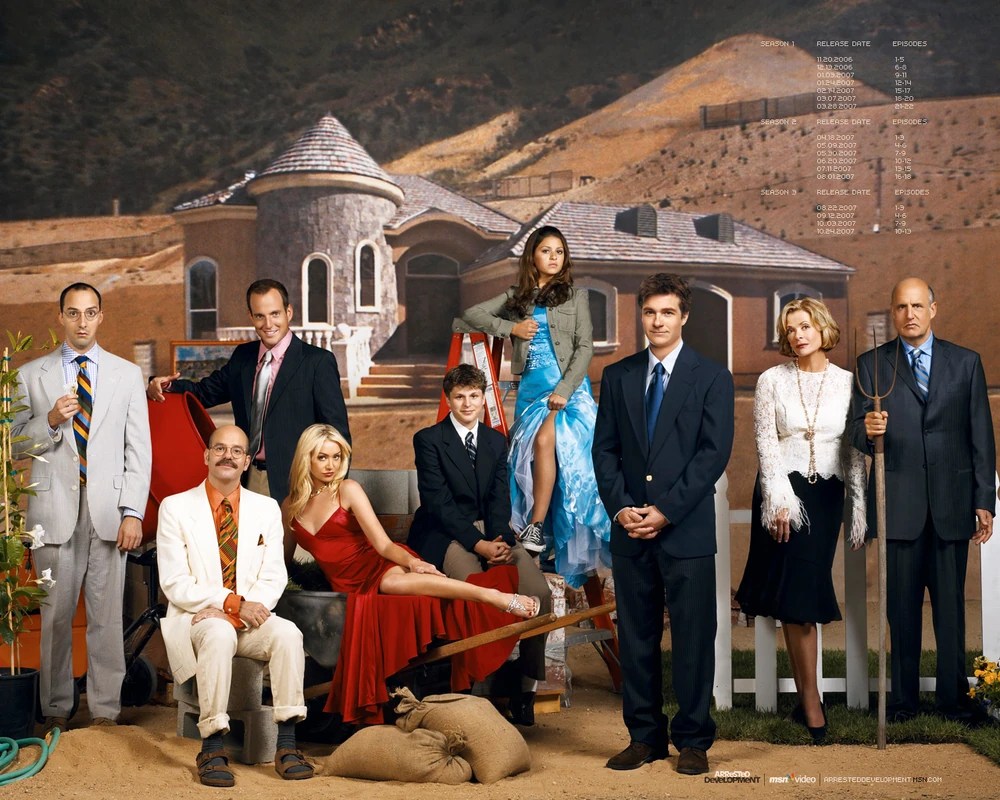
Arrested Development stars JASON BATEMAN as Michael, PORTIA DE ROSSI as Lindsay, WILL ARNETT as Gob, TONY HALE as Buster, DAVID CROSS as Tobias, MICHAEL CERA as George Michael, ALIA SHAWKAT as Maeby, JESSICA WALTER as Lucille, and JEFFREY TAMBOR as George and Oscar. With RON HOWARD as the Narrator.
I think this is, overall, Arrested Development’s best season, for as we’ve seen, most sitcoms reach their peak when “novelty meets knowingness” — when a premise and its key conceptual particulars are still new enough to regularly inspire fresh laughs and story, but the show has also come to better understand its characters (and character dynamics), so they can better offer support. For an idea-driven sitcom like this, novelty is vital — the speed and consistency with which this series consumes jokes and plot means that it prioritizes having creative, funny, clever ideas above all, especially given its growing reputation for intelligence aided by the mockumentary setup, which enables a unique sense of humor and storytelling that must also remain innovative, upheld by self-referential gags dependent on short-term and long-term narrative notions. In other words, story and style matter so much on Arrested Development — that’s what makes it special — so its success hinges on them still getting displayed in exciting ways. That’s why Season One, in being the most naturally fresh, has an elevated appeal, and indeed, it’s got a lot of great episodes… And yet, because crucial elements of identity related to this idea-driven focus are also something the show only better commands with practice, there’s an increased “knowingness” beyond just character in Two. That is, Arrested Development is now more equipped to showcase all stylistic aspects of itself, and with the characters also part of this enhanced understanding, the series is more able to deliver comedy based on its total situation. That’s why Two is the peak. And, specifically, the first trimester of Two is the peak of the peak (2004 is this series’ best calendar year). After that, the premise is less felt in story alongside everything else, and the season even tries mixing in some recycled beats from One to emphasize self-referentiality. But they are a hit-and-miss narrative distraction, often implying a redundancy that’s counterintuitive on a show also promising quick and ever-moving plot. It’s the first indication of something we’ll see later — the very idea-driven things that make Arrested Development special also create the metrics that determine its decline, particularly when over-embraced… But that’s for later; in the meantime, this season is still great throughout (I actually like every episode), and it’s the strongest showing for this series — 2004-2005’s finest sitcom.
01) Episode 23: “The One Where Michael Leaves” (Aired: 11/07/04)
Michael again tries to make a break from his dysfunctional family.
Written by Mitchell Hurwitz & Richard Rosenstock | Directed by Lee Shallat Chemel

Season Two’s opener resets the table after Season One’s finale, the end of which saw George Sr. going on the lam. That will essentially be the new status quo for the remainder of this year, while the premiere also takes time to establish some of its other new arcs, like Lucille enlisting Buster in the army, Tobias linking up with the Blue Man Group (creating a memorable running gag for the series), and Gob adjusting to his new role leading the company — the last of which is an easy but appreciated way to reinforce his rivalry with Michael and therefore the premised familial dysfunction that drives this entire offering, where Michael’s renewed efforts to walk away again prove unsuccessful, as he inevitably finds himself back in their clutches. Accordingly, this is a great reiteration of the situation that also adjusts for everything that’s happened previously — it’s another pilot, but now with an enhanced understanding of the characters and all the stylistic quirks that inform the series’ identity and make it a very special sitcom, the best of the 2004-2005 season. (Ed Helms is among this half hour’s many guests.)
02) Episode 24: “The One Where They Build A House” (Aired: 11/14/04)
Gob promises that the company will build a model home in two weeks.
Written by Mitchell Hurwitz & Jim Vallely | Directed by Patty Jenkins

Although there are more memorable entries here in Two that stand out more from a bird’s eye view, this one from the peak stretch of the series’ peak collection is just too excellent to overlook. Not only does it boast so many delectable jokes that truly exemplify Arrested Development at its best (see: “mayonegg”), it’s also a supreme exhibition of the situation at large, with George Sr.’s legal troubles continued as he hides out in Mexico (with Kitty, as played by Judy Greer), while the rest of the family is left trying to hold the company together, including new president Gob, whose relationship with Michael is well-utilized when they have to help build a model home in two weeks… or at least, the facade of one. This is a choice display of the family’s premised dysfunction and also sets up a wonderful climax — with an homage to Buster Keaton and the falling house that asserts some of the series’ classic slapstick and screwbally sensibilities (which also come into focus through Lindsay and the homeless man — an idea ripped straight out of a 1930s comedy). So, this is just too good a sample of Arrested Development to ignore — it’s got everything we want, from the series’ best era.
03) Episode 25: “¡Amigos!” (Aired: 11/21/04)
Michael takes George Michael and Ann to Mexico in search of George Sr.
Written by Brad Copeland | Directed by Lee Shallat Chemel

There’s also a screwball sensibility to this outing, which serves as an example of the season’s — and specifically, the early part of this season’s — pitch-perfect calibration of the series’ cultivated comic ethos. In terms of plot, as the central story about George Sr.’s run to Mexico continues, a terrific farce emerges when Michael takes some of the family, along with George Michael’s new girlfriend Ann (Mae Whitman), on a search for the escaped patriarch, only to be trailed by a bounty hunter (Malik Yoba) who’s been hired by Gob under the false assumption that Michael is fleeing as well. It’s a stellar use of the premise, fueled by the characters and their relationships, and it’s all engaged to big narrative ideas, along with mounting running gags, including Michael’s dismissive disdain for Ann — a new way that his “straight man” can be regularly funny, through this recurring joke that becomes one of the series’ hallmarks. It’s never better deployed than right here though… and speaking of which, Martin Mull also makes his debut as private detective Gene Parmesan — and the boost of his presence is never better than right here either.
04) Episode 26: “Good Grief” (Aired: 12/05/04)
The family holds a wake for George Sr.
Written by John Levenstein | Directed by Jeff Melman

This entry, which Mitchell Hurwitz has previously cited as one of his picks for the series’ best, is another stellar display of character, premise, and overall comic identity from the early — and peak — part of the season, with a story about George Sr.’s apparent death enabling an excuse to get all the regulars congregated for a wake (where Gob, of course, intends to pull off another magic trick). That’s a perfect breeding ground for the premise… especially when we know, unsurprisingly, that the man in question isn’t really dead after all and is instead going to be hiding out in the attic during the gathering. This sets up a good character show for the three generations of Bluth men — primarily George Michael, who discovers his Pop-Pop and has to play interference, and Michael, whose relationship with George Michael becomes a focus via the lingering Ann, whom Michael still detests. And with a memorable stylistic hook — several homages to Charles Schulz’s Peanuts — this isn’t just a tight character piece that emphasizes the situation, it’s also proof of the series’ smart sense of idea-driven humor, which is both self-referential and media literate. So, this is yet another exhibit of Arrested Development at its best.
05) Episode 28: “Afternoon Delight” (Aired: 12/19/04)
Gob alienates the staff at the company’s annual Christmas party.
Written by Abraham Higginbotham & Chuck Martin | Directed by Jason Bateman

My choice for this season’s Most Valuable Episode (MVE), “Afternoon Delight” is probably best remembered for the scene in which Michael and his niece Maeby perform an awkward karaoke version of the song “Afternoon Delight,” which becomes increasingly inappropriate given the juxtaposition of its sexual lyrics and their familial relationship. As a comedic idea, it’s tops — fresh and outrageously funny, one of this show’s finest. But that’s not all this outing has going for it. It’s also another superb showcase for several characters, the premise, and the series’ defining sense of both story and comedy. For instance, the aforementioned centerpiece notably occurs at the office Christmas party, where Gob makes a fool of himself in accordance with his regular depiction and in reinforcement of the current state of the company, which reminds us of the high-concept plot engine of the family’s legal turmoil. And when Michael must intervene to set things right with the employees, some of the central ensemble dynamics are also engaged, upholding the situation in full… Additionally, the return of the family’s banana stand brings back an iconic symbol of the series’ mythos, and factors into another terrific centerpiece that again sees its destruction, courtesy of Lucille, who wrecks her car while high on a type of marijuana called “Afternoon Deelite.” This is hysterical — it’s well-motivated by a believable farce that’s thematically connected to the previous centerpiece and utilizes both the Oscar and Lucille characterizations, the latter of whom has already had established troubles behind the wheel. Also, it ties in a subplot with Buster and a mechanical claw that foreshadows what’s about to happen to him, when he gets a claw of his own. So, all together, this is a tribute to the show’s masterfully well-plotted and self-aware storytelling, and its maintained capacity for exciting comedic ideas, which crescendo well. More than just the funny song sung by uncle and niece, this is a brilliant example of Arrested Development — an easy pick for MVE.
06) Episode 35: “Motherboy XXX” (Aired: 03/13/05)
Lucille has George Michael replace Buster in an annual mother-son contest.
Written by Mitchell Hurwitz & Jim Vallely | Directed by Joe Russo

The middle portion of Season Two is not as sublime as the beginning and end, because it recycles comic ideas (with guests like Lucille 2 and Maggie and Gob’s wife). In most series, calling back to what’s been established would corroborate the situation, but on a show that has to be fast with its storytelling, this does the opposite, grinding the pace to a halt. (Callback jokes and running gags must surprise and/or feel like they build!) Fortunately, things start to turn around when the season audaciously decides to have Buster’s hand get bitten off by a “loose seal,” and replaced by a hook. This is a shocking development that speaks to the series’ imagination, and it yields some outrageous laughs that are really well-applied in this offering, which is also propelled by a fun exploration of ensemble dynamics when Lucille takes George Michael instead of Buster to an annual mother-son contest. Additionally, Carl Weathers returns for a subplot that emphasizes metatheatricality as Tobias seeks to be cast in a film based on the Bluth family’s story — a sign of self-awareness that the series will lean into in later seasons.
07) Episode 37: “Sword Of Destiny” (Aired: 03/27/05)
Gob hires Buster to be his assistant in a new magic act.
Written by Brad Copeland | Directed by Peter Lauer

Episodes with plenty of Gob tend to be among the best because he’s a big comic character whose ambitions with regard to magic and illusions set up opportunities for set pieces where all the regulars’ story threads can be tied together (or even if not, they at least flatter the series’ comedic reputation). This installment is therefore a natural winner with its simple logline — of Gob recruiting Buster to be part of his act — especially because it’s now involving another member of the ensemble as well. Also, the addition of Ben Stiller as Tony Wonder, Gob’s chief nemesis, is a lot of fun — he’ll prove to be one of the show’s funniest special guest stars, and he’s a genuinely new element that continues Arrested Development’s novelty here in Two. What’s more, Tobias adds laughs when he starts to work at the company, while more grounded family dynamics are played with Michael after he has a health scare, making this a solid display for several of the characters, and a more fully satisfying excursion beyond just the Gob razzle dazzle and wonderful Tobias silliness. (Of note: Dan Castellaneta also appears.)
08) Episode 38: “Meet The Veals” (Aired: 04/03/05)
Michael hopes introducing Ann’s parents to his family will sever her from George Michael.
Written by Barbie Adler & Richard Rosenstock | Directed by Joe Russo

With the basic narrative setup of Michael scheming to break up George Michael and Ann by having her religious parents meet his terribly dysfunctional family, this is another outing that’s automatically poised for success. It not only corroborates the situation by naturally depending on our understanding of the ensemble’s ridiculousness and Michael’s place within it, which is a large part of the premise, it’s also a rich, fascinating use of his character: the good guy who’s nevertheless not above underhandedness, especially when it comes to protecting his son. And with the vital incorporation of Ann, the personification of a running joke, this also becomes a very funny showcase for Michael as well. Beyond that, most of the main cast also has moments to shine — Tobias is still in his Mrs. Featherbottom era (a bit of lunacy that only works because of Tobias’ own established delusion) and Gob introduces us to another memorable running gag in the form of Franklin. Also, Maeby’s arc as an accidental Hollywood exec (a way to get some trendy showbiz-about-showbiz in the mix that’s also a smart application of her character and a crazy comic idea in the “inept bureaucracy” style of The Phil Silvers Show — the granddaddy of idea-driven sitcoms) is creating its own long-form jokes that are reinforcing both her and the show’s ethos. An MVE contender. (Oh, and watch out for a young Simon Helberg.)
Other notable episodes that merit mention include: “Righteous Brothers,” the Emmy-winning season finale that has a lot of narrative things to accomplish but benefits from support by the premise and key relationships (it’s the one I most would have liked to highlight), along with “Sad Sack,” which has some funny ideas as it furthers the family’s ongoing legal troubles, “Ready, Aim, Marry Me!,” which concludes the brief return of Lucille 2 and boasts a broad but (I think) hilarious guest turn by Martin Short, “The Immaculate Election,” which has a fun climactic centerpiece, and “Hand To God,” which picks up right after Buster’s hand has been bitten off by a “loose seal” and is thus riotous because of this bold idea — I’d have highlighted it if it wasn’t bogged down by the redundant Maggie return.

*** The MVE Award for the Best Episode from Season Two of Arrested Development goes to…
“Afternoon Delight”

Come back next week for Season Three! And stay tuned tomorrow for a new Wildcard!
I agree this is the show’s peak. It’s hard to pick a favorite out of so many classics But “Afternoon Delight” is definitely a gem. You can’t ever go wrong with the banana stand though, as my favorite episode next week also proves.
Hi, MDay991! Thanks for reading and commenting.
Stay tuned soon for my thoughts on Season Three’s “Making A Stand” — it’s a favorite of mine as well!
Great season!.
Hi, Terrance! Thanks for reading and commenting.
I agree — it’s a great season with lots of great episodes!
I ignored this show when it premiered but I came aboard after it won some Emmys. Season 2 was great but nobody I knew was watching. That Sunday night slot was terrible, although I’m not sure anywhere on Fox’s schedule would have been better. It was crazy that the best sitcom on TV could barely crack the Top 100 programs. I suppose that’s not so unusual anymore but it was at the time (for me at least!)
Hi, Nat! Thanks for reading and commenting.
Yes, as we’ve seen, popularity is not directly correlated to value, for value is something we each individually define. As for the TV Academy, its decisions aren’t directly correlated to value either (or even a majority-rules perception of it), but you’re right that the gulf between what they choose to honor and what most people actually love has continued to widen.