
Welcome to a new Wildcard Wednesday! In honor of the late Bob Newhart, who would have been celebrating his 95th birthday this week, I want to pay my respects to this talented sitcom vet by sharing a treat with subscribers who comment below to alert me of their interest. It’s a copy of an early draft of “Fly The Unfriendly Skies,” the first aired and produced episode of The Bob Newhart Show, replacing its original pilot, which was recut and broadcast months later.

“Fly The Unfriendly Skies” is the series’ first example of its slightly redeveloped premise, dropping the original pilot’s narrative hook of the Hartleys hoping to start a family, along with the show’s proposed interest in their building and its many residents, to whom Bob was supposed to answer as head of the condo’s board. Instead, Bob’s career as a psychologist becomes the more important aspect of his character in story, and his life at the office (now tweaked also) is allowed to assume a near-equal prominence with his life at home. In brief, this episode promises to be less like the couple-centric He & She and more like the work-and-home Mary Tyler Moore, only with its anchor being a married man instead of a single woman.

I love The Bob Newhart Show in large part because of its obvious MTM pedigree — it’s the company’s second sitcom (following the flagship series created for its namesake), and it evidences the character-driven principles that their efforts tended to collectively champion throughout the 1970s. In addition to also being a low-concept multi-cam rooted in more literal reality than the genre had yet seen, and with a similar ensemble format around a star who could go back and forth between the home and the office, Bob Newhart also displays the same understanding that its characters are the main attraction, so stories, and the funny beats therein, must be tailored for them, and they must be believable via, if nothing else, consistency. Although not all the leads here are as precisely defined or as comedically exact as those on Mary Tyler Moore — for instance, Bob’s patients and Howard Borden are on the bolder side, while Carol, Jerry, and Emily are on the vaguer side — everyone is similarly able to give its star stimuli to which he can react, in accordance with Newhart’s already established brand. That is, just like Mary Richards offered a version of Mary Tyler Moore’s own Laura Petrie-esque timid but people-pleasing pep (which Rob Petrie also shared, incidentally), Bob Hartley is an avatar for his star’s personally cultivated comic identity: the meek deadpanner trying to remain nonplussed by humanity’s everyday quirks. This show’s ensemble cast, both its regulars and its recurring players, exist solely to help induce those responses — with some being quirkier than others, of course — crafted so they can all enable ideas that insist on them, while the star and his basic tone-setting, situation-defining perspective is also kept centrally located in the process.

As many of you know, I’ve always preferred The Bob Newhart Show to Newhart because the latter isn’t as artful with its characters — it has a wider extreme between the bolds and the vagues, with some leads being too bold and some leads being too vague — and this is consequently felt within both the comedy and the weekly stories, which aren’t as well-tailored to their depictions, because the bold ones only invite clichés and the vague ones only invite… well, nothing. So, the show resorts to more gimmicks to sustain itself, culminating in the biggest gimmick of all, the famous dream reveal in the finale that unintentionally reinforces The Bob Newhart Show’s supremacy by subjugating Newhart to its memory — defining his entire second sitcom around this singular moment, which speaks to the second series’ increasingly stunty application of story, yes, but still isn’t enough to justify the broadening that gradually occurs throughout its turbulent run, for no, the show is not intentionally surreal; most of the time, it’s just a mediocre effort, throwing everything at the wall for laughs, in the absence of more support from character. And as for Bob, this lack of humanity around him means that those laughs aren’t as well-suited to his specific ethos either, particularly in comparison to what we saw on Bob Newhart.
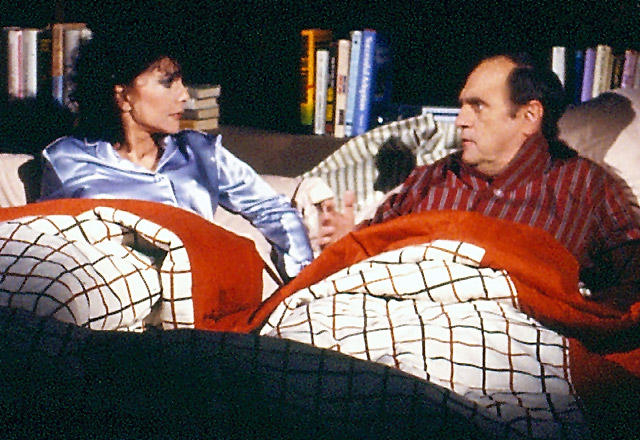
Now, that’s not to say The Bob Newhart Show is perfect. It definitely gets unmotivatedly broader over its last couple seasons as well, and because its characters aren’t as pinpointably defined as Mary Tyler Moore’s, I do think this show is always a bit more idea-dependent than MTM’s first and most shining example of the company’s character-driven ideals. However, with Newhart’s sense of humor being well-serviced by those around him, and the series’ very tenor reflecting his persona via this design, it ultimately feels like a triumphant character piece overall, advocating for the low-concept work-and-home ensemble setup as a venue to explore, well, people. Accordingly, I knew I had to pay homage here to Bob Newhart — and one of the best situation comedies of all time — with this script that finds the show at the beginning of its excellence, offering a smart first story that capably brings together Bob’s work life and home life, as Emily’s relatable anxiety about flying allows her to join Bob’s therapy group, giving him the chance to connect her (and airline pilot Howard Borden!) with the otherwise broader and more general “kooks” to whom he administers regularly. This is a terrific use of the situation — the premise, the characters, and the star’s particular comic style. Here’s a sample of burgeoning greatness — written by creators David Davis and Lorenzo Music (both former Mary Tyler Moore contributors who, interestingly, had tried to get Newhart to guest star in its first season).


Happy trails to you, Bob!

Stay tuned next week for a double dose of Arrested Development!
I am interested in this script. My grandfather was actually friends with Bob Newhart in high school!
Hi, Charlie! Thanks for reading and commenting.
Hope you saved your grandpa’s yearbook!
I have emailed you at your gmail address.
Very interested. Thanks Jackson!
Hi, Donald! Thanks for reading and commenting.
I have emailed you at your gmail address.
Yes. I’m interested. Thank you!
Hi, Nat! Thanks for reading and commenting.
I have emailed you at your yahoo address.
Sure. I’d like to see it.
Thanks for the offer.
Hi, Paul! Thanks for reading and commenting.
I have emailed you at your AOL address.
I would like a file of the script. I agree that this show was superior to NEWHART, which went too far at times, especially w/ Larry, Darryl, & Darryl.
Hi, Jon! Thanks for reading and commenting.
I have emailed you at your yahoo address.
How cool! please send.
Hi, Elaine! Thanks for reading and commenting.
I have emailed you at your yahoo address.
Thank you for this generous offer. I’d love to read this script!
Hi, Toby! Thanks for reading and commenting.
I have emailed you at your gmail address.
Hi there, I would be very interested in a copy of that script. Thanks. Keep up the great work!
Hi, Scott! Thanks for reading and commenting.
I have emailed you at your hotmail address.
I would like to see it! Thank you Jackson!
Hi, esoteric1234! Thanks for reading and commenting.
I have emailed you at your gmail address.
Do you know in which TBNS episode the scene Kimmel describes takes place in? https://www.youtube.com/watch?v=ImN7UXWcm1Q
Hi, The BayAreaGuy! Thanks for reading and commenting.
No, a scene like that doesn’t ring a bell to me. Perhaps he’s thinking of “Shrinking Violence” from Season Five? In a rage, Bob “steps outside” to fight a mechanic and ends up with a black eye — after an entire episode of discouraging others from anger and aggression.
Thank you for sharing, Jackson! I would love to get a copy of that script if it’s still possible! Thanks again!
Hi, Rashad! Thanks for reading and commenting.
I have emailed you at your gmail address.