
Welcome to a new Wildcard Wednesday! This week, I’m sharing the latest in my “potpourri” series on midcentury Broadway plays, specifically comedies, that I’m reading for (mostly) the first time. In this entry, I’ve selected three titles from the late 1940s!

THE SILVER WHISTLE (1948)
Logline: A hobo enters an old folk’s home with a potion he promises will make them all young.
Author: Robert E. McEnroe | Original Director: Paul Crabtree
Original Broadway Cast: Jose Ferrer, Robert Carroll, Eleanor Wilson, George Mathews, William Lynn, Doro Merande, Kathleen Comegys, and more

Thoughts: Cute, perhaps. Sweet, perhaps. But funny this play is not. It’s an unimaginative, predictable tale of a charlatan who builds up the hopes of the hopeless and, despite being a fraud himself, ends up meaningfully improving their lives anyway. There’s nothing fresh about the telling here — the plot of a hobo entering an old folk’s home and pretending to have a secret potion that’ll make the drinkers young again never deviates from a fairly obvious course, especially with a clichéd romantic subplot, wherein the hobo woos a sheltered woman and therefore forces her retreating beau to finally make an emotional commitment. The primary character — originally played by Jose Ferrer — drives the action and has a precise attitude that may perhaps attract a certain kind of comic actor. But there’s not much to play anywhere else — the dialogue is banal, the characterizations lack precision (which is criminal, especially for elderly roles who could otherwise be so specific and interesting), and again, the story never manages to surprise. And more than that, it’s just not that funny. So, I’m afraid I failed to see the charms of The Silver Whistle — there are better variations of this idea elsewhere; this one’s subpar.
Jackson’s Rating: 4/10

TWO BLIND MICE (1949)
Logline: A man tries to win back his ex-wife by saving the government agency run by her aunts.
Author: Samuel Spewack | Original Director: Samuel Spewack
Original Broadway Cast: Melvyn Douglas, Jan Sterling, Laura Pierpont, Mabel Paige, Richard Kendrick, Howard St. John, Elliott Reid, and more
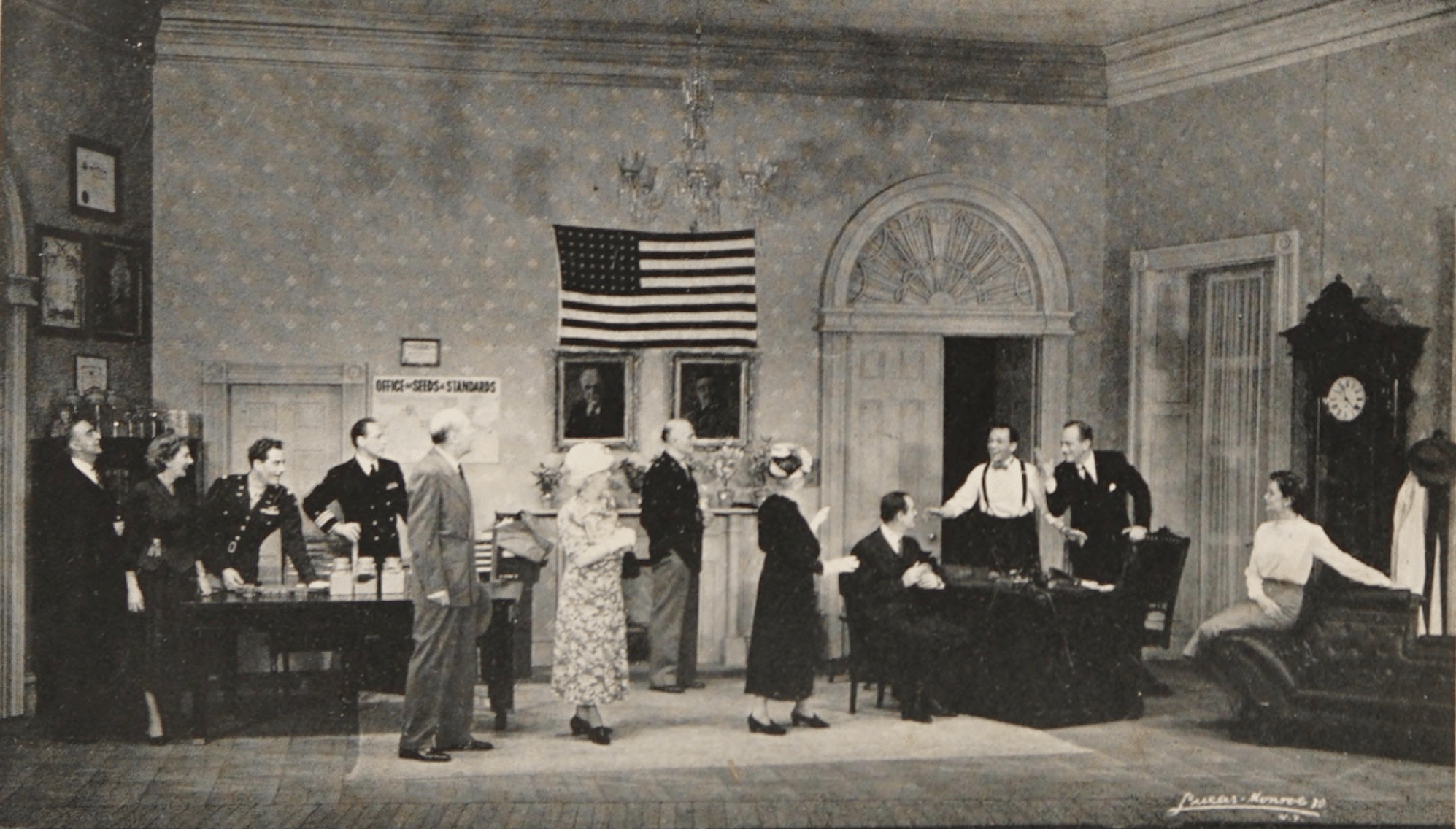
Thoughts: This is basically just a screwball comedy about a man who concocts an elaborate scheme to win back his ex-wife on the eve of her marrying another guy — only it’s couched inside a high-concept premise about his efforts to save the rinky dink government agency run by her two elderly aunts, whose office should no longer exist because it was ordered to be abolished years ago. That logline allows for natural comedy about the ineptitude of bureaucracy with the help of some Cold War-specific but elementally timeless jokes about a bloated government that’s filled with idiots and reprobates. It’s a funny idea, with a handful of funny characters — including the aunts, along with, most importantly, the leading man, a wheeler and dealer who’s driving the scheme, a Bilko-like fast-talker played originally by Melvyn Douglas (no stranger to this kind of screwball comedy). However, so much of the play itself is consumed by story-driven necessities that support its ostentatious high concept, with not much thought beyond it. That is, most of the other characters appear solely for manufactured chaos in a sometimes-hard-to-follow plot, which maybe isn’t quite as amusing as its initial premise suggests, and they lack dimension and/or clarity, feeling somewhat one-dimensional or convenient. And while the text is inherently comedic in its overall tenor, I’m not sure there’s anything that happens or is said that is exceptionally uproarious, especially as far as the basic love story is concerned (although, to its credit, Two Blind Mice ends without forcing a reconciliation between the exes; it’s implied that it’ll happen, but we’re spared the contrivance of seeing it). Perhaps a really smart cast with the right direction (both to guide the staging and refine the pacing) could elevate what’s on the page, for this is otherwise an affable but mostly workmanlike comedy that’s good but not great. (Incidentally, it strikes me as similar to the previous show that Sam Spewack wrote, with his wife Bella, the much more exciting Kiss Me, Kate, which has a familiar love triangle, a government-related element, and a flashy conceptual hook — i.e., the onstage musical version of The Taming Of The Shrew and its obvious parallels to the characters off-stage, which also helps disguise the narrative simplicity of its romantic storytelling.)
Jackson’s Rating: 6.5/10

THE BIGGEST THIEF IN TOWN (1949)
Logline: An undertaker conspires to steal a wealthy man’s corpse and profit off an up-charge.
Author: Dalton Trumbo | Original Director: Herman Shumlin
Original Broadway Cast: Thomas Mitchell, Walter Abel, Rhys Williams, Russ Brown, William J. Kelly, Lois Nettleton, and more

Thoughts: There’s a cynicism to this play that necessitates the proper adjustment of an audience’s expectations, but I think the tone of the piece is implied by the logline itself — in which a meager mortician conspires to steal the corpse of the richest man in town so he can profit off the up-charged expenses — and if you’re up for this kind of dark comedy, the script by Dalton Trumbo (one of the Hollywood Ten) largely delivers on the promise of its premise. In fact, it overdelivers in a few areas — for despite some documented difficulties during its out-of-town gestation, I think there’s a fine sense of construction and a welcome amount of thematic cohesion via the varying levels of deceit and dastardly behavior, along with the various justifications for why immorality may sometimes be moral (if it’s at the expense of someone worse, for instance), and it’s all tied together nicely by a romantic subplot that helps motivate the entire action. Also, the second act twist that the corpse is actually alive at the time of kidnapping is a fun (albeit, maybe expected) wrinkle that adds an element of farce to the proceedings, goosing the laughs and enabling a fairly surprising last portion that unexpectedly plays against our assumptions and ends things happily for the main character, without the sort of condemnation or consequence that one would anticipate given his ghoulish scheming. I don’t think this piece celebrates or agrees with the leads though — no, this is ultimately a satire of commercial greed, set in a typically reverent place where its abundance may nevertheless come as a shock, and the laugh’s on us for laughing. Interestingly, critics in 1949 who didn’t blanch at the very premise found the text’s attitude inconsistent — Trumbo apparently toiled to make it funnier between New Haven and New York — but it read okay to me, and while I can’t pretend it’s incredibly thoughtful about its characters or insightful about the human condition in a way that most erudite theatergoers would require to call this an excellent play (the third act has some parallels to Trumbo’s own life and the Hollywood Ten, but that’s “inside baseball,” as they say), it feels like it accomplishes what it wants. And I’d love to see it staged.
Jackson’s Rating: 6.5/10

Come back next week for a new Wildcard! And stay tuned Tuesday for more sitcom fun!