
Welcome to a new Wildcard Wednesday! This week, I’ve got the latest in my “potpourri” series on midcentury Broadway plays, specifically comedies, that I’m reading for the first time. In this entry, as our “1950s takeover” continues in celebration of my first book, Great American Sitcoms of the 1950s — which you can buy here (or on Amazon here) — we’re in 1953…

THE FIFTH SEASON (1953)
Logline: Two partners in the garment industry toil to keep their business afloat.
Author: Sylvia Regan | Original Director: Gregory Ratoff
Original Broadway Cast: Menasha Skulnik, Richard Whorf, John Griggs, Phyllis Hill, Nita Talbot, Dick Kallman, Augusta Roeland, Norman Rose, Lois Wheeler, and more

Thoughts: The Fifth Season is the only play in this post that never made it to the big screen, and this is despite enjoying the longest Broadway run of the three. Having now read it, I can see why; it’s easily the weakest of the trio — letting down a promising premise as an ensemble workplace comedy set in the garment industry with a terrible plot that indulges clichéd dramatics about an ill-defined but unlikable philanderer whose obvious indiscretions are telegraphed a mile away yet aren’t well-motivated in the text itself, along with a predictable subplot wherein the comic lead (originally played by Menasha Skulnik, who apparently carried the 1953 production on his back) finds inevitable romantic success with one of the office’s many beautiful but bland models. This story — and its uninspired telling — is further cheapened by thin, single-dimensional characterizations, especially for the females, all of whom (ALL of whom) feel underdeveloped compared to their male counterparts. The only role that shows any signs of fresh comedic color is the aforementioned lead played originally by Skulnik. Perhaps as a vehicle for him, this might have been a decent two hours at the theatre (which would explain why it ran for 650+ performances). But otherwise, in terms of both character and story, this is strictly subpar as a dramatic work — a weak version of what a play with this basic setting should be, working best in the minutiae of a struggling fashion company but failing quite a bit whenever actual narrative concerns must come to the fore.
Jackson’s Verdict: Subpar — forgotten for a reason.

MY THREE ANGELS (1953)
Logline: Three convicts help out a struggling family on Christmas Eve.
Author: Sam Spewack & Bella Spewack, based on a French play by Albert Husson | Original Director: José Ferrer
Original Broadway Cast: Walter Slezak, Jerome Cowan, Darren McGavin, Joan Chandler, Robert Carroll, Carmen Mathews, and more

Thoughts: Transferred to the silver screen as We’re No Angels in 1955, this 1953 Broadway adaptation of a French play from the year prior should be familiar to anyone who’s seen its Hollywood makeover. Aside from a few tweaks in the plot — making the criminal trio escapees from prison in the movie (as opposed to workers) and a little more passive in the pre-meditated murder of the rich antagonist — it’s the same cute story of three convicts who help out a family on Christmas Eve, as the father struggles in his business and the daughter struggles in her love life. But the stage version is a lot faster and funnier — condensing the action and leaving less space for unnecessary detail and ham-handed treacle. In fact, with three funny crooks coming in and out, and lots of doors opening and closing, the piece’s similarities to a French farce are clearer — and that’s a boon to the narrative overall, which has heavier, sadder moments that also play better when buoyed by a lighter, brisker, less indulgent pacing. As for the character work, everyone’s well-defined — even the three crooks are delineated against each other (and that’s made clearer in the way they’re often cast) — which means, by way of both story and character, My Three Angels, even more so than We’re No Angels, is a well-made text. And in terms of comedy, it’s got laughs too — rendering this a play that’s always ripe for revival and probably could use more present-day visibility; it just works — and well.
Jackson’s Verdict: A well-crafted play. Enjoy it!

THE SOLID GOLD CADILLAC (1953)
Logline: A meek shareholder in a big corporation uncovers some company corruption.
Author: Howard Teichmann & George S. Kaufman | Original Director: George S. Kaufman
Original Broadway Cast: Josephine Hull, Loring Smith, Geoffrey Lumb, Henry Jones, Wendell K. Phillips, Mary Welch, Fred Allen, and more
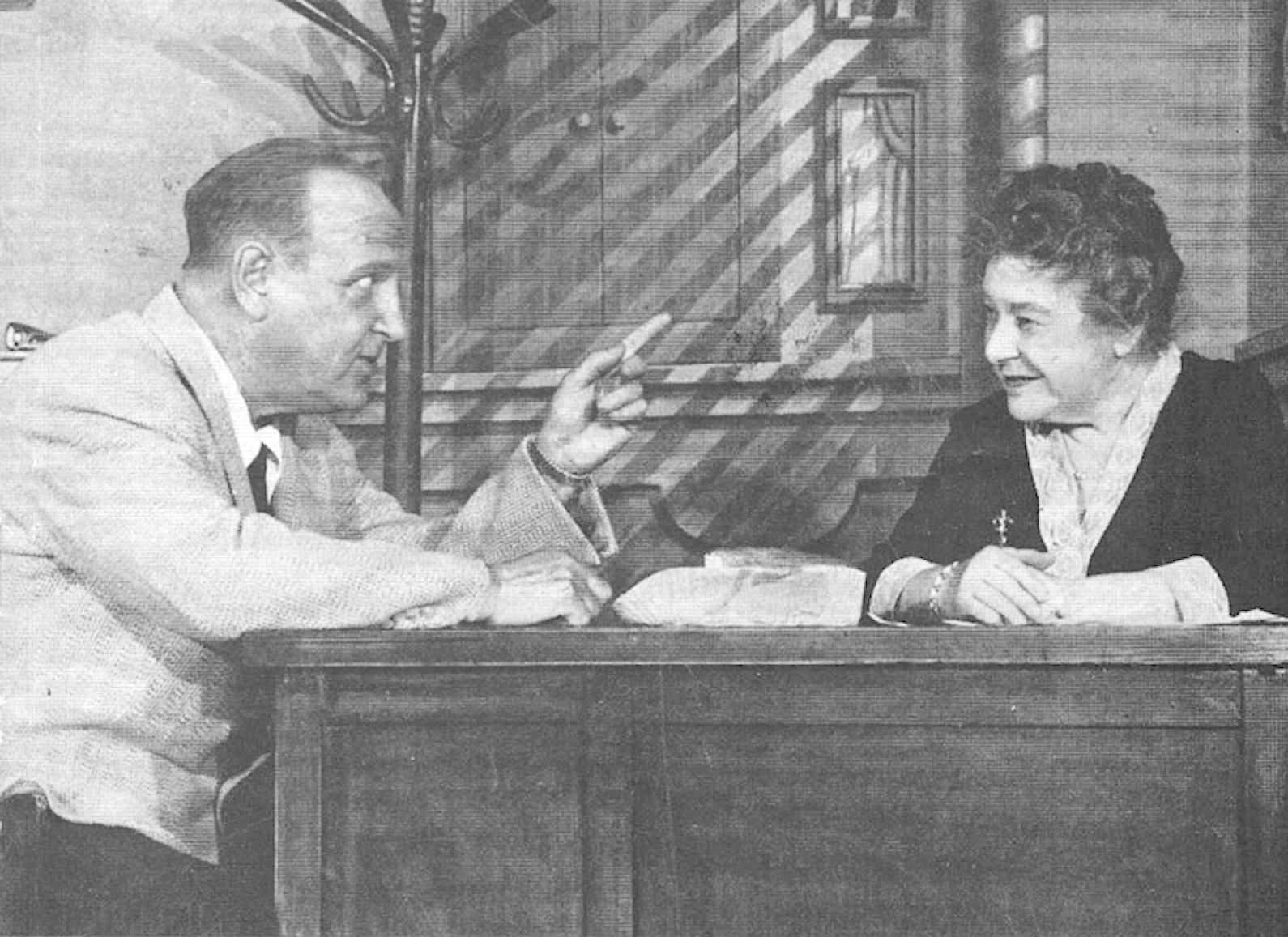
Thoughts: A likable comedy about a quirky underdog who brings down a bunch of crooked and underhanded businessmen, The Solid Gold Cadillac — co-authored by director George S. Kaufman — is probably best remembered today from its 1956 film adaptation starring Judy Holliday. The play from three years prior is similar narratively — except that it was originally written for Josephine Hull (you know her best from two great films: 1950’s Harvey and 1944’s Arsenic And Old Lace), who was then in her seventies. This actually makes for something of a big difference in how the play predicates its comedy. In the film, Holliday’s inquisitive shareholder is a quirky ingenue, looking out for the “little guy” while also getting a fairytale romance via a love story subplot with her politician co-conspirator, with whom she teams to take on the fat cats. Many laughs come from her inherent screen persona — situated in the juxtaposition of her apparent intellectual daffiness with her palpable humanity, which she proves time and again. For Hull, and the character as written for the stage, there’s a similar dichotomy in the role’s perceived intelligence and revealed emotional insight about people… but a lot of what makes her an underdog is a result of her age and how that makes her unassuming. That is, more than Holliday — the childlike bombshell who doesn’t belong in the corporate world — Hull, the grandma-like figure with her weathered astrology book, is really out of her element. Accordingly, I think the plot — which, I must say, is always contrived and quite predictable, especially when politics is injected in its back half — works better with someone like Hull in the role, for it makes more sense that these executives would think they’d easily be able to manipulate her and brush her off. In contrast, Holiday’s sheer charisma alerts us right away that she’ll get the best of these men, despite not fully knowing their ways yet, and although I think Holiday herself might be a more complex, dynamic presence — she can navigate a lot of different feelings with captivating clarity — the story is simpler and reads better here. Oh yes, it’s still too often illogical, and the viewer is pretty much always ahead of the action, but with good performers charming their way through an intrinsically likable story, this is a play (and a movie) that I can’t help but enjoy.
Jackson’s Verdict: More charming than it has any right to be.

Come back next week for more 1950s fun as our submersion in the decade concludes!