
Welcome to a new Wildcard Wednesday! This week, I’m sharing the latest in my “potpourri” series on midcentury Broadway plays, specifically comedies, that I’m reading for (mostly) the first time. In this entry, I’ve selected three big titles from the mid-1950s!

WILL SUCCESS SPOIL ROCK HUNTER? (1955)
Logline: An aspiring writer makes deals with a devilish agent in ten percent increments.
Author: George Axelrod | Original Director: George Axelrod
Original Broadway Cast: Orson Bean, Jayne Mansfield, Walter Matthau, Martin Gabel, Harry Clark, Tina Louise, and more

Thoughts: If you’ve seen Frank Tashlin’s splashy 1957 film of the same name, this play will be something of a surprise, for you actually haven’t seen anything remotely resembling George Axelrod’s Will Success Spoil Rock Hunter? That is, this Broadway stage play has nothing in common with its big screen namesake aside from the title and the presence of one Jayne Mansfield as a buxom parody of Marilyn Monroe (star of the movie version of Axelrod’s previous hit, The Seven Year Itch). And I hate to be the bearer of bad news, but I think it’ll be something of a disappointment to you as well, for while Tashlin’s bright and colorful motion picture is gimmicky and goofy, it’s also buoyant and eventful, with a creativity that I’m afraid eludes its stage predecessor. Oh, don’t get me wrong — Axelrod, as usual, is a capable writer. His dialogue is always engaging, and although every character here may not be well-defined (as we saw in Itch), he’s usually got a strong lead at least — someone who truly feels well-explored over the course of a two-hour play. That’s true in Rock Hunter. The problem, frankly, is that this story is inherently clichéd: it’s a Faust-ian tale placed in the world of Hollywood — a very on-the-nose setting for an already formulaic setup that was being more imaginatively explored (via baseball) in the concurrently running Broadway musical Damn Yankees, which had opened earlier that same year. Yes, there are easy jokes here about the literary agent taking incremental percentages of the gullible nobody with each genie-like wish that’s granted — “show biz is a world where your soul is for sale,” we got it — but that’s the point: they’re all so easy. Even in 1955, the Faust-ian formula keeps the show feeling more familiar than funny, and though not without laughs — Axelrod writes comedy (thank goodness!) — I just don’t think this is the best version of this story out there, or even the best version of this title.
Jackson’s Verdict: The movie is better (for what it is).

VISIT TO A SMALL PLANET (1957)
Logline: An alien lands on Earth in the mid-1950s with the hopes of viewing a human war.
Author: Gore Vidal | Original Director: Cyril Ritchard
Original Broadway Cast: Cyril Ritchard, Eddie Mayehoff, Philip Coolidge, Sarah Marshall, Conrad Janis, Sibyl Bowan, Bob Gothie, and more
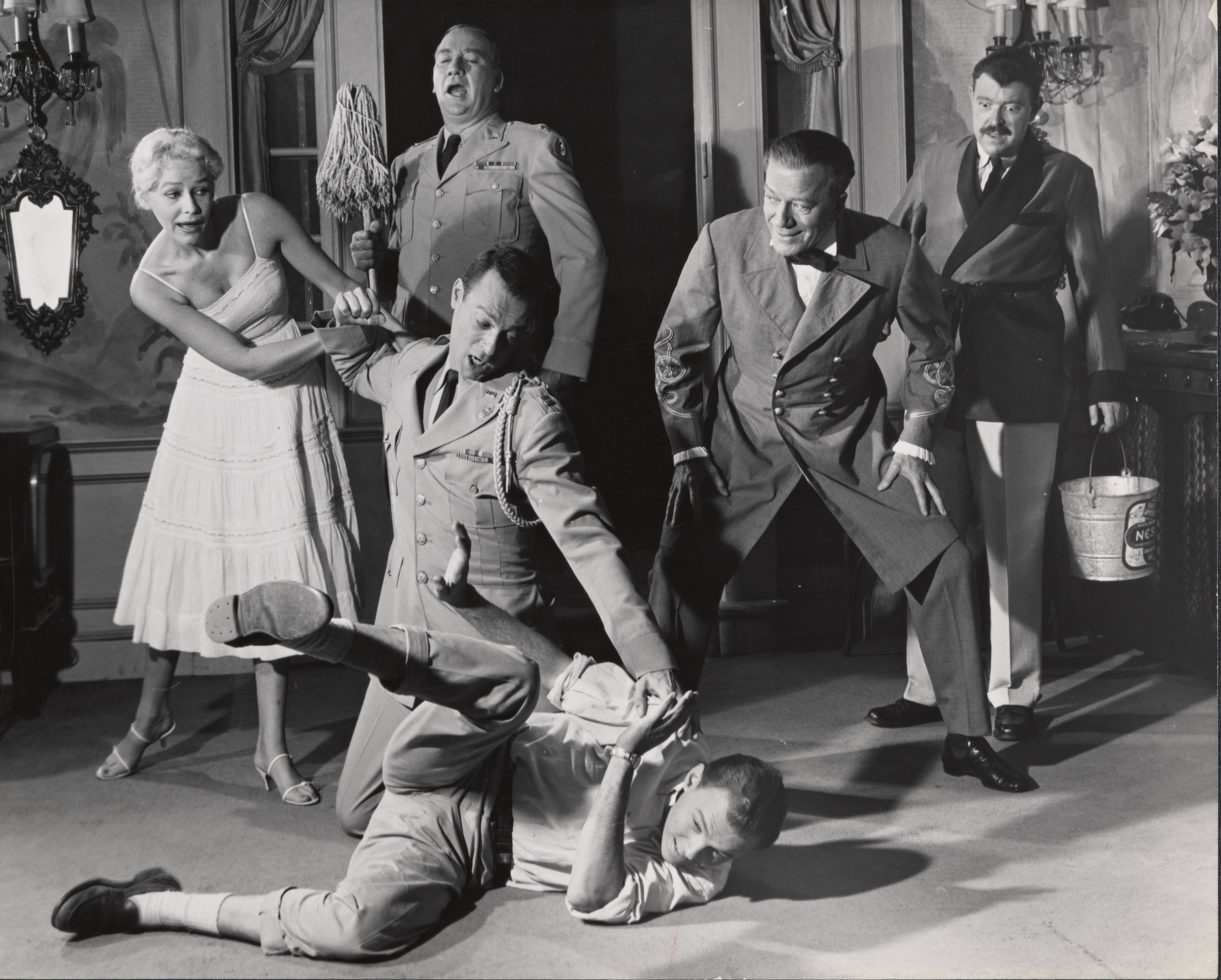
Thoughts: Once again — if you’ve seen the film adaptation of the same name, released in 1960 and starring the indefatigable Jerry Lewis, you haven’t really seen Gore Vidal’s Visit To A Small Planet, the 1957 stage play that itself was an expansion of his earlier 1955 teleplay. Free of the Jerry Lewis persona and the madcap, goofy mania that the movie had to invite, Vidal’s original comedy about an alien who visits Earth to study humanity is actually a sophisticated polemic in favor of pacifism, using the supernatural fun of an extraterrestrial imp with a hankering for conflict — played on TV by Theodore Bikel and in the expanded Broadway play by Cyril Ritchard — to spoof man’s penchant for war, particularly in the mid-20th century, near the height of America’s simmering tensions with the Soviet Union. This 1957 stage text — which is what I’m considering for this post — is not only a terrific time capsule as a Cold War comedy, but also a well-written play in its own right, deploying an ostentatious premise with a clear star part in the disruptive alien — all for the purposes of an anti-war message that nevertheless also finds time to explore several well-defined characters who exist in relation to each other, using their inherent humanities to corroborate and in fact deepen the thesis. In other words — it’s simply well-crafted by way of character, reflecting them through its enticing premise to effectively communicate a valid thematic perspective. And there are laughs to boot! So, any fears I might have had going in about the innate gimmickry of the alien logline (and the magical stunts he accordingly does) are rendered nil by the thoughtful character interactions and genuinely humorous and humane qualities of the text. I’d love to see this staged — it’s a beautiful, funny reflection of 1957 that nevertheless has evergreen things to say about America and about the human race as a whole. Easily the best play in this post.
Jackson’s Verdict: Great — very worthwhile.

THE TUNNEL OF LOVE (1957)
Logline: A married cartoonist hoping to adopt has an affair with the agency’s investigator.
Author: Joseph Fields & Peter DeVries, based on DeVries’ novel | Original Director: Joseph Fields
Original Broadway Cast: Tom Ewell, Darren McGavin, Nancy Olson, Elisabeth Fraser, Sylvia Daneel, Elizabeth Wilson

Thoughts: This show offered star Tom Ewell the chance to play another version of his basic persona, as crystallized by The Seven Year Itch — the seemingly benign married man whose preoccupations with sex, particularly extramarital sex, are rendered hilarious because of his innate juxtaposition as a sheep with secret wolf ambitions. Only, here, he really goes through with an affair — having sex with a PhD student who drops in to investigate the couple’s fitness to adopt a child — and complications then arise from both his guilt upon this uncharacteristic misdeed (egged on by his lothario pal, the devil on his shoulder), and the student’s pregnancy reveal… which leads, of course, to the couple adopting the child that’s actually his — made glaring by the physical resemblance that forces the new papa to finally confess his sins. It’s a tortured comic scenario in Ewell’s regular sandbox — that ol’ sheep vs. wolf tension — and really just exists to prop up the logline of the third act, as a couple half-unknowingly adopts the product of the husband’s liaison. As a premise, that’s not exactly hilarious, but the script is sharp with its dialogue and good about giving its leading man (also played briefly on Broadway by Johnny Carson) things to do that are funny — and unlike the sanitized 1958 film adaptation, wherein the husband isn’t able to cheat so the resemblance shared between adopted father and son ends up being purely coincidental, the boldness of having the main character indeed commit an indiscretion, and then mentally suffer thereafter as a result, is amusing in a more directly motivated way. Unfortunately, like so many of these plays — including Itch — not all the leads are well-defined. As usual, the men are fuller and more explored than the women — including the PhD student around whom the whole plot turns. Although “getting knocked up as research for her thesis” is an attempt to explain her choices, it still doesn’t make a ton of emotional sense — and hinging the whole story on this affair, along with the adoption process that follows with her guidance, really emphasizes the many contrivances this narrative demands. So, with shortcomings in both character and plotting, I can’t claim this is a great play — but it has its moments, and it’s certainly not the worst I’ve read in this sex-com subgenre.
Jackson’s Verdict: Flawed (and quite reflective of its era), but not charmless.

Come back next week for a new Wildcard! And stay tuned Tuesday for more 30 Rock!