
Welcome to a new Sitcom Tuesday! This week, I’m continuing my look at The Big Bang Theory (2007-2019, CBS), which is currently available on DVD/Blu-Ray and streaming!
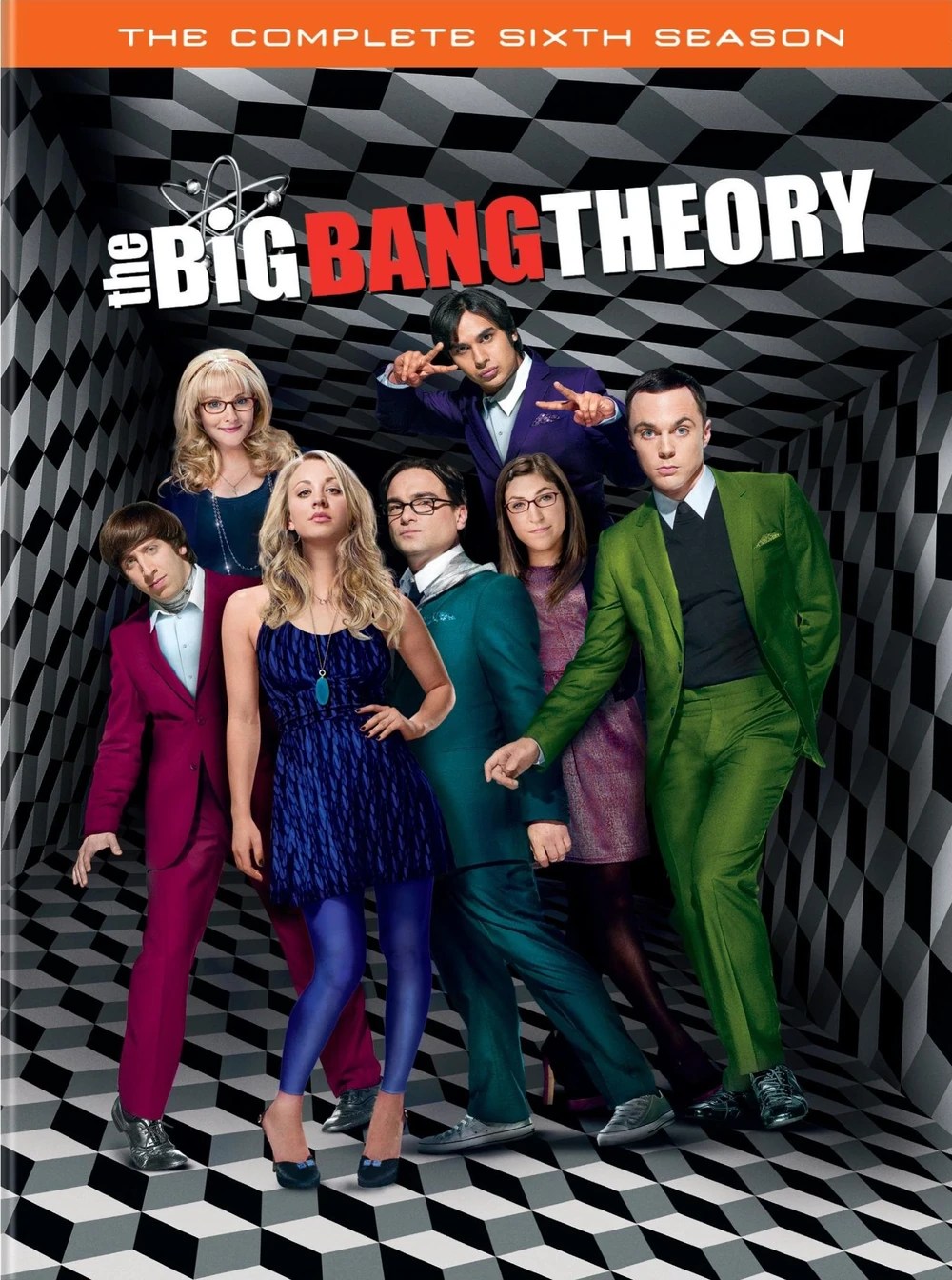
The Big Bang Theory stars JOHNNY GALECKI as Leonard, KALEY CUOCO as Penny, SIMON HELBERG as Howard, KUNAL NAYYAR as Raj, MELISSA RAUCH as Bernadette, MAYIM BIALIK as Amy, and JIM PARSONS as Sheldon.

Despite a new showrunner taking the reins, I think Five and Six are not terribly different in terms of value. They have a similar number of memorable episodes, and their average quality ends up pretty close. As with last week, Six’s best stories are predicated on the iconic Sheldon Cooper character, who’s not just the ensemble’s boldest comic force, but also an ambassador for the series at large. And with many stories continuing to track his evolution via his relationship with the funny Amy, there are still plenty of ways for the show to deliver valuable situation comedy for both character and even premise. What’s more, it can always deploy the basic science/nerd bent that all the guys collectively share, which defines Big Bang on a fundamental level, distinguishing it within this subgenre. Of course, there are more generic and therefore less individualized rom-com stories as well. But Six makes some smart choices. For instance, it’s about darn time for Raj to finally get his first serious love interest, someone who’s well-matched for him because she’s equally quirky and socially afraid. And the mini-arc of Penny going back to school is clever, for it’s able to spark some conflicts with Leonard related to their simple premised differences. Additionally, as Amy begins more obviously wanting physical intimacy from Sheldon, I appreciate this year’s deliberate paralleling of both Sheldon’s natural aversion to a formal relationship, and change en masse, with Penny’s own fear of commitment. The latter’s reluctance to commit was ostensibly the cause of her initial breakup with Leonard in Three — an idea that I’ve always found to be a convenient excuse that lacked continuity and was a little too unspecific for her character, particularly in relation to Leonard and how they differ based on the premise. That is, the reason for their split seemed like something we could see on any rom-com sitcom, independent of these characters, and it thus felt neither earned nor attached to specifics about Big Bang. However, with Six’s added context, maybe I can squint and say she didn’t want to commit to Leonard because of their discrepancies, while his limited social experience made him more committed because he’s more fearful of losing her… Okay, that’s still a stretch; the Leonard/Penny stuff remains among this era’s weaker fare, but overall, the show remains in good shape as it approaches its halfway point. After this, well, stay tuned…
01) Episode 120: “The Parking Spot Escalation” (Aired: 11/29/12)
Sheldon and Howard get into a feud over a parking spot.
Teleplay by Steven Molaro & Steve Holland & Maria Ferrari | Story by Chuck Lorre & Eric Kaplan & Adam Faberman | Directed by Peter Chakos

A Seinfeld-ian feud between two characters over a parking space isn’t terribly original, and I’m afraid this is an example of the show becoming less narratively specific in the generation of its ideas. That said, this entry is better than most in this category, for I think it ends up being a better showcase for the actual characters involved. In particular, it makes sense for Sheldon, whom we know is rigid and resistant to change, to be petulant and pedantic and fundamentally competitive over a parking space — which means the whole story is well-motivated by the series’ primary and inherently situation-reflecting character. What’s more, I love how the feud between Sheldon and Howard consumes their respective better halves as well, thereby accentuating their personalities. As Bernadette gets to show off the temper that is comedic because it’s anachronistic coming from such a sweet, seemingly mild exterior, Amy’s Sheldon-like lack of tact gets displayed, but in a less controlled manner, emphasizing her rawer humanity. So, although I don’t love this one on paper, the execution saves it, courtesy of support from these amusing leads who elevate the proceedings with their individualities.
02) Episode 121: “The Fish Guts Displacement” (Aired: 12/06/12)
Amy is excited when Sheldon cares for her while she’s sick.
Teleplay by Steven Molaro & Eric Kaplan & Jim Reynolds | Story by Chuck Lorre & Bill Prady & Tara Hernandez | Directed by Mark Cendrowski

Since Sheldon’s arc towards increased humanity via social bonding has centered around his struggles with natural empathy, a common source of character-revealing and thus premise-affirming story has involved him either being cared or having to care for another person. We’ve often seen Penny care for him, and in Season Three’s classic “The Adhesive Duck Deficiency,” he had to step up to the proverbial plate and care for her. Here, now that he’s in a romantic relationship with Amy, it’s only appropriate that he should have to care for her when she’s sick. It’s an automatically great notion that allows us to observe just how much his character has evolved by Six, for he’s actually eager to help her feel better. However, what’s really funny about the idea is Amy’s response — as someone who, starting from her slow redevelopment in Four, has been ahead of Sheldon in craving connection with other humans, she is hungering by now for this intimate contact with him. This essentially starts a more front-facing arc about her desire for sexual intimacy, which won’t culminate until Nine but becomes a major concern for her going forward, finding comedic conflict based on this clear, situation-rooted discrepancy.
03) Episode 123: “The Egg Salad Equivalency” (Aired: 01/03/13)
Sheldon causes an HR problem when he tries to get his assistant to stop crushing on Leonard.
Teleplay by Steven Molaro & Bill Prady & Steve Holland | Story by Chuck Lorre & Eric Kaplan & Jim Reynolds | Directed by Mark Cendrowski

My choice for this season’s Most Valuable Episode (MVE), “The Egg Salad Equivalency” is like all of Big Bang’s best: a brilliant display of the Sheldon character, whose strong personality is the boldest synthesis of all the guys’ social dysfunction, thereby making him the most potent figure for eliciting memorable situation-based comedy. Here, the rigid, socially awkward, and empathy-struggling Sheldon wreaks relational havoc in a way that we haven’t really seen him do before — at the university, where he gets himself and his pals in trouble with HR. This is something stories actually haven’t followed too much (surprisingly) — having Sheldon’s special brand of emotional intelligence (or lack thereof) cause problems for him out in the “real world” — for the show instead has been more insularly focused on his relationships with the other regulars (which should be the priority). But with a character whose basic differences, and heck, entire depiction, hinge on his difficulties in interacting with, well, the world around him, this kind of idea is situation-validating as well. And it can also be very funny, like when Sheldon insults his new recurring assistant Alex (Margo Harshman), whose crush on Leonard he hopes to dissuade with a tactless conversation — which proves to be hilariously offensive in accordance with his inexperience with “normal” social cues and mores. And then there’s an even funnier scene with Regina King as the dean, whom Sheldon also offends — an elevation that makes this one of the show’s most laugh-filled outings, and a great pick for MVE, exploring Sheldon’s character, and therefore the premise, in a story that’s remarkably fresh for a series at this point in its run.
04) Episode 124: “The Bakersfield Expedition” (Aired: 01/10/13)
The guys are stranded on their way to Comic-Con.
Teleplay by Steven Molaro & Eric Kaplan & Maria Ferrari | Story by Chuck Lorre & Jim Reynolds & Steve Holland | Directed by Mark Cendrowski

Another one of Big Bang’s best, “The Bakersfield Expedition” is a memorable sample of the series that’s not about the exploration of the situation through one particular character but rather rooted more in the collective comedic definition that the guys all share, which colors this show’s overall identity within this genre (and subgenre). That is, the fact that these are science and sci-fi-loving nerds is the most important element of the series’ DNA here, as they dress up as Star Trek: Next Generation characters for a Comic-Con costume contest in Bakersfield. Only, they get stranded out on the road, as their lack of real-world understanding makes them basically helpless, leading them to a roadside diner where they obviously stand out as goofballs in absurd costumes. It’s the kind of thing that maybe could happen on most sitcoms, but the details of their actual interests, and the specific outfits they wear — which determines how everyone else responds to them — are individualized to the series and this fundamental part of its makeup. It’s therefore a strong ensemble show, as evidenced also in the symbiotic subplot with the women, who are back at home trying to comprehend the guys’ love of comic books — another reinforcement of this overarching series-defining sensibility.
05) Episode 125: “The Cooper/Kripke Inversion” (Aired: 01/31/13)
Sheldon is upset to learn that Kripke’s work is better than his.
Teleplay by Steven Molaro & Jim Reynolds & Steve Holland | Story by Chuck Lorre & Eric Kaplan & Anthony Del Broccolo | Directed by Mark Cendrowski

One of the key traits for Sheldon Cooper is his belief in his greater intellect relative to others, which, in his rigid way of thinking, is one of the things that determines their value and how much he should respect them. And his social filter isn’t developed enough to hide those perhaps graceless judgements. This often means that he’s talking down to people and insulting them without fully intending to do so. But the reverse is also character-corroborating — for when he gets humbled by a superior intellect, it reveals the basic insecurities related to his own self-image and how he considers both himself and the world. Accordingly, it’s a lot of Sheldon-specific and thus series-specific fun to have him mopey because of Kripke’s more advanced work — a comic idea that then becomes the launching pad for further movement on Sheldon/Amy’s intimacy front, as he allows her to comfort him, and afterwards, confides to both Leonard and Penny that he may be open to a more physical relationship in the future. It’s the kind of baby step that sets this as a check point for his growth, and perhaps a symbol that it’s indeed nearing completion. So, naturally, it’s something this uber-successful series will have to keep slow-walking…
06) Episode 126: “The Spoiler Alert Segmentation” (Aired: 02/07/13)
A feud between Leonard and Sheldon makes Penny and Sheldon nervous about change.
Teleplay by Steven Molaro & Maria Ferrari & Adam Faberman | Story by Chuck Lorre & Eric Kaplan & Anthony Del Broccolo | Directed by Mark Cendrowski

As noted in my seasonal overview, I think Season Six, in particular, deserves credit for paralleling Sheldon’s innate aversion to increased forms of intimacy with Amy to Penny’s own fear of commitment with Leonard, for it not only bonds those two characters who were designed, by the premise, to exist in juxtaposition, but it also reinforces their depictions and actually strengthens them. That’s even true with Penny, whose qualms about Leonard have, in previous years, felt forced and generic. Here, when framed intentionally alongside Sheldon and his well-established angst regarding change, there’s a humanity to Penny that, while still not individualized or based on her relationship with Leonard specifically, at least makes more internal sense. (Plus, it now has more continuity to back it up.) What’s more, because the structure of an episode like this — where Leonard and Sheldon feud after tactless Sheldon spoils the sixth book of the Harry Potter series to Leonard — naturally emphasizes differences between the two guys, it also reminds us of the differences between Leonard and Penny, which the show has only been intermittently adept at reiterating in story. Six, fortunately, is better than many at doing that, and this entry, though seldom regarded as a classic next to this list’s flashier outings, is a prime exhibit of the year’s relatively positive attributes. And it’s one of my favorites.
07) Episode 130: “The Closet Reconfiguration” (Aired: 03/14/13)
Sheldon reads an unopened letter left for Howard from his deceased father.
Teleplay by Steven Molaro & Steve Holland & Eric Kaplan | Story by Chuck Lorre & Jim Reynolds & Maria Ferrari | Directed by Anthony Rich

This is an unusual offering with a rare dramatic undercurrent — a sensibility not uncommon in the sitcom during the 2010s, as the entire medium was moving towards a more self-serious comprehension of itself, but definitely foreign to Big Bang, which was the leading representative of network multi-cams, a form whose intrinsic comedic promises stand in stark contrast to this overarching trend. However, this is still a pretty funny and, more importantly, character-rich showing that expands our understanding of Howard (who’s sort of otherwise defined in this era only by the tension between his mother and his wife) by humanizing him more and filling out his backstory. And the conflict, of course, is sparked by the emotionally clueless Sheldon, who crosses a social boundary by reading a private unopened letter written to Howard by his late father — a misstep that the ensemble, including Sheldon, endeavors to rectify in a powerful, yet still amusing, climax that cements this half hour as being too memorable to overlook. It’s not your typical sample, but it’s one of the series’ most sincere, so it feels special.
08) Episode 132: “The Closure Alternative” (Aired: 04/25/13)
Amy tries to get Sheldon over his obsessive-compulsive need for closure.
Teleplay by Steven Molaro & Jim Reynolds & Steve Holland | Story by Chuck Lorre & Bill Prady & Tara Hernandez | Directed by Mark Cendrowski

When Sheldon is unnerved by a TV show ending on an unresolved cliffhanger, Amy takes it upon herself to help him deal with his obsessive-compulsive need for closure. That’s a funny logline that’s predicated specifically on his character, with a conflict based on his difficulty in evolving past rigidity to become more socially “normal,” or moderated. It’s a wonderful idea for this series — something that makes individualized sense here. Additionally, I appreciate the subplot with Penny and Leonard, which again reinforces their differences as she struggles to understand why he likes a particular show. As usual, whenever Big Bang is able to contrast Penny and Leonard — the two least “extreme” members of the ensemble who nevertheless are designed to sit on separate social planes, with separate interests and intellects, and therefore opposing insecurities — the show is honoring them as precise characters who also uphold the situation in uniquely determined ways. So, it’s a very good subplot for them. And speaking of which, Raj is now in his first real romantic arc with Lucy, played by the well-cast Kate Micucci.
09) Episode 133: “The Proton Resurgence” (Aired: 05/02/13)
Sheldon and Leonard are delighted to meet one of their childhood idols, Professor Proton.
Teleplay by Steven Molaro & Eric Kaplan & Maria Ferrari | Story by Chuck Lorre & Jim Reynolds & Steve Holland | Directed by Mark Cendrowski

The iconic Bob Newhart debuts here in his well-remembered role as Professor Proton, the former host of a science-themed kids TV show that Leonard and (in particular) Sheldon revered, counting him as a childhood hero. As a nerd-approved idol of Sheldon’s, Professor Proton essentially functions as the fictionalized version of, a, say, Leonard Nimoy, and that makes him especially useful, for the show can still play up the geeky characters’ fanaticism, but with more leeway to craft comedy from self-created specifics that don’t require any prior or outside knowledge. This renders him great not only for the show and the broad understanding of its subject matter relative to other sitcoms, but also to Sheldon specifically, who is the most extreme and obsessive avatar for the guys’ shared definition. What’s more, Professor Proton is ingeniously cast with the naturally gifted Bob Newhart (who even won an Emmy for this half hour). Now, I think his character actually gets funnier once he dies and becomes a figure of Sheldon’s psyche in appropriate Obi-Wan form, but there’s no denying the sheer star power in his debut, and how well it works for both this series and its primary comic force.
10) Episode 134: “The Love Spell Potential” (Aired: 05/09/13)
The women play Dungeons & Dragons with the guys, while Raj goes on a date with Lucy.
Teleplay by Steven Molaro & Eric Kaplan & Steve Holland | Story by Chuck Lorre & Jim Reynolds & Maria Ferrari | Directed by Anthony Rich

This is a good showing for the ensemble, along with several characters in particular. One of those lucky characters is Raj, who is slowly tiptoeing into a relationship with the equally shy Lucy — a pairing that naturally speaks both to Raj’s inherently premise-affirming social evolution and his bashful definition, which is mirrored and thus accentuated by hers (in the same way that Amy, early on, was another version of Sheldon). This is the best episode in the Lucy arc, for it gives them the most direct interaction, with explicit talk of them both wanting to evolve away from their dysfunction. Meanwhile, the ensemble shines in a simple Dungeons & Dragons story, where the girls join their three guys — it’s low-stakes stuff that elementally reinforces the series’ situation because of its geeky bent, but it yields a drama between Amy and Sheldon, as she forces him to finally speak about her desire for physical intimacy and what he thinks. This leads to a very funny scene where the two do some erotic role-playing using the Dungeons & Dragons dice — a perfect use of the show’s nerdiness for a premise-rich conflict about socially awkward characters struggling to navigate a real human relationship. That’s uniquely Big Bang — capping off an era where such fare is routinely offered.
Other notable episodes from this Emmy-nominated season include: “The Monster Isolation,” which explores Raj’s romantic difficulties and has a subplot that centers the Sheldon and Penny friendship, along with both “The Extract Obliteration,” where Penny goes back to school and the differences between her and Leonard are emphasized in a situation-reflecting conflict, and “The Habitation Configuration,” a decent addition to the nevertheless textbook “Sheldon offends Amy and must apologize” category (this won Jim Parsons another Emmy). I’ll also take this space to cite “The Tenure Turbulence,” where Regina King returns in a less successful sequel to my MVE (with a competition story not as funny as “The Parking Spot Escalation” above), and “The Date Night Variable,” where Sheldon quotes Spider-Man to Amy after she demands some kind of verbal affirmation from him. Incidentally, I feel like I should also make note of several popular outings that I just find too generic and not well-tailored to the characters or premise, “The Re-Entry Minimization,” with a game night subplot that looks like Friends-ian tripe, “The Holographic Excitation,” a Halloween offering that mostly banks on the guys’ scientific/sci-fi interests, and “The 43 Peculiarity,” which hinges on a mystery that has not enough to do with the regulars’ actual depictions and claims a Leonard/Penny subplot that doesn’t feel specific enough to them or this show’s situation.

*** The MVE Award for the Best Episode from Season Six of The Big Bang Theory goes to…
“The Egg Salad Equivalency”

Come back next week for Season Seven! And stay tuned tomorrow for a new Wildcard!
The last good season imo
Hi, GGlor! Thanks for reading and commenting.
I agree with you. I think there’s a big drop-off between this season and the next. Stay tuned…
It is unusual for most sitcoms to be good in Season 6. Don’t you think the show’s good shape this season is somewhat remarkable?
Hi, Martinism! Thanks for reading and commenting.
Yes, I think the show’s quality relative to its own established standards here in Season Six is very good — and indicative of its earned bona fides as a strong long-running sitcom. However, I also think there is a noted discrepancy between the consistency of this year and the series’ peak (Three) — it *has* slipped — and in the big picture of the genre as a whole, I also maintain that BIG BANG’s overall value compared to its contemporaries is lesser than the era’s actual best. Specifically, the elements of its situation outside of Sheldon are never reliably well-used; he almost single-handedly has been the thing that’s kept the show afloat, and that remains glaringly true here in Season Six.