
Welcome to a new Sitcom Tuesday! This week, I’m continuing my look at The Big Bang Theory (2007-2019, CBS), which is currently available on DVD/Blu-Ray and streaming!

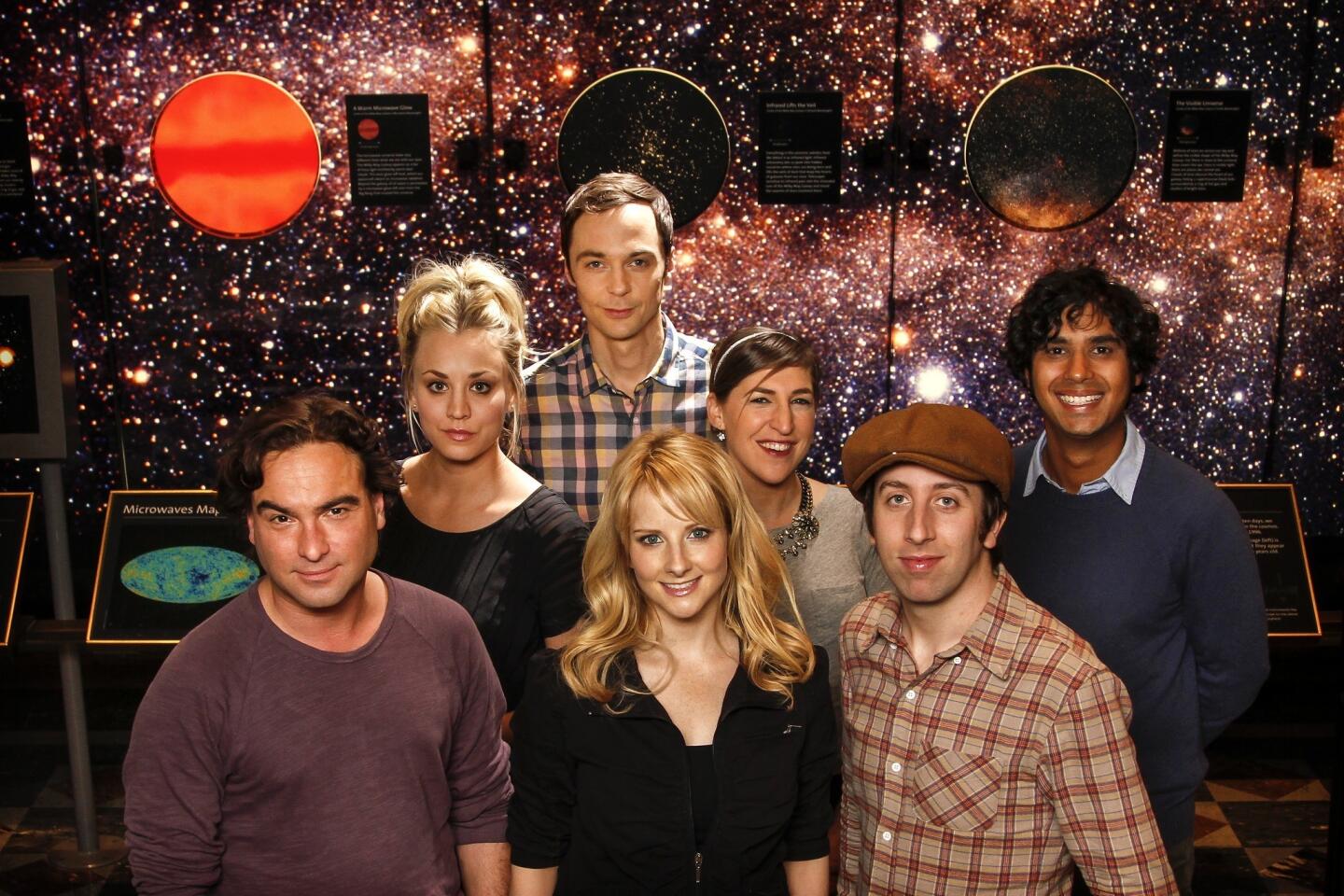
The Big Bang Theory stars JOHNNY GALECKI as Leonard, KALEY CUOCO as Penny, SIMON HELBERG as Howard, KUNAL NAYYAR as Raj, MELISSA RAUCH as Bernadette, MAYIM BIALIK as Amy, and JIM PARSONS as Sheldon.
After six years of reliable situation comedy as the result, primarily, of one well-defined and premise-reflecting character, Season Seven observes Big Bang’s first big drop in quality. By now, the show has fully morphed into a formulaic three-couple sitcom with more generic stories common to this subgenre, personalized mostly by the fact that they’re nerdy scientists, which is now doing the heavy-lifting in plot. This is not merely because the series has run out of ideas to explicitly explore the premise. It’s also because Sheldon, its crowning achievement, is not quite as helpful as he used to be. For one, he’s starting to become pettier and more vindictive. In early years, such behavior was rare — he’d lash out at an illogicality or an injustice that struck him to the core, in evidence of the rigidity over which he did not have full control. Now, however, it’s possible for him to hurt others not unintentionally, but purposefully. This is a shift from his socially graceless character, for it’s not merely that he lacks EQ — actually, he’s grown a lot; now he is more conscious of social norms, so when he’s a jerk, it’s often intentional. It’s an unideal trend — a caricature of his role as the comic nuisance, less supported by his uniquely situation-affirming flaws. However, that issue with Sheldon is symptomatic of a larger problem here at Big Bang’s midpoint. That is, Seven makes obvious — more than any year prior — the narrative stagnation that often plagues these successful rom-coms, where emotional growth for the leads is promised and then halted to sustain elongating runs. For Big Bang, which is about nerdy guys forming healthy social connections, it’s always been vital that this sitcom offer progress on those terms. So, by Seven, when everyone but Raj is romantically happy, the premise feels nearly fulfilled, leaving the only possibilities for future growth attached to clichéd developments like weddings and babies, or for Sheldon/Amy, their first tryst — closure-giving beats that this show, to extend itself, must now strategically delay. And with a forced halt to all progress with Sheldon in particular, it gets tough to explicitly explore the situation in weekly plot. This is the main reason the year disappoints, yielding weaker stories and strain to the characters. Oh, yes, eventually those unimaginative but necessary growth-signifiers will come, but slowly, in the back half of a run that only continues to weaken this show’s capacity for situation comedy.
01) Episode 136: “The Hofstadter Insufficiency” (Aired: 09/26/13)
Sheldon and Penny bond over missing Leonard while he is away at sea.
Teleplay by Eric Kaplan & Jim Reynolds & Steve Holland | Story by Chuck Lorre & Steven Molaro & Tara Hernandez | Directed by Mark Cendrowski

Season Seven’s premiere boasts several decent ideas with a surprisingly keen eye on the characters. Its A-story finds Sheldon and Penny growing closer as they connect over their mutual longing for Leonard, who’s still away at sea. As the regulars most primed to explicitly engage the premise — via the fact that Penny’s casual humanity is the catalyst for evolving the rigid Sheldon into becoming a more empathetic, relationship-capable person — it’s a shame that Sheldon and Penny are no longer paired as often as they once were. Yes, their material here isn’t as sharp as it used to be back when he was less evolved, but with Penny trying to push Sheldon into vulnerability and then hurting his feelings in the process, later having to apologize to him, it’s a smart reversal of the usual dynamic — where Sheldon is the one often doing the offending — and it reinforces their characterizations by playing against them. Meanwhile, the show has wisely dropped the conceit that Raj can only talk to women while drunk — it was always a foolishly imposed self-limitation that kept him narratively ham-stringed — and though it’s been conveniently jettisoned without much motivation, at least it looks like a sign of personal growth.
02) Episode 138: “The Scavenger Vortex” (Aired: 10/03/13)
The group breaks up into pairs to compete in Raj’s scavenger hunt game.
Teleplay by Steven Molaro & Jim Reynolds & Maria Ferrari | Story by Dave Goetsch & Eric Kaplan & Steve Holland | Directed by Mark Cendrowski

Although I could squint and say that a bunch of adults participating in a scavenger hunt is intrinsically nerdy and therefore a reflection of the situation, I fundamentally think this offering indulges a narrative gimmick not motivated uniquely by the characters or the premise, making it on paper, something most shows would be able to do in a similar way. However, I also think it really is a highlight of the year — because it makes the conscious decision to split up the three couples and pair them with counterparts with whom they don’t usually engage directly in story. Well, aside from Sheldon and Penny, that is — they’re the most situation-affirming duo and thus always well-matched, especially in terms of emphasizing Sheldon’s personality. But beyond them, it’s fun to see Bernadette boss around Leonard for a change, while Amy bonds with Howard as they realize they have more in common than they assumed. These new combinations accentuate the characterizations through new juxtapositions, and for the sheer freshness of these pairings alone, “The Scavenger Vortex” is one of this era’s most memorable.
03) Episode 142: “The Proton Displacement” (Aired: 11/07/13)
Sheldon is upset when Professor Proton consults Leonard on a paper instead of him.
Teleplay by Steven Molaro & Eric Kaplan & Jim Reynolds | Story by Chuck Lorre & Maria Ferrari & Anthony Del Broccolo | Directed by Mark Cendrowski

Bob Newhart, coming off an Emmy win for his debut as Professor Proton last season, returns in this installment that finds Sheldon becoming quite the nuisance as he seeks the approval of his boyhood idol. This is already trodden ground — Sheldon has a lot of idols — but Newhart’s Professor Proton is such a well-cast avatar for the series’ scientific identity that he inherently represents the situation, playing to its elemental uniqueness. And because he draws out some of Sheldon’s well-established character traits — like his obsessiveness and childishness — all of Newhart’s appearances tend to be a showcase for Big Bang’s primary comic figure, the one most likely to guarantee a good excursion. As for this outing in particular, we get a glimpse of the year’s pettier, more vindictive Sheldon — see: the cameo by Bill Nye as himself, brought in to rival Professor Proton — but I appreciate how this idea is used to force Sheldon’s acknowledgement of the fact that he can be annoying. This highlights the kind of evolved social understanding that speaks right to the premise — it’s how Sheldon is supposed to be used.
04) Episode 144: “The Thanksgiving Decoupling” (Aired: 11/21/13)
The group spends Thanksgiving at Howard’s, where Sheldon bonds with Bernadette’s dad.
Teleplay by Steven Molaro & Jim Reynolds & Jeremy Howe | Story by Eric Kaplan & Steve Holland & Maria Ferrari | Directed by Mark Cendrowski

The group has dinner at Howard’s house in this Thanksgiving entry that offers nothing truly original or inspired narratively — meaning, there’s nothing here that’s especially creative or individualized to Big Bang. But the half hour itself is steeped in so many things that play to well-known elements of the series that it indeed feels like a genuine sample of it. For starters, the fact that Howard’s mother is cooking the meal is fun, utilizing one of the show’s most well-known recurring gags — a perennially off-screen menace (voiced by Carol Ann Susi), who also represents Howard’s immaturity, from which Bernadette has to help him evolve. Simply by being here, this is an episode of this sitcom. Furthermore, while the return of Penny’s ex Zack (Brian Thomas Smith) is boring and contrived, it’s at least rooted in the series’ continuity, which means it’s also predicated on established specifics. And with Sheldon’s backstory getting fleshed out via the surprising bond he forms with Howard’s father-in-law (Casey Sander), the show’s star character is smartly displayed as well, rendering this, oddly enough, one of Seven’s strongest.
05) Episode 146: “The Cooper Extraction” (Aired: 12/12/13)
The group spends Christmas without Sheldon imagining what life would be like without him.
Teleplay by Jim Reynolds & Steve Holland & Tara Hernandez | Story by Steven Molaro & Eric Kaplan & Maria Ferrari | Directed by Mark Cendrowski

With a sketch-like take on a well-worn Christmas cliché — an homage to It’s A Wonderful Life — this is another excursion with a generic narrative idea that could be found on any sitcom. Fortunately, the individual details here elevate it, for this version is built around Sheldon Cooper. His extreme qualities long ago turned him into the most potent ambassador for Big Bang’s situation, positing him as its nucleus and someone whose centricity in a weekly story naturally displays what makes this series unique. By now, it’s a given that Sheldon is more vital to this cast than both Leonard, the “straight man” bridge between the nerdy guys and the hot girl (the original construct, now abandoned for a three-couple-plus-Raj design), and even Penny, the initial inciting agent who is no longer as directly involved in premise-related plot because the guys’ arcs have progressed beyond her. Accordingly, it is a reflection of the series’ own evolution when a segment like this posits Sheldon as the reason for their being. And with fantasy scenes that, despite their inherent gimmickry, play with the show’s continuity in a way that elementally reinforces its basic identity, this is a memorable, must-include outing.
06) Episode 149: “The Convention Conundrum” (Aired: 01/30/14)
Sheldon pursues James Earl Jones after deciding to host his own Comic Con.
Teleplay by Steven Molaro & Dave Goetsch & Steve Holland | Story by Eric Kaplan & Jim Reynolds & Adam Faberman | Directed by Mark Cendrowski

James Earl Jones guest stars as himself in this episode that looks to cover similar terrain as Professor Proton — with Sheldon acting childlike and obsessive about an idol who speaks precisely to his nerdy interests, which further reiterates his depiction and the basic situation of the series. The main difference is Jones’ casting is a gaudier stunt, for he’s a real star with real sci-fi credentials, as opposed to a fictional character created specifically for this series and in a more personal reflection of the leads’ backstory. Nevertheless, Jones’ presence is also effective, for this is indeed how Big Bang distinguishes itself in this era — it finds something flashy that can accentuate the guys’, and especially Sheldon’s, geeky pursuits, and then builds an entire half hour around it. However, this entry does deserve some credit for its creativity, for it knows enough to play against expectations. Instead of being annoyed like most people over whom Sheldon obsesses, Jones embraces his new fan, which is funny because it’s fresh and surprising while still emphasizing the leading characterization. (Carrie Fisher also appears.)
07) Episode 150: “The Locomotive Manipulation” (Aired: 02/06/14)
Amy plans a romantic train ride on Valentine’s Day with Sheldon.
Teleplay by Steven Molaro & Eric Kaplan & Maria Ferrari | Story by Jim Reynolds & Steve Holland & Tara Hernandez | Directed by Mark Cendrowski

Sheldon kisses Amy seriously and intentionally at the climax of this Valentine’s Day-themed outing that obviously supplies this crescendo as a mile-marker of Sheldon’s arc towards more physical intimacy with his girlfriend — an idea that’s symbolic of his premise-backed evolution into someone more increasingly able to sustain a healthy, “normal” human relationship of real magnitude. It’s the only true forward movement on that front here in Season Seven, which makes it a novelty on this list — one of the year’s only fully premise-exploring showings for the main character. And with a basically fun notion where Amy takes Sheldon on a romantic train ride, only for him to become distracted by a fellow train enthusiast with whom he prefers to make conversation, this is one of the season’s best displays of his characterization as intended, for he’s not trying to annoy her vindictively, he just can’t help himself. That’s the sort of elemental social gracelessness that honors not only his character, but also the premise, rendering this the year’s finest sample for Sheldon and an MVE contender for that reason alone.
08) Episode 151: “The Table Polarization” (Aired: 02/27/14)
Sheldon decides to break up with Amy after Penny points out that she’s changed him.
Teleplay by Chuck Lorre & Jim Reynolds & Steve Holland | Story by Steven Molaro & Maria Ferrari & Tara Hernandez | Directed by Gay Linvill

Ostensibly just another entry in the subcategory of stories about Sheldon’s resistance to change — which emphasizes a rigidity in his personality that makes social connections difficult — “The Table Polarization” is all that and more. That is, it’s also a self-aware examination of how both Sheldon and Leonard have evolved as a result of what the series has always promised to follow regarding their increasing ability to sustain serious relationships with others, especially love interests. Here, Sheldon realizes just how much Leonard has been made different by the influence of Penny — he’s gotten more confident and less self-minimizing to the rest of the world, including to Sheldon, who can no longer exert his will over Leonard as easily. It’s an interesting observation that’s not fully backed up outside this half hour (because the series doesn’t write well for Leonard and Penny anymore — their stuff is too generic), but the idea is right, for this should be the case. Fortunately, what’s better corroborated by the show is the fact that Sheldon has changed since being with Amy. As Penny points out to Sheldon’s own chagrin, he’s now been molded by Amy’s hand, evidenced through his enhanced willingness to indulge physical intimacy (like making out!). That’s a huge progression — particularly for the show’s boldest character, and seeing as he so innately spotlights the ongoing, albeit slowing, exploration of its premise, simply calling attention to his evolution enables ideal situation comedy. Accordingly, I can think of no finer selection this year to choose as my MVE (Most Valuable Episode). There’s plenty flashier on this list, but none more situation-based.
09) Episode 155: “The Relationship Diremption” (Aired: 04/10/14)
Sheldon considers a different field of study while Howard and Bernadette double date with Raj.
Teleplay by Chuck Lorre & Eric Kaplan & Steve Holland | Story by Steven Molaro & Bill Prady & Jim Reynolds | Directed by Mark Cendrowski

This installment earned Jim Parsons his fourth and final Emmy for The Big Bang Theory (which this year also nabbed its last nom for Outstanding Comedy Series). Like all his choices, it’s a selection where the Sheldon character is reiterated in a one-off loosening that reinforces well-set expectations by playing against them. Here, Sheldon is discouraged by advancements in physics that outpace his work, so he considers taking up a different field of study. It’s one of many examples of Seven turning to career pursuits to maintain situation-affiliation, instead of more premise-based relational concerns. But it’s centered around Sheldon and quite funny, especially when he wakes up groggy next to a geology book — the very subject we know he considers to not be a real science. It’s a twist on the trope of a regretful one-night stand, but with a quintessentially Sheldon and therefore Big Bang slant. Meanwhile, I appreciate the subplot where Howard and Bernadette double date with Raj and his new girlfriend Emily (Laura Spencer) — the latter has no discernible personality (Lucy was more comedic), but it’s good to see Howard’s past romantic woes (i.e., his previous social dysfunction) brought back up when it’s revealed he and Emily once had a bad date. It’s affirming for both character and premise.
10) Episode 157: “The Proton Transmogrification” (Aired: 05/01/14)
Sheldon deals with his grief over the death of Professor Proton.
Teleplay by Steven Molaro & Eric Kaplan & Steve Holland | Story by Jim Reynolds & Maria Ferrari & Jeremy Howe | Directed by Mark Cendrowski

Bob Newhart’s Professor Proton dies in this episode, as Sheldon struggles with his grief over the loss of his idol, and eventually, friend. It’s a terrific logline because it forces Sheldon to deal with raw emotions, which plays to the premise of him becoming more in tune with his feelings inside the larger process of learning to form realer, stronger, human bonds. Thus, while it’s not a romantic story about Sheldon’s progression with Amy, it does suggest the situation via his evolution towards greater humanity. What’s more, this is the first time that Professor Proton appears in the holographic style of Obi-Wan Kenobi, a sci-fi reference that not only reflects Sheldon’s character and the tenor of the entire series at large, but also sets up a wonderful recurring gag that’s funnier and more unique than anything the professor could have continued to offer while alive. Accordingly, this is a strong half hour for Sheldon and Big Bang — fundamentally individualized to its own charms. More and more, science/sci-fi and Sheldon are the only things personalizing Big Bang, and that’s going to increasingly prove limiting…
Other episodes that merit mention include: “The Deception Verification,” which has a funny subplot where Howard absorbs estrogen cream, “The Indecision Amalgamation,” which boasts narrative symmetry and thus thematic cohesion, and “The Status Quo Combustion,” which builds to a terribly conceived cliffhanger that nevertheless mines earned dramatic tension from Sheldon’s inability to handle mounting change (like Leonard/Penny’s engagement and what that may mean for the status quo going forward). I’ll also take this space to cite “The Roman Resonance,” where Howard presents Bernadette with a clichéd but memorable romantic gesture, along with two amusing entries where Sheldon is exaggeratedly vindictive in a way that I’d argue stretches his premised characterization, “The Raiders Minimization,” where he tries to hurt Amy for ruining Indiana Jones, and “The Itchy Brain Simulation,” where Sheldon seeks retaliation against Leonard for lying to him. Lastly, I hate the generic A-story but appreciate the Sheldon subplot in “The Hesitation Ramification,” where he attempts to study comedy — an inherently social phenomenon that’s therefore a great play to the premise.

*** The MVE Award for the Best Episode from Season Seven of The Big Bang Theory goes to…
“The Table Polarization”

Come back next week for Season Eight! And stay tuned tomorrow for a new Wildcard!
This is not a bad season but also not a good season in my opinion. Sort of the turning point.
Hi, esoteric1234! Thanks for reading and commenting.
I agree. I think there’s a noticeable slowing down this year of progression in the series’ primary character arcs (relationships) — the only real way that BIG BANG can still, at this late juncture, freshly explicitly explore its situation in story. So, the season is inherently disappointing.
Surprised by mve
Hi, BB! Thanks for reading and commenting.
This was a season without a clear standout for me; instead, I picked the entry that I thought explored the lead character best per the series’ premised terms, and with the most narrative freshness.
lolololol That picture with Sheldon and the geology book is sending me! I totally forgot about that episode.
Hi, GGlor! Thanks for reading and commenting.
It’s a very funny idea — based on what we know of his character!