
Welcome to a new Sitcom Tuesday and the continuation of our coverage on Murphy Brown (1988-1998, CBS). Only the first season is on DVD; check it out soon on Antenna.

An investigative journalist at a D.C. newsmagazine show faces all the trials and tribulations of being a career woman. Murphy Brown stars CANDICE BERGEN as Murphy Brown, FAITH FORD as Corky Sherwood, CHARLES KIMBROUGH as Jim Dial, ROBERT PASTORELLI as Eldin Bernecky, JOE REGALBUTO as Frank Fontana, GRANT SHAUD as Miles Silverberg, and PAT CORLEY as Phil.

Warning: This will be my longest Murphy Brown post… In last week’s commentary debating whether or not the liminal third season deserved to be viewed as the end of the show’s first era (largely based on aesthetics) or the start of a new one (largely based on the use of politics), I made it a point to note that when most people think of the series, the demarcation they use to separate the earliest (best) years from those that follow is both the arrival of baby boy Avery Brown and the departure of creator Diane English for a new series (Love & War, which we’ll be discussing next week) – both of which occur at the end of the fourth season. Despite all that we discussed last time, using these two simultaneously occurring events to symbolize a turning point makes obvious sense; they represent the most tangible shifts in the series’ constitution and are linked with the Dan Quayle debacle, which officially began the day after this year’s finale was broadcast and would have a – spoiler alert – adverse effect on the year ahead. So while I think there’s enough evidence to support both of last week’s arguments regarding era differentiation (and as previously proven, I find them the more interesting topics of discussion), there’s no denying that Season Four itself will prove to be an ending all its own. This was clear at the time; in fact, even without the benefit of hindsight, viewers knew English would be leaving at the end of the year, and it’s obvious, after the premiere, that Murphy Brown will never be a baby-less series following the predictable May Sweeps birth. Those are big show-shifting changes. Furthermore, with the benefit of hindsight, we know that this will be the last year in which Murphy Brown was able to avoid a significant dip in quality. That is, this is the last year in which the series can boast an average – or base level – quality that never drops below what I would qualify as mediocre (which, for our intents and purposes, means of dubious Sitcom Tuesday merit). Additionally, we know that this is the last year before Quayle, which means this is the last year the show can pretend it’s not political… but, once and for all, is Season Four political?

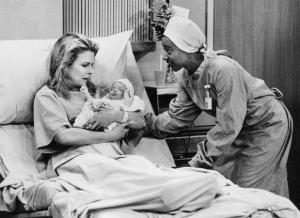
Yes, it allows itself to be. If Season Three found the show, with English emboldened by its upswing in popularity, actively crusading for social relevance – mostly on an episodic basis – then Season Four cements its creator’s evolved objective, for the narrative arc that shapes the entire season invites audiences to view the series politically, suggesting to many that its creator is making a grand cultural statement with implications that will, for some, be taken as political. In other words, by choosing to engage with the single motherhood storyline, English makes the conscious decision to enter into a political debate, for regardless of intention, its inclusion was obviously going to be perceived (by some) as a statement. (Neither intent nor ignorance of implication can be a defense.) Now, I’d like to believe that English didn’t want her show to be too associated with political discourse – yes, she wanted to reflect her socially progressive view of working women in the ‘90s (in which single motherhood was indeed mirrorable) – but otherwise, I’d like to believe her primary reason for inflicting Murphy with an unplanned pregnancy was for the sake of story: the shocking cliffhanger, a season’s worth of conflict (“If Murphy is already difficult, imagine how difficult she’ll be pregnant!”), and a sense of narrative focus that could keep the soon-to-dip series creatively rejuvenated for another year. This makes sense because it fits English’s modus operandi: the arc purports to be character-centric (let’s give Murphy her ultimate conflict), but is actually driven by the mechanics (and potential benefits) of the story. The scenario, if true, would represent the ultimate failure with regard to English’s desire to be The Mary Tyler Moore Show’s successor, for while the ability to make her heroine a single working mom is something that does represent the cultural evolution English aimed to depict, her writing rarely matches the aforementioned show’s ability to motivate its stories through character. This pregnancy arc, then, is the perfect representation of English’s style: writer-imposed… and because it feels writer-imposed, it opens itself up to be political.
I said I’d “like to believe” all of the above with regard to English’s intention, but the fact of the matter is, because the storyline is writer-imposed, that means the rest of her decisions – her style – are called into question as well, forcing us to look back at the way she started preaching (mostly apolitically, but with characters whose beliefs were clearly liberal) in Season Three, began increasing the amount of light, but (perhaps to some) gratuitous jokes about the then-current Republican administration (mostly as a function of Murphy’s own personality flaws, but almost always without any real disagreement), and most importantly, situated her series – from the beginning – upon the notion that Murphy Brown was going to embody the evolution of the working woman – both on TV and in society. All of this could point towards an overarching agenda, which obfuscates English’s ability to convince those with contrasting political opinions that she prizes the nature of the show over her personal beliefs. What’s worse: she lacks the uproarious sense of comedy that helped Norman Lear’s shows – in the beginning, when they were potent and sharp and actually relevant – transcend party lines and be so entertaining that dissenters overlooked the bias and were proud regular viewers. You see, a political point-of-view is fine (it’s often identity-rooted and therefore necessary) – if it can be supported by the entertainment, by the laughs. English never really had that foundation – she’s never gotten Norman Lear style guffaws – which was another strike against the show when she decided, via this unplanned pregnancy, to adopt an elevated (and Lear-ian) social importance. Comedy, like character, can be a justification for anything, but in Murphy Brown, justification often comes from story… and that doesn’t justify a thing. (And neither do splashy cameos – a gimmick that becomes a series hallmark around this time, and despite generally working in these few circumstances, won’t always succeed and already indicates narrative trouble.)

At the risk of going off on a tangent, I think it’s important here to reinforce the tonic that is character-driven comedy, especially when it comes to socially relevant programming. There’s no argument that Norman Lear’s All In The Family was the funniest show on TV in the early ’70s when it could balance its politics alongside the humorous humanity of the characters; when there was too much of either (even too much “humorous humanity” without enough politics, as in the final few years), the show didn’t work because it wasn’t fulfilling its premise obligations. For Murphy Brown, however, Maude is the better point of comparison, due to both shows’ successful (unlike AITF) identity evolutions – one for the better, one for the worse. We’ve been exploring over these past few weeks how Murphy Brown has been transitioning into a more political show, and because it didn’t have either the necessary (it had some, but not enough) character-driven storytelling or character-rooted laughs at the start, these shifts haven’t been favorable. Maude, meanwhile, did the opposite; it started as a highly issue-based show with occasional laughs and ill-defined characters, and then began changing – throughout Season Two, but actualized in Season Three – into a series more comedically satisfying and narratively concentrated on its core players. Both shows suffered from uneven ensembles around what ultimately became viewed as dominating socially symbolic female leads, but the latter series recognized that in order to survive, it needed to pivot away from the politics – away from heavy story-constructs – and build up its players. As a result, it became a better show – not a perfect one; not one with an ensemble strong enough or a reputation for quality high enough to overcome the alienating charges of political topicality that, like Murphy Brown, weakened its standing in syndication, but – one that successfully recognized how to handle its politics: make them character-driven. The two are linked today because of their poor politically-tinged post-run reputations, but one of the two I’d count as a qualitative success story, instructing us in how identity-rooted politics can exist alongside quality character laughs. Because of at least half the seasons still to be discussed of the other series (this series), that compliment can’t be shared.

Ultimately, I find that this show’s politics in Season Four – for many reasons: the narrative focus, the lack of a physical baby, the hand of its creator – don’t do the damage that eventually comes in Season Five when the baby-filled scripts respond to Vice President Dan Quayle, for that’s when the series takes a single part of its identity – its politics – and makes it its whole identity. In effect, the series “leans in” to its political reputation and suffers the consequences. But that’s for next week… right now, it’s important to credit the fourth season for supplying the perspective that ratcheted up those tensions and poised the show for this type of debate. I noted above that Season Four cemented English’s social consciousness by employing the arc that opened itself up for politics… but this all has more to do with English than the arc itself. First, single motherhood was not exclusive to Murphy Brown – Molly Dodd had a kid out of wedlock in 1991, Designing Women had flirted with the idea of having one of its regulars become artificially inseminated, and Cheers was attempting to accommodate Kirstie Alley by exploring a pregnancy arc with Sam and Rebecca that same season – so this was actually a trend: one of the very few into which Murphy Brown actually fit neatly, and because of the show’s growing visibility, it got to serve as the symbolic poster child. Additionally, the series intentionally structured the arc safely – the father was a man to whom Murphy had been married (thus sparing her from being labeled a trollop) and there was little actual entertaining of the idea that the character might go the Maude route (this was when some critics tried to make the two political bedfellows, forcing a connection that only illustrated the direction into which Murphy Brown was allowing its reputation to move — especially post-run). So, as a storyline, this appeared to just be a sensationalistic cliffhanger with which the show now had to reckon. But English, whose style we’ve been tracking, exacerbated the problem with two specific precipitating decisions that made the series ripe for the upcoming Quayle brouhaha…

The first is both the contrived dismissal of the father and the ambiguous, but obvious mitigation of the potential step-father’s presence within the hour-long season premiere (discussed more below). While Jake Lowenstein (Robin Thomas) chooses to leave of his own accord, problems with character motivation leave the entire scene feeling like a rushed plot development – the means to English’s single motherhood end. In other words, it doesn’t make full sense for the character, which then welcomes accusations of writer-imposed agenda-pushing. This is reinforced later with Jerry Gold (Jay Thomas), whose involvement is first made to seem recurring, but then proves insignificant when we only see him once more throughout the year. The way the show handles the two men in Murphy’s life – as pawns for story – opens the door for Quayle and other conservatives’ complaints; had the two been treated with more believability, more humanity (the kind actually afforded to Murphy), critiques would be harder to level. The second thing that made the storyline seem political is the show’s general bolstering of the topical sensibilities we started to observe last season. With an election approaching, jokes about politicians become even more common (this is specifically what contributes to the show’s “datedness”), stories about politics (like Corky and Murphy attending a White House luncheon) increase, and the show’s penchant for preaching – a sermonizing sister to its belief that drama can justify a laugh shortage – become overbearing. An example of the latter is the interminable “Send In The Clowns,” inspired by the Anita Hill scandal, in which Murphy gets to lecture a panel of caricatured senators. It’s hilarious (sarcasm), and marks a sharp difference from episodes like last season’s “Hoarse Play,” and even this year’s “I’m As Much Of A Man As I Ever Was,” which predicate their humor on Murphy’s desire to get a story (instead of “her” beliefs), and mocks its figures without scorning them. So, in amping up its usage of identity-related politics, and at times failing to entertain in the process, the show’s beliefs become fit for discussion and embed the year’s primary arc with its emerging reputation. English paved the political way.

But, as we always wonder, what do these developments do to quality? Well, as most would agree, there is a sorrowful difference between Seasons Four and Five that has as much to do with the latter’s inferiority as the former’s superiority. In fact, many fans (including English herself) consider this one of the show’s strongest; it’s easy to see why – narrative focus is a hook that engenders varying degrees of serialization, draws viewers, and feeds ideas of quality (we’ll also see this with Seinfeld). Now, as regular readers know, I’m not one to let a story or the mere use of serialization count as being inherently good for character without proving the point. In this case, I think English – based on standards she’s set – does a fine job with the way Murphy’s depicted, and given Candice Bergen’s previously discussed reliance on quieter, dramatic moments to suggest substance, this arc works for her. The Television Academy seemed to agree, for Bergen won her third Emmy here, the show won its second (this was, of course, after the Quayle comments, mind you), and Barnet Kellman, who returned to direct the ballyhooed finale – “Birth 101” (which I find too consumed by its own narrative self-importance to enjoy alongside other entries) – was recognized. So, the arc itself isn’t, here, destructive; on the contrary, it works just as intended. The problem, of course, is that we know a baby is coming… Meanwhile, the year’s emphasized politics – while good for the invocation of the series’ premise – come occasionally married to the sanctimonious preaching that English likes to indulge, and this breeds more tonal schizophrenia, as the current staff of writers (which now includes Michael Patrick King) pushes harder for big laughs. They still succeed more often than they fail though, which is a fundamental positive that may not hold much longer… In the meantime, we’re down from past years, but still above this series’ acceptable base level, so I have, as usual, picked ten episodes that I think exemplify this season’s strongest installments. For new fans, this list will give you a place to start. For seasoned fans, there might be a few surprises.

Here are my picks for the ten best episodes of Season Four. (They are in AIRING ORDER.) Remember: installments originally aired in a one-hour block are considered two separate entries.
01) Episode 76: “Uh-Oh (II)” (Aired: 09/16/91)
Murphy worries about her positive pregnancy test.
Story by Diane English & Korby Siamis | Teleplay by Diane English | Directed by Peter Bonerz

Although the opening of the fifth season would prove to be the show’s most buzzworthy premiere (and the highest rated installment from its entire run), I can think of no better Murphy Brown cliffhanger than the one resolved in this offering, which aired first in a one-hour block. Much funnier than the prior season’s finale, both the second and third parts of this “Uh-Oh” trilogy are worthwhile, for not only is this blasted baby story launching with the necessary number of laughs (somewhat of a surprise, incidentally), but the episode capitalizes upon the audience’s natural curiosity without becoming too self-indulgent; we can’t say the same for next season. I recommend both, but Part II (this one) is more exciting than Part III, which despite a funny scene in which Murphy tells the FYI staff her news, is bogged down by Murphy’s scenes with each of her two love interests — both of which, as discussed above, point the show towards trouble (and, in the short-term, don’t bring the laughs). Part II, though: terrific.
02) Episode 78: “I’m As Much Of A Man As I Ever Was” (Aired: 09/23/91)
Murphy is determined to get a quote from the President.
Written by Steven Peterman & Gary Dontzig | Directed by Peter Bonerz

Mentioned above, this is an example of the show’s generally good use of politics. The story concerns itself with a contemporary political figure — but one that modern viewers can identify, the President — and derives the crux of its comedy not from some specific incident or any lampoonable characteristics of a particular person, but on the nature of the lead character herself, whose irascibility (and politics) have hampered her ability to get a quote from the leader of the Free World. Thus, it’s a character-concerned source of humor with which all viewers can connect. Also, this represents the year well — it uses the seasonal narrative, features gratuitous topical references, and is built towards one big block comedy scene (with Murphy and a bike).
03) Episode 79: “Male Call” (Aired: 09/30/91)
Murphy is curious about a “men’s movement.”
Written by Michael Patrick King | Directed by Peter Bonerz

Writer Michael Patrick King, whose numerous credits are overshadowed by his best known work, Sex And The City, starts his two-year Murphy stint with this episode, which will later prove to be quite in keeping with what we’ll know of his own personal style. King is an interesting choice for the series, for while we tend to think of his work as being female-centric, his work here is always more laugh-driven than the higher-ups’ (particularly English’s), making him a valuable asset. The story is good for the premise and provides for easy laughs, and even though the teleplay is broad (especially in the debatably realized climax), because the alchemy of pen and performance is mixed well (as it is here), we come up with an enjoyable, highlightable entry.
04) Episode 82: “The Smiths Go To Washington” (Aired: 10/28/91)
The show tries to acquire a tape of a senator’s indiscretion.
Written by Michael Patrick King | Directed by Peter Bonerz

King has said that his work on this episode — specifically a broad and off-beat joke about a kid being afraid of chairs — is what got him hired full-time on Murphy Brown, and I can see why this offering, even more than his prior effort, would make a case for his talents. For although this is a very story-driven episode from conception, it’s so well-supported by its comedy that we really don’t have time or don’t care to wish that the entry itself was any different, especially when the characters themselves are delivering the laughs. Also, with the subject matter being a senator’s videotaped indiscretion, the show can connect to its D.C./political themes without going overboard. So, all in all, a laugh-heavy, memorable episode from the fourth season.
05) Episode 84: “The Queen Of Soul” (Aired: 11/11/91)
Murphy arranges an interview with Aretha Franklin.
Written by Tom Palmer | Directed by Peter Bonerz

This episode may represent a turning point in the series. While increased popularity — as it does with any show — has continued to make Murphy Brown more and more conscious about its self, its storytelling, and its comedy, it isn’t until this moment, when we have an outing built entirely around a guest star, that it becomes clear that the show has perhaps gone too far: using its identity to traffic in highly promotable gimmicks that otherwise have nothing to do with character-driven fare. Of course, one could argue — and because I obviously like this episode, I will — that Aretha Franklin works on the series because of Murphy’s love for her music (which goes back to the pilot) and that the script is clever enough to guide the action around her, but only use her as the pièce de résistance in a memorable final full-circle scene. So, it’s a hit.
06) Episode 85: “Inside Murphy Brown” (Aired: 11/18/91)
Murphy asks Jim to accompany her to the gynecologist.
Written by Gary Dontzig & Steven Peterman | Directed by Peter Bonerz

If I didn’t select my chosen MVE as this year’s finest, that honor would have gone to this outing, which is a milestone in the pregnancy arc for it reveals to Murphy (and the audience) that she’ll be having a boy. Now, I’m not wowed by these narrative beats or the sentimentality that obviously serves in support, but I am appreciative of the script’s decision to have Jim accompany Murphy to the doctor (as opposed to Eldin, who takes her to Lamaze later in the season), and find the teleplay to be especially comedic. Dontzig and Peterman, who’ve been with the show since Season One, are behind many of the year’s best offerings, asserting themselves as the logical choice to assume English’s reins for Season Five. Great.
07) Episode 90: “Guess Who’s Coming To Luncheon” (Aired: 01/13/92)
Murphy tries to butter up Corky in the hopes of getting an invite to a White House luncheon.
Written by Tom Palmer | Directed by Peter Baldwin

Even from the start, Corky has been a reliable character for both humor and plot, particularly when juxtaposed off the other regulars. She tends to function best, in fact, when paired opposite Murphy (which we first saw back in the second aired episode), and this installment thrives precisely because of the interaction that the premise allows between the two. In her hopes to be invited to a White House luncheon from which she was excluded, Murphy schmoozes Corky into taking her along. The comedy comes from the inversion of Murphy’s attitude towards Corky and the accompanying change in their relationship. As a result of being relationship-driven (despite the broader second act at the White House), this is a winner.
08) Episode 95: “Come Out, Come Out, Wherever You Are” (Aired: 03/04/92)
Miles panics when he has a homoerotic dream about a coworker.
Written by Gary Dontzig & Steven Peterman | Directed by Lee Shallat

As noted above, Dontzig and Peterman are the shining stars of this season, especially when it comes to comedy. Their natural sense of what’s funny (and commitment to keeping the show comedic) is matched with a greater knowledge of the characters that stems from their tenure. This teleplay was nominated for an Emmy and it’s indeed one of the funnier outings here, boasting an inherently amusing premise based around Miles, who early on proved himself to be one of the most conducive players to the broader kind of humor that this entry employs. The story has Miles entering a panic when he has dreams about a gay coworker that everyone — his friends, his therapists — identifies as being homo-erotic. Funny idea, good execution.
09) Episode 96: “Rage Before Beauty” (Aired: 03/16/92)
The network panics when Murphy cuts her hair.
Written by Peter Tolan | Directed by Lee Shallat

Murphy Brown tends to function well when it derives stories not about news, but about being in the news business. With shades of TMTMS in all of these TV related stories, this series nevertheless differentiates itself in a handful of ways — starting with era, and ending with the fact that FYI is on a network, meaning the behind-the-scenes politics are different. What I appreciate about this episode, in addition to its network-focused story about Murphy cutting her hair and shocking her peers, is that it’s a relatively simple idea. There’s really no pomp and circumstance besides the change in hairstyle, which by the way, is obviously a wig (and that’s my only nitpick about this installment — it’s a leap to buy that anyone was fooled).
10) Episode 100: “A Chance Of Showers” (Aired: 05/11/92)
Murphy has a baby shower filled with famous guests.
Written by Michael Patrick King | Directed by Peter Bonerz

More gimmicky cameos? Check. Names that might mean nothing to viewers watching 25 years later? Check. An episode that works? Surprisingly, check. Much like the aforementioned Aretha Franklin show, this offering’s decision to include Katie Couric, Faith Daniels, Joan Lunden, Mary Alice Williams and Paula Zahn all playing themselves indicates the series falling back on an old tried-and-true gimmick. However, there are, once again, excuses that can be made. First, being in the news industry, having actual news personalities on the show just helps lend credibility to the show’s “reality.” Second, this episode is less about the guest stars as it is about Murphy having a baby shower before her impending delivery (which therefore means it feeds into the season’s purpose). And third, it’s the funniest episode here. So while it may embody some problems inherent to this season, because the installment itself is enjoyable, I’m selecting it as my MVE; it represents the season well, but with a greater number of laughs.
Other notable episodes that merit mention here include: “Heartfelt,” a King script with some funny moments for Miles (and was the closest to making the above list — very close), “Murphy Buys The Farm,” a solid ensemble entry that uses its characters well but doesn’t land any terrific laughs, and “He-Ho, He-Ho, It’s Off To Lamaze We Go,” a Dontzig and Peterman script that boasts a more comedic idea than execution (mostly because it chooses to use Eldin instead of someone funnier). Other offerings of more honorable mention variety include King’s “Mission Control,” which finds a few laughs in an overwrought, not believable, and uncomedic premise, and “Be It Ever So Humboldt,” one of the year’s better Frank offerings.

*** The MVE Award for the Best Episode from Season Four of Murphy Brown goes to…..
“A Chance Of Showers”

Come back next Tuesday for the best from the fifth season! And tune in tomorrow for a new Wildcard Wednesday!