
Welcome to a new Sitcom Tuesday! This week, we’re continuing our coverage of Curb Your Enthusiasm (2000-2011; 2017-2024, HBO), which is currently available on DVD and MAX.

Curb Your Enthusiasm stars LARRY DAVID as Larry David. With CHERYL HINES as Cheryl David, JEFF GARLIN as Jeff Greene, and SUSIE ESSMAN as Susie Greene.
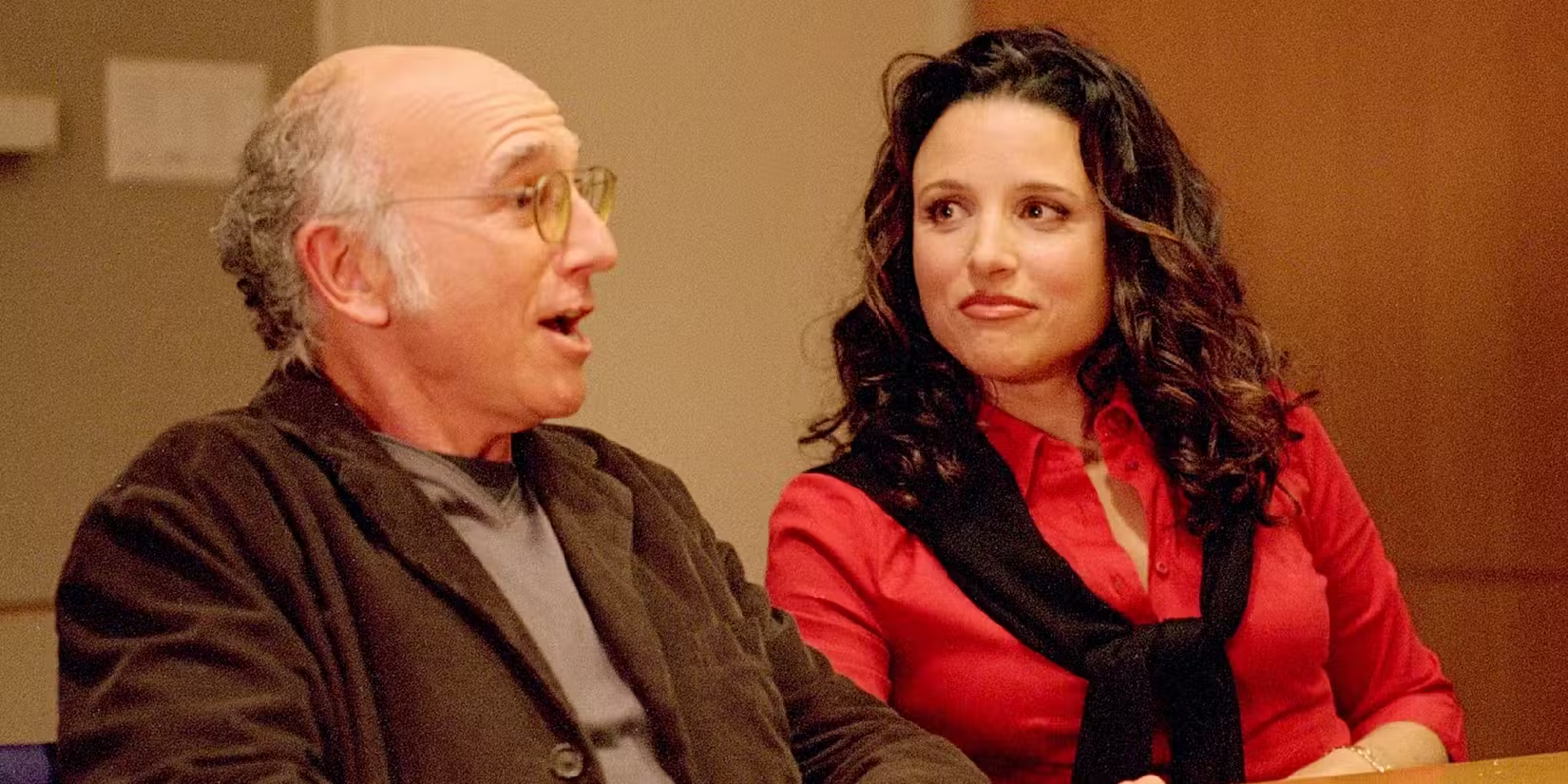
Season Two sees Curb continuing to refine its projection of self. Although this idea-driven show has always had funny ideas, it’s getting better at performing and applying them in story. For one, the cast is more adept now at “retroscripting” — a type of improvisational comedy that works within a narrative outline — for they’re more reliably able to accomplish plot-wise what needs to be accomplished in scenes, with less of the disorienting nervous tension that made Season One feel like it was trying too hard to be off the cuff, which actually emphasized artifice by calling attention to the show’s produced nature, challenging the behind-the-fourth-wall premise that’s vital to its overall ethos. Oh yes, there’s still room for more refinement, but since Curb demands a performance style that only comes from material that doesn’t sound like pre-written text yet nevertheless is focused by characters with purpose, a move closer to this ideal calibration — which I believe exists in Seasons Three and Four — is worth celebrating. Meanwhile, this favorable shifting also aids the storytelling, which is better at interweaving small comic notions so they pay off with hilarious crescendos now that it has believable spontaneity to counteract a plotting that might otherwise seem contrived — too clever, too perfect. That plotting is also aided by the right kind of stories — stories that uphold the situation, like many in Two’s season-long arc about Larry pitching a show for Julia Louis-Dreyfus (after Jason Alexander backs out). This is terrific; the arc not only provides a narrative direction that helps little ideas connect, it also reinforces elements within the series’ situation — namely, the Hollywood setting and its attached metatheatrical implications, along with Larry’s well-established characterization, as his history and personality are so entirely framed around our pre-existing knowledge of Seinfeld that its explicit incorporation in plot brings him to the fore, and it’s something he specifically invites. Every season hereafter will also claim a story arc, but the best of these have a certain show biz bent (it doesn’t even have to be Seinfeld related), for that’s the sort of fare Curb is designed to offer — with its visual style corroborating the single-cam veritas and its meta sensibility. Accordingly, this is a great season — the show is still on the ascent, but it’s already close to peak form, with a handful of strong episodes as a result of its own increasing self-fulfillment.
01) Episode 12: “Thor” (Aired: 09/30/01)
Larry has his tires slashed by an angry professional wrestler.
Directed by Robert B. Weide

Curb’s evolution into the best version of itself continues throughout Season Two, and this episode is another example of the show discovering its best practices with regard to storytelling, as a lot of little threads are woven together here for an entire narrative that feels cohesive and yet not so elaborate or convenient that it strains the aesthetic reality of the series’ situation. Aside from just having funny ideas — like Larry getting accused of being an “ass man” (which is a winking Seinfeld reference) — it’s also an early showcase for a few members of the regular cast, especially Jeff and Susie, who get a mini separation arc this year that grants us a view of their overall dynamic as it’ll basically remain for the rest of the run, even after reconciling. (Jason Alexander appears as himself; Mina Kolb and Louis Nye are back as Jeff’s parents.)
02) Episode 13: “Trick Or Treat” (Aired: 10/07/01)
Larry’s house is vandalized after a dispute with young trick-or-treaters.
Directed by Larry Charles

Although last season had several stylistically formative entries with stellar comic ideas at their core, this is the first installment both plotted and performed in a way that emphasizes these hilarious notions and their hilarious arrangement as a form of situation-based satisfaction in its own right, via a recognizable storytelling apparatus (like Seinfeld’s). As a result, it’s the show’s first selection comparable to what we’ll see in its best seasons (and even up through Eight), with again, funny notions driving the appeal — the best of which mentions the concept of the “social contract,” the exact turf where Larry David likes to play, and on which he sharpens his “real George Costanza” character, for petty social grievances menace him and are often exacerbated by his own doings. This is Curb. (Danny Breen and Zane Lasky also appear.)
03) Episode 17: “The Doll” (Aired: 11/04/01)
Larry must replace the head from a doll that belongs to a network executive’s daughter.
Directed by Robert B. Weide

Long heralded as one of Curb’s early gems, “The Doll” is a half hour that can sometimes get taken for granted today, as there are many more funny offerings with hysterical loglines ahead, once the storytelling structure that Curb is just now perfecting in Two becomes commonplace. But this is easily a standout from this important, show-defining year — and it’s indeed my MVE (Most Valuable Episode) — because it boasts the most masterful look yet at all the series’ core attributes, and with a laugh-a-minute quality that flatters Curb’s reputation for being among the 2000s’ funniest and most comedically worthwhile sitcoms. Its story also involves the year’s primary arc — with Larry trying to sell a new show (starring Seinfeld alum Julia Louis-Dreyfus) — and in addition to satisfying the situation, with a Hollywood meta that both Curb’s premise and very look establishes, this excursion creates dramatic stakes around the success of Larry’s career endeavor, which naturally heightens the comic tension of the social faux pas that he both encourages and can’t avoid. To that point, “The Doll” is a choice display of the amusing ideas on which this series thrives — the bathroom with no lock, for instance, is one of the relatable grievances that then proves disastrous for someone as trivial and prone to misfortune as Larry — yielding Curb-specific success. Also, beyond ideas that work for the show and its central character, both the recurring players and special guests are used smartly as well, especially Rita Wilson as the network executive’s wife, who’s furious when Larry cuts the hair off her daughter’s doll, and Susie, whose combativeness with Larry becomes a series staple, probably due to her hilarity here. So, this is Curb’s first masterpiece — a quintessential showing that deserves its high standing. (Other guests include Jane Carr, Merrin Dungey, and Zach Grenier.)
04) Episode 18: “Shaq” (Aired: 11/11/01)
Larry experiences unusual good fortune after accidentally injuring Shaq.
Directed by Dean Parisot

With a guest appearance by a supersized basketballer who plays himself — in support of the situation-backed metatheatricality that “Larry David as Larry David” encourages — this installment is memorable both for Shaq’s inclusion and for how it exemplifies the way that Curb, in particular, can use such casting to earn its premised identity. Additionally, even though I consider its central idea — of Larry accidentally tripping Shaq and getting blamed for it — to not be as fresh as most of this series’ best, I appreciate that the outing goes against expectations, with Larry finding good luck after the incident, suggesting that he’s stolen Shaq’s karma. It’s a similar notion to Seinfeld’s “The Opposite,” and while I don’t think this entry is as clever or revealing as the aforementioned, it’s very much a show that knows the Larry character and Curb’s unique style of humor. (Joel McKinnon Miller and Aisha Tyler also appear.)
Other episodes in consideration for the above list include “The Shrimp Incident,” which launches Julia Louis-Dreyfus into the arc about Larry pitching a new show; it has several hysterical ideas and is truly a tough one to exclude, for it’s such a good sample of this season. I’ll also take this space to cite the finale, “The Massage,” which concludes this season and its arc.

*** The MVE Award for the Best Episode from Season Two of Curb Your Enthusiasm goes to…
“The Doll”

Come back next week for Season Three! And stay tuned for a new Wildcard Wednesday!