
Welcome to a new Wildcard Wednesday! This week, I’m studying and sharing picks for the best episodic samples from the second season of HBO’s The Comeback, which returned in 2014 for eight more episodes, nine years after its 2005 debut. Though it’s still starring Lisa Kudrow, along with Robert Michael Morris, Damian Young, Laura Silverman, and Lance Barber, I decided to split up my look at this series because I consider the two seasons otherwise different – they exist within the middle of two different decades, were received differently by critics, and embody different trends associated with their respective eras. Naturally, if you haven’t already, I urge you to check out my thoughts on Season One here – a collection that got a mixed response when it premiered, I believe, because the show applied a gimmicky but complicated layering of metatheatricality into its situation for a critique of reality TV that was maybe hard to grasp (utilizing “cringe” humor before it was popular), along with a backstage showbiz premise and easy multi-cam lampoon that, at the time, felt overly familiar and uninspired.

But shortly after its cancellation, The Comeback grew in popularity and became something of a cult classic, gaining an enhanced appreciation for its thoughtful concept and its fascinating central character, brilliantly played by Lisa Kudrow. By the end of the 2000s, media outlets were reflecting on the series as one of the decade’s best. What happened? Well, although Hollywood has never given up its interest in analyzing itself, by removing the show from the specific context of 2005, it no longer got caught up in the redundant, overcrowded glut of formulaic showbiz satires with deliberately applied metatheatricality. This made the situation, overall, fresher and easier to appreciate for its unique charms. Additionally, our perception of reality TV had changed – no longer a tired fad but a major part of the media landscape (especially post-WGA strike in 2007), there was more of an understanding and thus an appetite to see it examined as a venue for produced artifice. What’s more, reality TV had further infiltrated the sitcom format via the mockumentary; The Office had just premiered in 2005, but by the end of the 2000s, many sitcoms were now employing this construct to create their own internal fourth walls, thereby better conditioning audiences to embrace this inherent, omnipresent form of self-awareness. To that point, the show’s too clever nature – and the once alienating “cringe” comedy that came packaged with it – was now a feature not a bug, and simply, better understood, for the high-concept and initially difficult-to-grasp setup of a former sitcom star (played by a real-life former sitcom star) making a reality show about making a new sitcom – and what we’re seeing isn’t the reality show or a single-cam backstager about the reality show, but the “footage” being “shot” for it – became more comprehensible and palatable, and of course, one could study the whole first season as an establishing proof of concept. In that regard, the show was always bound to become more appreciated in a second year – regardless of when that occurred – and this should have been obvious to HBO, a still-elite pay cable channel on which building an audience required time. It only took about a decade, but The Comeback was finally hot enough to receive a comeback, and in front of a crowd now ready to celebrate it.

However, even though it was better received, I personally don’t think the show’s 2014 return is better. In fact, I think the opposite. Nearly a decade later, its situation is weaker as a result of its narrative strain to maintain the meta inside its gimmicky high-concept design, and its comedy is less pronounced thanks to an effort to emphasize a stronger dramatic arc. Both of these shifts play into trends associated with the middle of the 2010s — a less hospitable time for comedic programs in general… For starters, let me explain the updated situation. The season begins with Valerie shooting her own pilot for a potential reality show that she hopes to pitch to Andy Cohen. In the premiere, she learns that her former writer nemesis Paulie G. is producing an HBO dramedy obviously based on his bad experience making the doomed single-season multi-cam “Room And Bored.” She initially intends to tell him off, but in the process, auditions for the role inspired by herself and gets it. Starting in episode two, Valerie brings back Jane, the producer of “The Comeback,” to follow her for online content about the making of this new single-cam HBO dramedy that’s a clear roman à clef about making the sitcom that “The Comeback” first followed her making. A few episodes later, the footage being shot for this web series gets repurposed into a more earnest and formal documentary, which alters some of the look of the production… until the very last few moments of the finale, which I’ll discuss below. So, the season tweaks its situation several times, always evolving its excuse to maintain the layers of meta. There are parts of this I like a lot. For instance, the premiere smartly addresses the changes in reality TV since 2005, and it’s a great, character-backed idea for Valerie to be pitching a show about herself to Bravo. What’s more, the notion of Val shooting a show about herself while she shoots a show based on shooting a show that she shot while shooting another show about herself is exactly the kind of complicated meta that was vital to the series’ premise and definitely a seminal aspect of its reputational distinction. On that alone, Season Two of The Comeback feels like it wants to lean into the image of itself that had calcified on reflection during its hiatus – just as we saw with Curb when it returned after its long six-year gap. Only, this is genuinely smart and intends to uphold some key situational tenets.

That said, I think the show struggles to earn these pivots, along with its attached narrative twists. For one, it’s a tough sell to have Val get cast on this HBO dramedy in the first place. I mean, I’ll buy it because it earns the meta and is a fun notion, setting up opportunities for The Comeback to now mock the conventions of 2010s cable dramedies (which it does, but with less of the scorn it had for multi-cams in the mid-’00s). However, I think it’s an even tougher sell to have Jane come back to shoot… uh, some nebulously defined web material that is so vague it’s unable to suggest a precise lens through which Val’s efforts to make a show about making a show can be conceptualized in plot. I get that it’s probably meant to address the rise in avenues for content given the social media boom – Lisa Kudrow was then starring in her own web series called Web Therapy – but, again, the rules here are not well-defined, and accordingly, it looks less like we’re watching Val make a show about herself while also making a scripted show (as on “The Comeback”), and more like we’re merely watching Val, an actress on a scripted show. That’s a reduction of the idea-driven situation that negates its complexity and feels unintended – like the show can no longer figure out how to narratively utilize its full meta premise and has to simplify, losing some conceptual novelty in its strain to imply it. This turns The Comeback into a more generic single-cam about an actress, and it’s easier to digest – maybe inevitably, but also, consequently. Additionally, while I appreciate the later switch to a documentary format because it’s a more specific framework that can reinforce the meta, it mostly proves to be an excuse for the show to become heavier in tone – embracing a seriousness that was always an undercurrent in the complex Valerie character, only now, unlike before, it’s pushed to the fore at the expense of humor and humorous story beats. This, to me, is a major concession to the 2010s, and the cable dramedy aesthetic it should otherwise want to critique for being just as artificial as other media forms – the multi-cam sitcom, the reality show, etc. By venerating the documentary style as more legitimate – and earnestly so, no irony or commentary – while also embodying the leaden traits we associate with cable dramedies, minus a conceptually congruous wink, The Comeback loses its blistering critique of all media as a home for the egotistical and insecure.

This undermines the thesis of the Valerie Cherish character as an embodiment of this negative pursuit of love through fame, and it’s an unpopular opinion, for most would say she’s more explored here, given her application inside a more dramatic arc about how her desire to be in front of the cameras damages her relationships. But, to that point, if this is supposed to be a rich examination of her character and the premise at large, it mostly just delivers trite marital drama that we could find on any single-cam dramedy about a working woman, independent of the occasionally acknowledged camera crew. Yes, I know that watching as Val’s ego and insecurities blind her to the things in life that really matter has to be a central focus – but all this was already well-invoked in Season One… without the need for an obvious, self-serious plotting that supersedes humor and, with corresponding visual shifts, actually crowds out the situation as much as upholds it, losing the one-of-a-kind specificity it boasted in 2005… Now, I want to be fair; The Comeback is definitely a victim of its first cancellation, for many of my critiques would be allayed if the series had just returned in 2006 or 2007, when the reality show “The Comeback” could have been renewed, thereby avoiding all the narrative maneuverings that weaken this season’s concept, and supplying a more situationally supported buildup to the Valerie/Mark tension. With this gap, the marital drama feels forced and convenient – a predetermined plot that’s less earned because of its disrupted continuity… not to mention the fact that we get a Val who’s less exaggeratedly flawed than before – perhaps more human, but less poised to motivate conflict predicated on her faults: a classic dramedy dilution of character in the name of nuance. In fact, these decisions ensure that the show basically does transition from a comedy to a dramedy in Season Two. In addition to fewer episodes but longer runtimes, this collection offers a dramatic storyline that’s overly evocative of prestige cable and also brings with it a more familiar aesthetic (less visually obvious about its “found footage” conceit), in turn making it harder to address the initial idea-driven situation and its comedic opportunities, which were built on a critique of media that must also include its own contained forms.

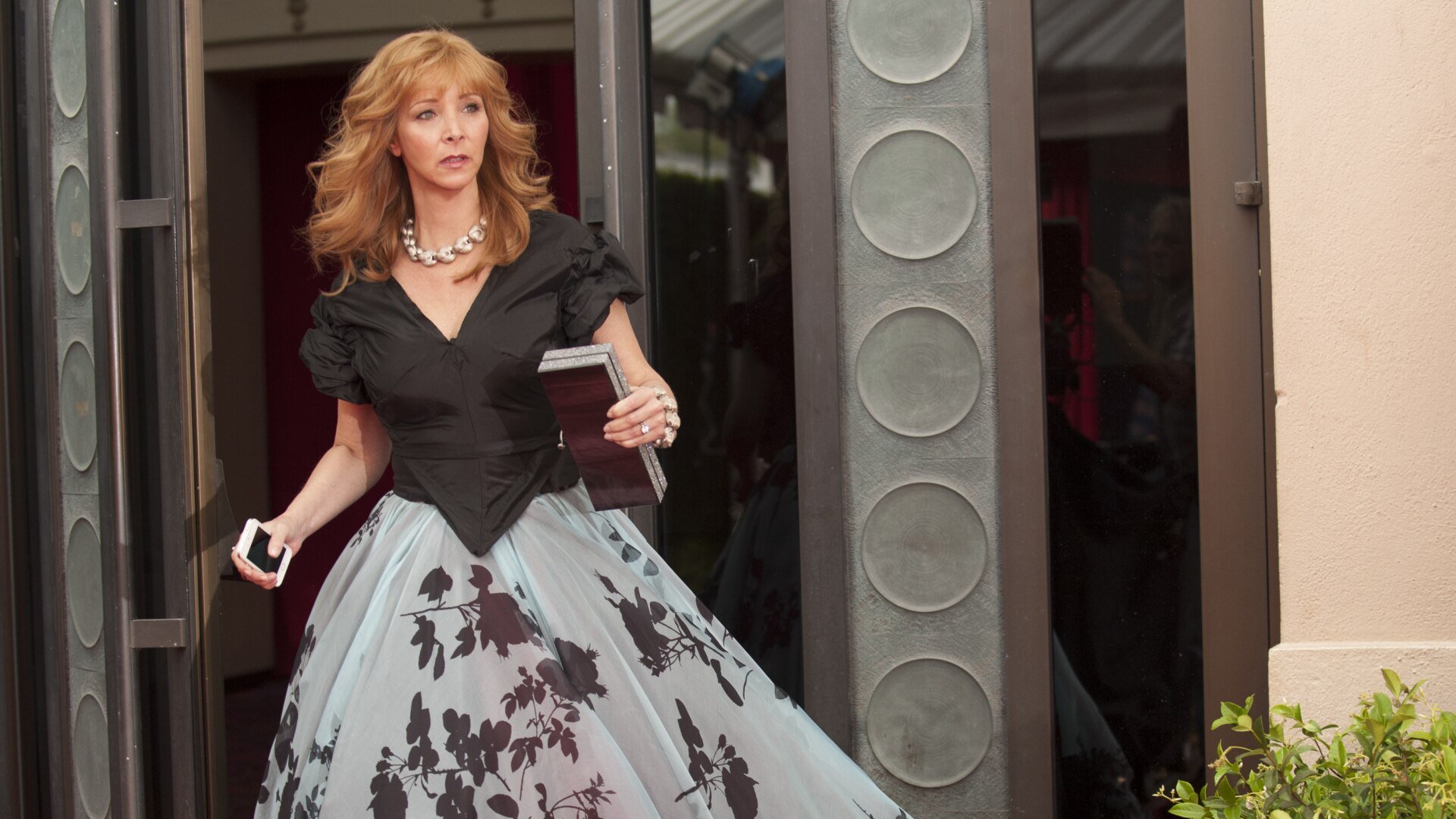
Even if you’re a fan of these changes and don’t see the move away from comedy as innately undesirable, I think it’s hard to view The Comeback’s second season as anything other than a rejection of self, especially given the last 20 minutes of the finale, which drops the pretense that we’re watching “footage” shot for a show or doc and instead becomes a bona fide HBO drama, gorgeously framed and edited, with a centerpiece where Val leaves the Emmys to be with her husband and best friend. I get the gist; it’s a breakthrough – Val abandons her cameras for something more important, her life. Premise fulfilled. But by putting this scene in an authoritative, serious, now-produced lens that evokes the ethos of a big-budget prestige drama, it asks us to believe this gaze is credible. That’s jarring – now we’re implored to consider this form of televised product legitimate, as opposed to everything else – everything! – ever seen on The Comeback (including cable dramedies… which were gingerly spoofed earlier in the season). Okay, you might argue that the difference with all those other lenses is Valerie consents to them – they’re character-approved, so they’re performative – and this one, not approved or known by her, is honest. And it’s supposed to jar. However, this also demands we break from the show’s established pattern of spotting clichés. That is, how are viewers of a show that foundationally has a tongue in its cheek about Hollywood’s artifice supposed to read an overly stylized, visually pristine set piece — where a begowned Val hurries in the conveniently pouring rain to reach a hospital where the two most important people in her life are waiting — as anything other than a too-perfect dramatic contrivance indicative of a manufactured form? (This might as well be a season finale of Sex And The City, or that show’s painfully self-important 2020s revival, And Just Like That…, which reveals the humorless track on which head writer Michael Patrick King has been moving in the last two decades.) It’s just as overly produced as anything else, only now we’re asked to set aside the metatheatrical media criticism previously encouraged as part of The Comeback’s situation for a justification of its own heavy hand. This negates the situation and deflates the drama, for Val’s arc is undermined by a false distinction that requires a real one.
Am I too tough on this season? Maybe. Lisa Kudrow is customarily sublime and there are moments of inspiration in this brief collection. And since it didn’t intend to continue, perhaps I shouldn’t care that the series fatally discredits its premise — its self-destruction is purposeful and without future consequence. But I can’t ignore how the second season of The Comeback seems to misunderstand what initially made the series great, for its situation and its comedy are undercut in accordance with then-contemporary trends that assert the primacy of another aesthetic formula, the deference to which opposes its once premised perspective that all cameras provide a playground for ego (a way to seek love), which is especially corrupting to any individual in an industry as fake and brutal as television. This unideal compromise isn’t only made glaring by the bold, deliberate shift at the end, it’s also felt throughout the year, given the hit-and-miss projection of its foundational meta, which is encroached upon by an authoritative single-cam style more familiar to many cable dramedies of the time. And more than affronting my personal beliefs regarding comedy’s essentiality, I think this isn’t what the show wants to be — it’s no longer an innovative examination of a unique character through a complicated yet precise lens that genuinely critiques the culture; it’s now a faux-complicated and sometimes simplified acolyte of qualities its new era, the mid-2010s, was guaranteed to celebrate. Seemingly more thoughtful in terms of character, it’s actually not, for Val’s usage is predictable and a lot easier to digest, in part because of the idea-driven concept’s own erosion… Oh, I still think The Comeback is one of the best shows ever made about showbiz, but that’s only because of its 2005 first season, which established a sophisticated metatheatricality that began as a value-adding tool before devolving, here, into a hard-to-maintain situational hurdle. That duality is evident in the episodes below; I’m highlighting the three (of eight) that I think represent what this season does best. You’ll note that they all come from before the year unfortunately descends into something more conventionally uncomedic and narratively safe within HBO’s brand identity from the mid-2010s, where The Comeback was less conceptually difficult but ultimately less special.
01) Episode 14: “Valerie Makes A Pilot” (Aired: 11/09/14)
Valerie shoots a pilot for a reality show that she hopes to pitch to Andy Cohen.
Written by Michael Patrick King & Lisa Kudrow | Directed by Michael Patrick King

As noted above, Season Two’s premiere smartly addresses the changes in reality TV since 2005 by creating a backstory about Valerie’s failed post-“Comeback” attempts to get back on television, and then follows her efforts to land a reality show on Bravo, the current venue for middle-aged women eager to be in front of a camera. Although this entry has to labor a bit to set up the season’s metatheatrical idea that Valerie will end up playing a version of herself in a dramedy inspired by her experiences on “Room And Bored,” it’s a funny and unique way to maintain this important aspect of the situation, and it works — blending the old and the new. (Also, there are several celebrity cameos here — most notably Andy Cohen.)
02) Episode 16: “Valerie Is Brought To Her Knees” (Aired: 11/23/14)
Valerie is subjected to humiliations on the set of her new HBO series, “Seeing Red.”
Written by Amy B. Harris | Directed by John Riggi

Of all the episodes here, this one boasts the most insightful critique of single-camera HBO dramedies from the mid-2010s, as Val, per her established definition, remains willing to humiliate herself and accept discomfort… all for the sake of a successful TV endeavor. Indeed, this is a straightforward backstage excursion akin to what we saw the show do with multi-cams in Season One, only now, it’s using the tropes familiar to this particular style of programming, such as gratuitous sexuality and superfluous cursing. Meanwhile, this offering also provides an accurate snapshot of what I discussed above regarding the show’s struggle to maintain the metatheatricality in its very premise, instead adjusting itself to be a more straightforward single-cam dramedy about an actress working in Hollywood, sans a more complex but specific lens, for the web show Val is shooting while also shooting the cable show is much less relevant to the story or the comedy. (Seth Rogen appears as a version of himself.)
03) Episode 18: “Valerie Is Taken Seriously” (Aired: 12/07/14)
Valerie is worried about what a critic thinks of her work in the yet-to-air HBO show.
Written by John Riggi | Directed by John Riggi

This is the midpoint of the season, the pivot where it’s going to start getting more serious, in accordance with both its main narrative arc, which here finds Mark moving out of the house, and the evolving visual aesthetic used to help corroborate these shifts — as the project for which these cameras have been following Valerie now transitions into a documentary, which invites a less casual, more formal look, thereby justifying the slow adoption of a more serious and authoritative (but less unique) frame over the rest of the season. But what I like about this outing, aside from being indicative of what’s to come, is that it’s also a decent display of the Val character, who doesn’t know what to make of a critic’s casual review — a sign that she still has a warped perception of herself, something that the cameras, and her pursuit of validation through fame, can never fully correct. Additionally, the CGI monster sequence feels like an update of Season One’s cupcake shtick. So, this is a telling representation of the series… in flux.
Other notable episodes that merit mention include: “Valerie Tries To Get Yesterday Back,” a jokier entry that has to contort itself to reintroduce Jane. And, yeah, I guess I should cite the last three segments, which are celebrated for their well-played but situationally self-destructive and humor-superseding drama, “Valerie Cooks In The Desert,” “Valerie Faces The Critics,” and the finale that I discussed above, “Valerie Gets What She Really Wants.”

Come back next week for a new Wildcard! And stay tuned Tuesday for more sitcom fun!