
Welcome to a new Sitcom Tuesday! This week, before my look at The Big Bang Theory, I’m finally getting around to the second (and seemingly final) season of Paramount Plus’ revival of Frasier, which is currently available on… Paramount Plus!

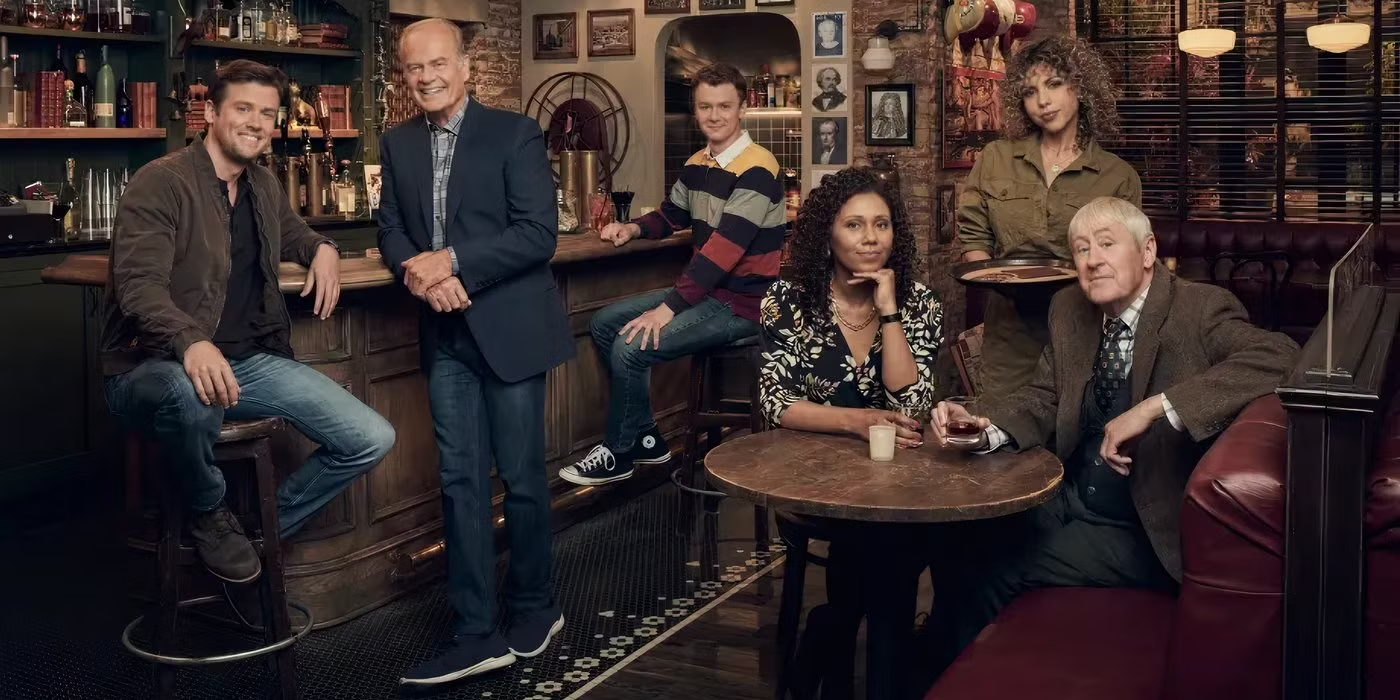
Frasier stars KELSEY GRAMMER as Frasier, JACK CUTMORE-SCOTT as Freddy, TOKS OLAGUNDOYE as Olivia, JESS SALGUEIRO as Eve, ANDERS KEITH as David, and NICHOLAS LYNDHURST as Alan. With PERI GILPIN as Roz.
With Paramount Plus’ 2023 revival of Frasier seemingly canned, this look at the best episodes from its fall 2024 second season could easily be an autopsy or postmortem, explaining why the series creatively faltered. But the truth is, while I agree it naturally disappointed compared to its original namesake, as far as these twenty-first century reboots (or revivals) go, the new Frasier sat at a higher baseline of quality than most of its resurrected peers. What’s more, this second season was an improvement over its first, and that’s what I want to focus on in this entry — how this collection fares in relation to its freshman predecessor. If you’ll recall from my January 2024 essay on Season One, I outlined four main points on why I think this revival was poised to inevitably fall short of the original, particularly in terms of its ability to sustain a healthy run of genuinely good situation comedy. The first point had to do with its design, and primarily, the absence of a Niles-like character to dimensionalize the fraught odd-couple father/son dynamic between Frasier and Freddy, which was a clear parallel to the original’s Martin and Frasier. Well, there’s no character like Niles that this second season adds to make the show more comparable by way of the first series’ richer familial chemistry, and though many of the similarly overeducated snobs in the ensemble (Alan, Olivia, David) continue to be maneuvered in a way that occasionally lets Frasier become more of a middle ground, in this series’ central construct — the family — he’s still an extreme without a stronger force to nuance him. And instead, the show relies on our decades of familiarity with his character to supply a moderating depth that isn’t ever generated by the revival itself. But that’s an inherent benefit to all these “reboots” — the carried-over characters have already been established and made resonant to the audience, so there’s less that must be done in the present to make them interesting.

That brings me to my second point — the disparity in strength between the old and new leads. It still exists in Two — this show’s own creations are less pinpointably definable and therefore less capable of generating specific laughs and story situated exactly on their known depictions… However, I have to say there’s improvement with everyone. Freddy, in particular, works better now when he’s allowed to exhibit an innate duality, emphasized in the moments where he finds himself acting like his father. Such instances of comic compatibility prevent him from being a boring “straight man” and grant him definition outside of being a Martin proxy. Meanwhile, characters like Eve and David remain more single-dimensional, but they (especially David, the junior Niles) have personalities that can at least be labeled. And as Nicholas Lyndhurst’s Alan continues to be the most helpful newbie because of his stated history with Frasier and his positioning as a sidekick sounding board, the show’s weakest regular — Olivia — even starts to come into view by the end of this collection, courtesy of a few stories that accentuate her quirks, letting her also be similar to Frasier as an exaggerated academic. So, while overall, there’s an obvious tier between Frasier and the still-new characters whom we barely know, it’s a lot better than it was in Season One. And that speaks to my third point about this revival — season orders of ten episodes each are too small for the sitcom genre, which is predicated on consistency. It takes time to cultivate nuanced characters — they’re built through repetition via practiced utilization within narrative, which refines their definitions (clarifying and expanding them through details), thereby opening them up to color or inspire even more stories.
That’s the kind of self-perpetuation that sustains a long run — elements of a situation being able to intrinsically and reliably provide lots of ideas. With only ten scripts per year, these characters don’t get the exercise to suggest such utility. And that continues to be true here, in this second ten-episode season, bringing the revival’s full count up to only 20, four fewer than the first season of the original series. This is a shame, for you can see how much better these new characters, and the revival itself, feel by episode 20 compared to episode 10. Now imagine if at the end of two years, the show had been past episode 40. All these leads would be better defined, and more likely to continue on in a third season. With limited chance to develop in episodic stories, situation comedy is harder to deliver, and premature termination is somewhat self-fulfilling… Speaking of which, my last point about the revival is that it was relying too much on our nostalgia for the original, instead of cultivating value unique to this new series. Well, I’m afraid that critique still stands, and frankly, it seems to have been accelerated. Although there’s less melancholy schmaltz about Martin’s death, references to the original show are more explicit than ever in plot. Roz Doyle (Peri Gilpin), who showed up in Season One’s finale, recurs in five of this year’s ten episodes. (Her now-adult daughter Alice appears in two, played by Greer Grammer.) In one of those five, Frasier returns to KACL in Seattle and visits Bulldog and Gil — an explicit throwback to the original Frasier. And in still another entry, Frasier reunites with Bebe Glazer (Harriet Sansom Harris). That’s over half the season explicitly calling back to the original series, putting the bulk of its narrative interests in things previously developed instead of anything first cultivated here. Or, in less extreme terms, these episodes use the crutch of familiar elements to compensate for and distract from the newer ones that are weaker.

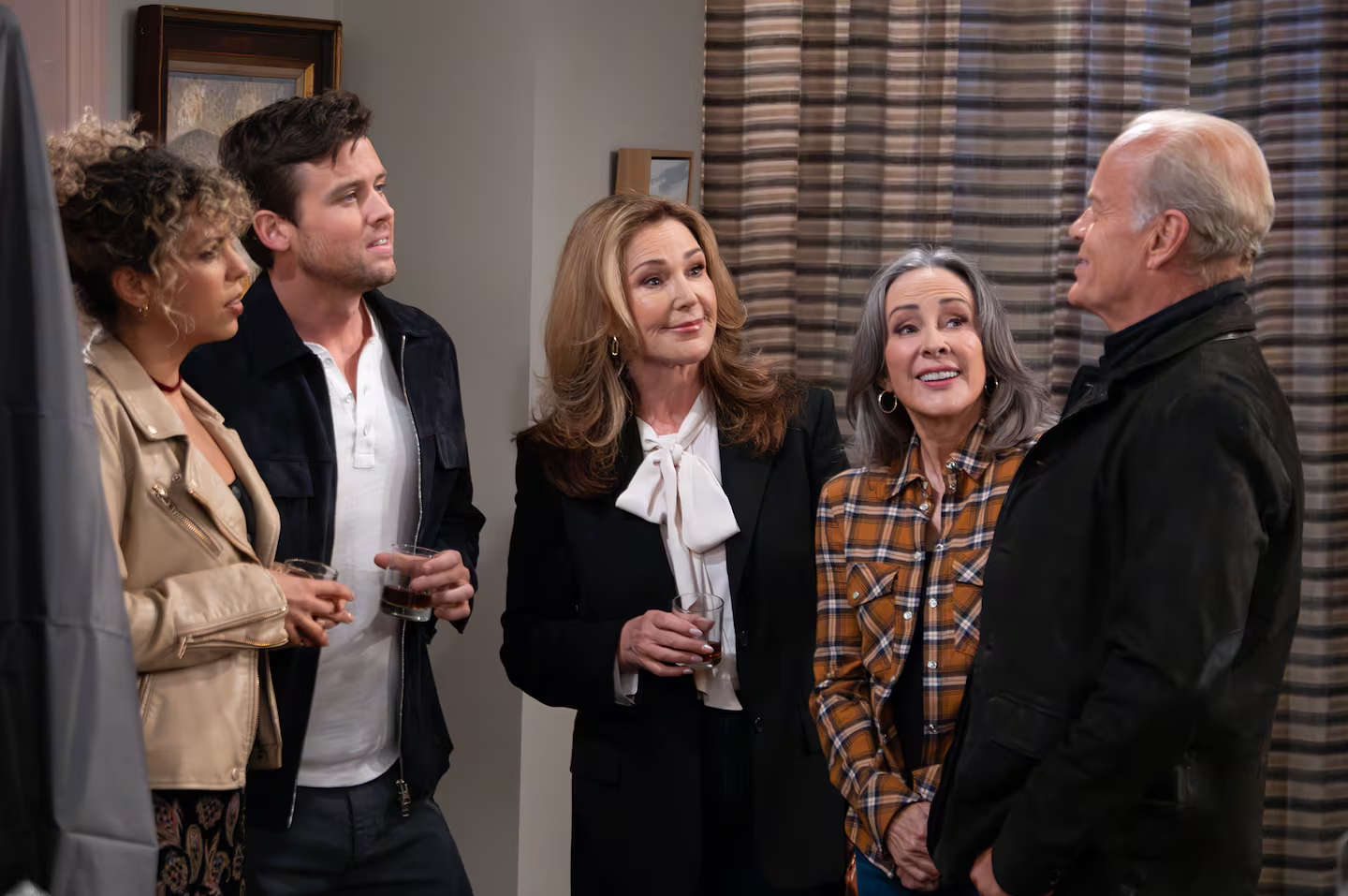
To wit, Roz often ends up being Frasier’s natural sidekick, usurping Alan in that role, and sometimes even Freddy, who’s otherwise one half of the series’ emotional nucleus. It’s perhaps what viewers want — this whole reboot exists for the purpose of making money on happy memories. Again, this crowds out the new elements, giving them less time to develop the presence necessary to themselves one day offer the same. But that’s intentional; a big reason this season is more enjoyable than the first is because it feels more like the first Frasier, with less focus on the parts of the new series — like the new leads — that don’t compare as well, plus more emphasis on the narrative style and actual characters from the original. Heck, Frasier himself is even more centralized in plot this year (e.g., he gets a three-episode love interest in the form of Patricia Heaton, Kelsey Grammer’s former Back To You costar, playing a plain-talking but opera-versed bartender.) So, in essence, the second season of the Frasier reboot improves upon the first because it leans more on its strengths, even if they aren’t original to the revival. And although this suggests a sitcom that’s not capable of sustaining a long run — just a couple seasonal orders of ten-episodes each — I’m afraid that was again a self-fulfilling inevitability, for after 20 episodes, it no longer needed to generate anything more. This is it… and hey, as far as these revivals go, I think Frasier’s was one of the best. The four entries I’m highlighting below are a lot of fun — much better than those from the first list — and in complete honesty, I enjoy them, not just because I love Frasier, but also because I love the sitcom form, and had this new show been able to truly develop like the genre requires, the improvements with the new elements here would have likely been exponentially greater and potentially worthy of standing alongside the original on its own merits (or at least, partially). Oh, well. It’s the era we’re in… and the era from which the nostalgic Frasier 2.0 allowed us, on brief occasions, to escape.
01) Episode 15: “The Squash Courtship Of Freddy’s Father” (Released: 10/10/24)
Frasier is worried after bonding with his former agent’s daughter, who seems exactly like him.
Written by Sasha Stroman | Directed by Jude Weng

Harriet Sansom Harris’ Bebe guests here — she’s a reminder of the original series that exemplifies how this season leans even heavier on the revival’s predecessor to generate episodic value. However, I highlight this entry not just because it’s fun to see Bebe again, but because of its new elements — including Rachel Bloom as Bebe’s equally scheming daughter, whom Frasier is temporarily led to believe may be his from a tryst with Bebe back in 1995 (as seen on the original Frasier). Bloom is funny and deployed here as a contrast to Freddy, who’s seemingly Frasier’s opposite… until a climax where he behaves exactly like his dad, thereby emphasizing the innate DNA that helps make Freddy a more complex character (he’s Martin and Frasier combined), and their relationship, the revival’s emotional nucleus, can perhaps then become more than just an inferior replacement for Frasier’s old dynamic with Martin.
02) Episode 16: “Cape Cod” (Released: 10/17/24)
Frasier enlists Roz in helping him matchmake with Freddy and Eve.
Written by Joe Cristalli & Chris Harris | Directed by Sheldon Epps

There are several farces in the revival’s second season that very consciously attempt to replicate the comedic rhythms and most familiar narrative template of the original series, which was known for its intricately plotted misunderstandings — an earned manifestation of the Frasier character and his own stylistic sensibilities as a highfalutin romantic. This is the best of them, with a story where Frasier teams up with his old pal Roz (in deliberate evocation of the original series) to help play matchmaker for his son and Eve — a mission complicated by both their mistaken belief that Frasier is making a play for Roz, and a visit by Roz’s now-adult daughter Alice (Greer Grammer), who likes Freddy despite David liking her. As you can see, all the ingredients are present and arranged here for maximum comic hay, and even though it’s not quite as well written — and the younger actors aren’t nearly as adept at sustaining the delicate comedy — it feels enough like the original series to be appreciated as a successful effort.
03) Episode 19: “Murder Most Finch” (Released: 11/07/24)
Frasier brings his new girlfriend to Olivia’s lame murder mystery party.
Teleplay by Eliot Fish & Allison Gilbert | Story by Allison Gilbert & Katharine Konietzko | Directed by Sheldon Epps

A murder mystery party is a classic Frasier-like centerpiece that again exhibits how Season Two is more intentionally seeking to play to what its audience wants and the known, pre-established strengths of its situation. Truly, this version is not sublime as far as this category of sitcom story goes (I’ve seen a lot of murder mystery parties in my day, kids), but I appreciate how it utilizes the individual definitions of the main characters, including Olivia, who finally feels more fleshed out from personalized details that render her both quirkier and more compatible as a friend of Frasier’s. The half hour also benefits from Patricia Heaton as Holly, Frasier’s new girlfriend, who seems uncomfortable at a party with all these intellectuals — a fact that emphasizes her own definition and naturally depends on Frasier’s as well. (Parvesh Cheena guests.)
04) Episode 20: “Father Christmas” (Released: 11/14/24)
Frasier tries to reunite Alan with his estranged daughter at Christmas.
Written by Bob Daily | Directed by Kelsey Grammer

My choice for this year’s Most Valuable Episode (MVE), “Father Christmas” is the second season’s finale, and likely the series finale of this ultimately short-lived reboot. It actually works well in that conclusive capacity though, for it offers a happy ending in the arc of Frasier’s regenerated relationship with Freddy — the core emotional tentpole of the situation and the revival’s narrative raison d’être. Here, that situation is explored in a less comedic but nevertheless thematically appropriate story where Frasier, ever the meddler, tries to reunite Alan with his estranged daughter. It’s an idea that enables support from Freddy, who speaks to his own experience — the premise of this series — and then realizes how he’s got more of his father in him than he wants to admit, via a shared love of helping that further bonds them and allows the show to end with father and son closer than ever. Had there been a Season Three, it would have been fun to see the two, as Frasier suggested, act more as a team; now that Freddy is less Martin and more a mix of Martin/Frasier, he’s more ready to be a bona fide sidekick. But alas, a sitcom like Frasier wasn’t meant to survive the streaming era with this kind of model. And I’m afraid this is where we must leave, for the third time, Dr. Frasier Crane.
Other notable episodes that merit mention include: “My Brilliant Sister,” which also has farcical ideas flowing as it tries to develop the Olivia character, and “Thank You, Dr. Crane,” which ostentatiously takes Frasier and Roz back to KACL in Seattle to reunite with Bulldog and Gil — a forced tribute to the original series.

*** The MVE Award for the Best Episode from Season Two of the Frasier Revival goes to…
“Father Christmas”

Come back next week for more sitcom fun! And stay tuned tomorrow for a new Wildcard!