
Welcome to a new Sitcom Tuesday! This week, I’m concluding my coverage of How I Met Your Mother (2005-2014, CBS), which is currently available on DVD and streaming.

How I Met Your Mother stars JOSH RADNOR as Ted Mosby, JASON SEGEL as Marshall Eriksen, COBIE SMULDERS as Robin Scherbatsky, NEIL PATRICK HARRIS as Barney Stinson, and ALYSON HANNIGAN as Lily Aldrin. With CRISTIN MILIOTI as The Mother.

There’s a boldness to the choices made in How I Met Your Mother’s ninth season that I appreciate, especially compared to its most recent predecessors. For starters, it’s intrinsically more poised for satisfying situation comedy based on the terms of the high-concept premise, which claims to explore how its main character arrives at a pre-established narrative endgame — meeting the mother of his kids — because now he’s finally about to meet her. (And it was clear going in that this was the absolute final season.) We even get to follow The Mother at long last — she’s played by Cristin Milioti, whose face was first shown at the end of Eight and who cleverly recurs throughout Nine as each of the leads bumps into her before Ted does. The show really lucked out with its casting here — Milioti exudes likability, has strong and believable chemistry with Josh Radnor, and essentially makes her late debut worth the wait (which was no guarantee). Now, with her actually present and part of Nine, as their fateful meeting draws nearer, Mother reignites heavy anticipation and therefore feels like it’s directly playing to its premise. But there’s good news and bad news. You see, with Eight ending on everyone heading to the Barney/Robin wedding that we know is going to have something to do with Ted’s meeting of The Mother, Nine opts to keep this plot point affiliated with their endgame and has the first 22 episodes of this 24-episode season taking place during the 55 hours prior to this momentously teased event. That is, unlike past years of Mother that stayed chronologically true to the calendar, Nine tells what happened in one weekend. This is a gaudy but inherently exciting gimmick that’s allowed within the situation because it indicates the high-concept setup of Ted narrating a long-form tale to his kids. And, heck, gaudy non-traditional frameworks for storytelling have forever been a series-defining way that Mother has reflected its own identity. I also appreciate that it’s a challenging narrative template — forcing the writers to come up with a year’s worth of story not shaped around big plot turns (outside of the two that we know are forthcoming), and this sort of requires more of a focus on the characters and their individual relationships in a few tight, limited settings. Plus, it’s also a chance for the series to flex its pronounced continuity muscles, treating Nine’s plot like an old-fashioned serial, where the narrative is literally ongoing.

However, this is a sitcom not a serial, and in practice, this granular pacing turns out to be a problem of its own. Not only is it the gimmick of all gimmicks — a display of exaggerated flair that redirects value away from the characters and even the plot — but the show does struggle to come up with a year’s worth of funny, interesting ideas that justify this bold narrative choice (particularly in Nine’s first half, when Marshall is separated from the rest of the cast to accommodate Jason Segel’s film career — a condition of this last renewal). What’s more, if the plotting felt slow before, building an entire season towards one event — an event that’s also been teased throughout the past three years too — makes Nine especially plodding, for we’re so close, closer than ever… and yet still so far. And after a few weeks where this gimmick is exciting, it quickly dawns just how excruciatingly sluggish this year will be, which is bad for a series whose premise demands forward plot progression — sheer movement — as a sign of its own satisfaction. To that point, Mother’s ninth season looks like naturally better situation comedy than, say, most of Seven and Eight, because we actually see The Mother and we’re so near to the now-definitively established finish line of Ted meeting her, that the premise is therefore fundamentally engaged with on a regular basis, even just through flash-forward teases. And its extra-ostentatious storytelling is a foundationally appropriate reflection of this dramatically focused, narrator-guided series and its chosen situation, which has always used the way its plot is told as an encapsulation of its own unique sensibilities. Unfortunately, the year’s sitcommery is undercut by the simple quality of these episodes and the basic fatigue that’s plaguing the characters and the premise at this late juncture. As usual, the show is a victim of its earned success — it’s gone on too long. Had there not been one more renewal, Eight would have likely ended with the wedding and mother-meeting in a two-parter. So, this is quite the fateful season. In fact, giving us a whole year with the brilliantly cast and charmingly played Mother, while accentuating a presumably happy ending for Barney/Robin via, what every single episode makes us anticipate, their wedding — as Neil Patrick Harris and Cobie Smulders’ own chemistry also grows — ensures that the series’ implemented finale lands differently… or rather, worse.

After Nine, of course fans would be shocked by a one-hour finale that quickly rushes through the implied happy endings of both couples and then destroys them — divorcing Robin and Barney, and killing off The Mother — all to deliver the real ending of Ted pursuing Robin again, after she’s now realized that she should be with him instead. Oh, sure, it’s easy to say with hindsight that there were clues. There absolutely were — one episode in Season Eight and another a few weeks before Nine’s finale depicted Future Ted as notably melancholy with regard to The Mother. And as for Ted/Robin, they were positioned in the pilot and throughout those early formative years as the series’ main couple — the Ross/Rachel — and even though it was annoying that the show kept circling back to re-cement just how much he was still in love with her despite her loving Barney and not being The Mother, Ted himself was certainly much more consumed with love for Robin during this series than love for the future mother of his kids. Thus, what initially seemed like a symbol of growth and something Ted would need to evolve beyond in order to get his happy ending — his love of Robin — secretly was the point of the whole story. That’s, honestly, a cool re-contextualization of perspective that is supported by the show’s premise — the ultimate evidence of this biased, unreliable narrator, enabled by the high-concept. So, I get it. And frankly, it’s clever. On paper. But it’s not the ending that I think the show itself, at the close of its ninth season, wanted or earned, for it resorts to outdated plans from the earliest years and ignores what the regulars revealed in actual practice — honoring, instead, a couple that hasn’t formally existed since Season Two, all at the expense of pairings that had, since then, developed better chemistry and portended more precise character value. Specifically, although Barney and Robin’s initial fifth season relationship was hastily imploded before their mutual growth potential could be actualized, Mother has spent its last four years predicting their wedding — explicitly in the last two, where we were encouraged to root for them because we were also rooting for premise-fulfillment via Ted and the mom. And during that time, Barney/Robin became a more well-matched couple than Ted/Robin, regardless of Ted’s feelings, which again, looked more like a weakness he needed to overcome, not shelve.
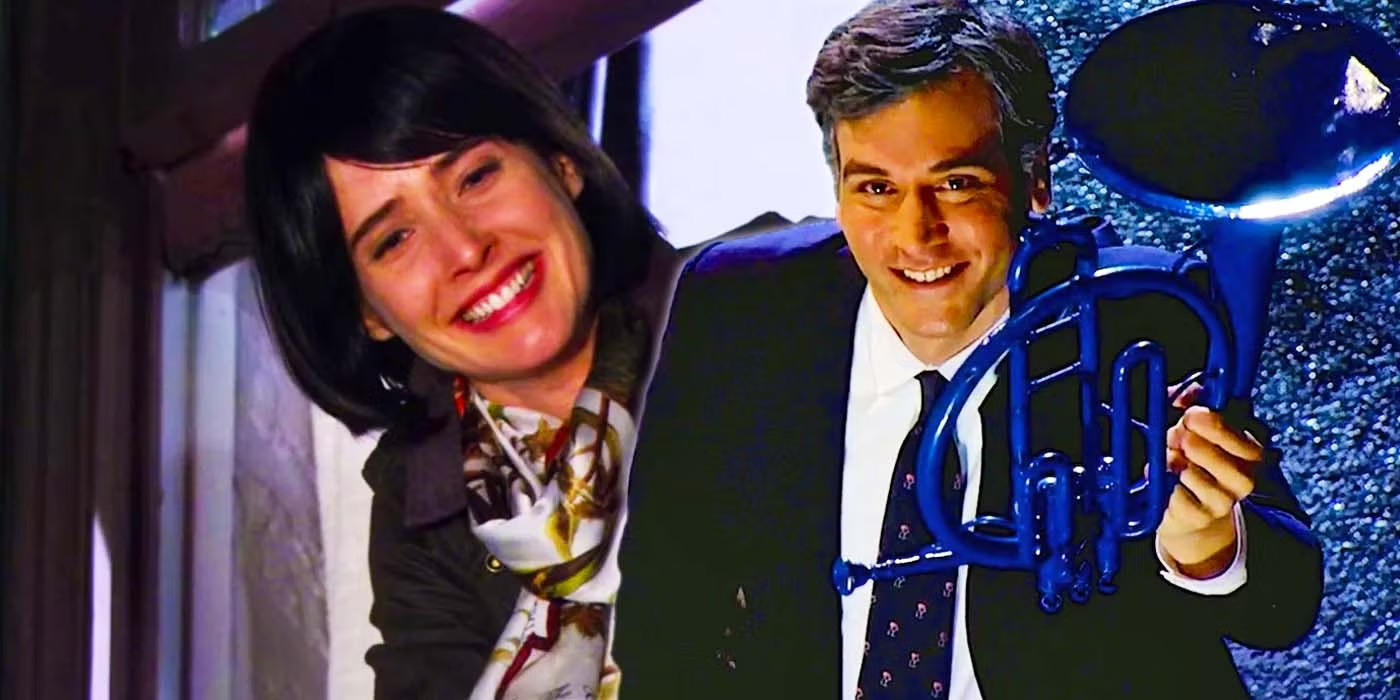
Okay, I hear the rationale — Robin had to be with Barney to learn that she should be with Ted, and Ted had to let go of Robin to have a beautiful romance with The Mother before he could be right for Robin. “Timing!” It doesn’t not make sense. It just pretends that Ted/Robin became more suited for one another than Barney/Robin, which recent seasons, even with their Ted/Robin teases, counterintuitively had to argue against in support of this wedding flash-forward that shaped the entire last four years (especially Nine). At this point, to separate Barney and Robin’s wedding from their actual happy endings, and from Ted’s happy ending, feels like an insult to the audience for enduring Seasons Six through Nine. And a waste of time, based on the show’s design, which is hinged on narrative progression towards the previewed conclusion of a long-form story. (Why drag it out and thus inflate its importance if it wasn’t as momentous?) It’s particularly bad given Nine’s choices; Barney/Robin are bolstered by having this whole season be about their forthcoming commitment to each other… while Ted and The Mother, in flash-forwards throughout this year, display a lovely rapport that makes her late arrival not only premise-fulfilling but actually worth building a series around. We want Ted with her now more than ever. And, heck, even if not for Nine, that’d still be the case. This is literally called How I Met Your Mother, and we were told it’s about Future Ted telling his kids the story of how he met their mom, with the ending long implied, by default, to be their meeting. Of course, this finale proves otherwise — it’s, again, a re-contextualization… but it’s a major eleventh-hour shift that, for a high-concept idea-driven series like this, comes across like a core betrayal. Remember, in high-concept sitcoms, a high-concept — a premise — matters most when delivering situation comedy, and by altering a premise, or by changing what the audience understands it to be (Mother told us what it was, but it was speaking through unreliable Narrator Ted), this entire situation is upended and therefore undermined. It’s no longer strong, reliable, durable from beginning to end. It’s a gotcha, a surprise, a gimmick. And that’s anti-situation comedy — a genre predicated on creating reliability through satisfied expectations.

So, I’d say the finale was primed to disappoint — it makes fools of the viewers by telling them they were duped, while both denying things most came to enjoy during the run, like Barney and Robin’s relationship, and minimizing elements they believed to be fundamental to the situation, like the happy ending Ted would finally receive by meeting and then being with The Mother. And after a long narrative wind-up — with a ninth season that amped up the anticipation by slowing its typically slothy plotting to a glacial gait — I think this was a real miscalculation on the part of the writers, who favored an originalist, cerebral take on these characters over what they actually needed after long-term usage, based on what actually happened as the plot progressed. This ending would have worked fine in early years, but not now. Now, it weakens the show’s credibility, and in terms of reputation, this finale does do damage; a sitcom once honored for the smartness of its long-form plotting disappoints with its long-form plot… well, that kind of hurts the whole thing, no?… And yet, there are a lot of sitcom finales I hate, and setting aside the exact expectations established by Mother as a matter of its premise, I don’t fault this one for being a head-scratcher. In fact, I respect the boldness. It’s a big swing that makes me feel stuff, and for a show like this, which was often sentimental and even dramatic, I’d say it’s fitting and itself identity-reflective just to have a finale that evokes such strong feelings. What’s more, this finale doesn’t take away from my ability to enjoy the good years — not just the peak of Two and Three, but really the first five, which this study has impressed upon me as being worthy of our time in a survey of this genre. It was often funny and engaging as situation comedy, at least given our then-perception of the premise. And despite the final years’ inevitable decay due to the usual difficulties associated with high-concept designs, particularly ones so predicated on plot and storytelling gimmicks (how things are “told”) — trends within the sitcom that you know I personally don’t love, often signaling a broader shift away from comedy towards drama — How I Met Your Mother is both an enjoyable and revealing sample of its era. It’s been fun and intellectually stimulating to ruminate on it here with you, especially for this last entry.
01) Episode 185: “The Locket” (Aired: 09/23/13)
Lily tries to stop Ted from giving Robin her missing locket.
Written by Carter Bays & Craig Thomas | Directed by Pamela Fryman

Nine’s unique and initially novel storytelling device of setting a whole season during one single weekend is never more exciting than in its premiere, for it’s not yet clear that the show is going to have trouble generating enough ideas to sustain this as a worthwhile gimmick. It also helps that this is the first full episode with Cristin Milioti as the woman whom we know to be The Mother, as she gives Lily advice on a bus ride — a neat recurring trick that is one way, in addition to flash-forward teases with Ted, for the year to keep her engaged throughout, prior to the moment where she and Ted meet. It’s clever, and at this juncture anyway, compelling because it’s the most direct premise-fulfillment Mother has offered since Season Five. Also, here I’ll note that the subplot is one of the year’s many displays of Neil Patrick Harris and Cobie Smulders’ well-developed chemistry, and even though Marshall is sequestered away from the other regulars for most of Nine’s first half, at least he’s with the amusing Sherri Shepherd.
02) Episode 193: “Platonish” (Aired: 11/11/13)
The group remembers a pivotal point back in Fall 2012.
Written by George Sloan | Directed by Pamela Fryman

You’ll note that many of the year’s best entries find excuses to break away from Southampton and the wedding weekend construct, or confines, which emphasize the premise foundationally but are difficult, in practice, to draw comedic ideas from that qualitatively justify this very slow plot progression. This excursion is a winner because it flashes back to early Season Eight, a terrible time in the show’s run that’s nevertheless uplifted by inserting The Mother into the action, as her advice to Barney encourages him to make The Robin play that he eventually uses to propose, thereby ensuring that The Mother herself has an instrumental role in Robin and Barney’s wedding and thus her later meeting with Ted. And it’s the kind of re-contextualization of perspective that’s innately indicative of this high-concept premise’s biased narrator.
03) Episode 199: “Unpause” (Aired: 01/20/14)
Marshall and Lily attempt to pause their fight for a moment of passion.
Written by Chris Harris | Directed by Pamela Fryman

Although all the Marshall/Lily drama from this year feels like time-wasting filler, since we’re sure they’ll end up fine regardless, this installment at least benefits from the fact that they’re finally together in the main story of the season, after many weeks of his being away. What’s more, the subplot where Robin and Ted realize that drunk Barney is a truth-teller is a lot of fun, making for one of his character’s more amusing showcases in Nine, where the narrative construct of his upcoming wedding renders him a little more dramatically serious than his prior depiction, which is thus better invoked here. Also, there are some nice flash-forwards with Ted and The Mother that remind us of just how close we are to complete premise-fulfillment!
04) Episode 200: “How Your Mother Met Me” (Aired: 01/27/14)
Future Ted recounts the events that led the mother of his kids to him.
Written by Carter Bays & Craig Thomas | Directed by Pamela Fryman

Aside from the controversial finale, this is the most memorable episode of the season — and one of the most memorable episodes of the whole series, as it essentially tracks every single forward-moving tease that the show has presented in its A-story plot between the pilot and now regarding the identity of Ted’s kids’ future mother, crafting one elaborate narrative in a condensed half-hour form… Only this time, it’s following The Mother, as Narrator Ted finally fills in many details about her, and how she got to be at the inn in Southampton right next to her future love. It’s an automatically thrilling excursion in terms of sheer dramatic payoffs, with Mother getting to exhibit its strong continuity and the expert craftsmanship of its long-form plotting (with flashbacks from throughout the run that also honor its history and the viewers’ long-term investment), along with the premise’s natural suspense, which continues to grow the more we see of The Mother and realize that she’s oh-so close now to Ted. And it’s an explicit play to the situation, because it really is covering what we believe Mother is slated to cover — exploring how Ted and The Mother met (or rather, will meet). Accordingly, I think I have to pick this as my MVE (Most Valuable Episode)… even though, frankly, it’s not funny. Like, hardly at all. As a situation comedy, part of the promise this series implicitly makes to the audience is that it will attempt to be humorous as a matter of priority, and since it’s not, I can’t pretend it’s an ideal sample of this show compared to other as-satisfying outings that manage to have laughs… And yet, there’s nothing else here in Nine that’s worthy of more praise, or evokes the same heavy premise-affirming romanticism of this entry, so what can I say?
05) Episode 201: “Sunrise” (Aired: 02/03/14)
Ted reminisces on his past relationships while strolling the beach with Robin.
Written by Carter Bays & Craig Thomas | Directed by Pamela Fryman

With hindsight, there are a lot of clues throughout the series, especially here in Nine, about its ultimate intentions with regard to Ted/Robin, as his chronic inability to move on from her will be reframed as the guiding emotional undercurrent that justifies their final pairing, and not, as we presume, the personal baggage that he has to evolve beyond in order to get his happy ending with The Mother. Again, I prefer the latter, so much so that a segment like this, where Ted and Robin walk on the beach and talk about his past relationships, almost feels like yet one more chance for maybe, perhaps, possibly final closure for him with her… But alas… As for “Sunrise” specifically, Ted reviewing his history plays like a summation of the long-form plot and thus premise-affirmation, and it’s fun to see cameos from Stella and Jeanette, making for another installment that honors the show and its continuity.
06) Episode 202: “Rally” (Aired: 02/24/14)
The group tries to perk up Barney when he wakes up on his wedding day with a hangover.
Written by Carter Bays & Craig Thomas | Directed by Pamela Fryman

Of all the episodes set in or around Southampton here in this ambitiously creative but ultimately not-entirely-pleasant final season, I think this is the one that most feels like classic Mother, as all the regulars are finally together for a single unifying story in which they attempt to find a hangover cure for Barney on the morning of his wedding, while simultaneously reminiscing about all the times he helped them through similar malaises. This logline allows for a structure that jumps back and forth in time (there’s Mother flash-forwards as well), again mining the show’s long history and lore to enhance our understanding of these characters, thereby emphasizing one of the truly remarkable and individually unique aspects of this series’ identity: its long-form plotting, and its recognition of how to play with continuity as a central, fundamental display of the situation, per these premised terms.
07) Episode 204: “Daisy” (Aired: 03/10/14)
As Robin reunites with her mother, Ted and the guys piece together a mystery about Lily.
Written by Carter Bays & Craig Thomas | Directed by Pamela Fryman

The hysterical Tracey Ullman guests here as Robin’s mother, granting this installment an extra appeal it would otherwise lack without her notable casting. However, the A-story alone is quintessential Mother, boasting a straightforward plot where Marshall and the guys visit the Captain (played by a returning Kyle MacLachlan, in his farewell appearance) to track down a missing Lily, which eventually leads to the discovery that she’s pregnant — via a piecing together of information through a re-contextualization of events, and a shift in perspective that’s enabled by the unreliable narrator framework. All of this speaks to the high concept and inherently validates its existence in the process, making this the kind of show only this series could do.
08) Episode 205: “Gary Blauman” (Aired: 03/17/14)
The group reminiscences about Gary Blauman when he unexpectedly shows up to the wedding.
Written by Kourtney Kang | Directed by Pamela Fryman

Taran Killam returns in his recurring role as the eponymous Gary Blauman for this affable outing that, like many of this year’s better showings, goes through the series’ long history and re-contextualizes our understanding of everything that’s happened by adding some new information. Namely, it inserts Gary more directly into the action, thereby shifting our perception of him, mainly from the realization that he’s gay (and in fact had a hand in splitting up Barney’s brother’s marriage). It’s a story that’s told in a structurally complicated way, with vignettes that jump back and forth in time through several framing devices, both at the wedding and in the future with Ted and The Mother on their first date, and it’s thus designed to play up Mother‘s unique identity, all while also offering content that, like a lot of Nine, seeks to honor the show by reflecting on its past (with a lot of beloved guest stars).
09) Episode 206: “The End Of The Aisle” (Aired: 03/24/14)
Both Ted and The Mother help ensure that Robin and Barney make it down the aisle.
Written by Carter Bays & Craig Thomas | Directed by Pamela Fryman

The 22nd episode of Season Nine ends with Barney and Robin going down the aisle, following several scenes that have been used as framing devices for the past few seasons, as Ted is wanted by both the anxious groom and the nervous bride on their big day. Robin is especially nervous because, once she realizes that Ted is the one who found her locket, she ponders whether she should be with Ted instead of Barney. This forces a seeming climax in Ted/Robin’s possibility as a couple, as Ted conclusively decides that they’ve evolved past each other and that she’s meant to be with Barney, a fact that would look to suggest that he’s finally moved on. And this sets up a quick meeting between Robin and The Mother, the resolution to the classic series-defining Slap Bet running gag, and the marriage of Barney and Robin — which we assume to be their happy ending, since this is something the show has been building up to for years, and Ted, of course, is about to meet the presumed love of his life as well… fulfilling the premise!
10) Episode 208: “Last Forever (II)” (Aired: 03/31/14)
Ted finishes the story of how he met the mother of his children… but was it really about that?
Written by Carter Bays & Craig Thomas | Directed by Pamela Fryman

I’ve shared the bulk of my thoughts on the series’ widely disliked finale above, but here I’ll reiterate that I think its final re-contextualization of the premise is justified by the premise itself, for it’s always had a biased and unreliable narrator in Ted, whose explanation of the series’ focus we maybe shouldn’t have believed. It’s just that, again, the show has long made Barney and Robin appear fated, while making it seem like Ted’s feelings for Robin was baggage that he needed to work through to earn the implied ending to his story, The Mother. And now that we’ve spent an entire year zeroing in on Robin and Barney’s choice to commit to each other, and enjoying the chemistry Ted shares with The Mother, it’s devastating to have both destroyed in this rapidly paced final hour — as the series tells us its suggested end is actually not its end, for the show has actually been about something else all along. I know, I know, there were clues. But it’s an insult to the high-concept situation nonetheless to upend it like so, and if not for the scene where Ted literally meets The Mother, Tracy, at long last — which is just as charming and rooted in the show’s long-form understanding of itself as you’d hope — I’m not sure I’d highlight it here…. Nevertheless, this finale is bold and memorable and reflects a series that’s centralized story and storytelling as a matter of premise, which it had an increasingly difficult time maintaining as its run progressed — an inevitability with this type of sitcom.
Other notable entries include: “Knight Vision,” which has a few fun gags with Sherri Shepherd as Daphne, “The Rehearsal Dinner,” which is one of the year’s better Barney shows because it features a scheme that’s revealed at the end and shifts our perspective about its events, “Bass Player Wanted,” which is carried by guest Andrew Rannells, and “Vesuvius,” which has downbeat flash-forwards with Ted and The Mother that most foreshadow her eventual death. I’ll also take this space to cite both “Coming Back” and “The Lighthouse,” simply because they feature flash-forwards of The Mother and thus invoke the premise via her sheer inclusion, along with the first half of the series finale mentioned above.

*** The MVE Award for the Best Episode from Season Nine of How I Met Your Mother goes to…
“How Your Mother Met Me”

Come back next week for Season Nine! And stay tuned tomorrow for a new Wildcard!
You put into words all my thoughts about that ridiculous finale. After season 5, it no longer was going to work. I rewatched it this week and I still hate it. Killing off the mother (a title chatacter) is nasty work. Why were they so invested in Ted&Robin like that? I don’t get it.
Hi, Elaine! Thanks for reading and commenting.
It was an ending they planned and shot (with the kids) in Season Two, and they just fully committed to it thereafter, dropping hints along the way as to their intention. But I agree, it’s an ending that works much better for Season Two than Nine!
I wasn’t as bothered by the series finale as most of the critics and fans because I never cared for Barney and Robin as a couple but I agree that killing the mother was in bad taste. Also a whole season for one wedding weekend? Maybe that plays better on a binge but definitely not week-by-week in the real-time! So its hard to defend this season. Just my 2 cents
Hi, Oscar! Thanks for reading and commenting.
I agree — the season drags because of its limited narrative focus, which only seeks to build up the importance of Ted’s meeting with The Mother. Killing her was never going to be popular with the audience, especially after a whole year like this!
Do you like this season better than the 11th season of Two and a Half Men?
Hi, Jon! Thanks for reading and commenting.
Yes, it’s a lot more narratively interesting, not to mention situationally fulfilling, despite all its problems!
Great stuff as always, but as not one of my favorite sitcoms, I must be honest, I’m glad it’s over! I’m excited that “Big Bang” is finally on the docket, as that’s a much better show IMHO. I’m hoping that you will enjoy it too!
Hi, Nat! Thanks for reading and commenting.
Yes, I enjoy THE BIG BANG THEORY — and I too prefer it over HOW I MET YOUR MOTHER!
I did not like this show and I’m certain after reading all of your blogposts over the last few months that even though you have found ways to appreciate it, it’s still not one that you consider a great sitcom (one of the greats) either. Am I correct?
Also I just ordered your book but I put in the wrong shipping address. Where can I contact to give you the correct one?
Hi, kv! Thanks for reading and commenting.
Yes, that’s a fair way to put it — I’ve found ways to enjoy and appreciate this series, but I don’t think it’s not a top-tier sample of the genre, even for tis era.
Also, thanks so much for buying my book! I have emailed you at the address affiliated with your order.
Cristin Milioti was such brilliant casting. She was WELL worth the wait and I was DEVASTATED when they had her die. I had a feeling they were going to pull something like that, or do some kind of twist. I remembered reading the “mother is dead” theory on online forums at the time as well. I hate that those turned out to be right.
Hi, esoteric1234! Thanks for reading and commenting.
I agree — she was very likable, and she and Josh Radnor had perfect rom-com chemistry!
Awesome looking forward to Big bang theory
Hi, BB! Thanks for reading and commenting.
Me too — stay tuned, it’s coming up soon!