
Welcome to a new Wildcard Wednesday! This week, I’m sharing the latest in my monthly series on midcentury Broadway comedies. For this entry, I’m revisiting three 1920s plays — all written by women — that I’ve spotlighted on this blog many years ago in individual posts.

NICE PEOPLE (1921)
Logline: A young heiress runs into trouble when she spends the night alone in a country house with her casual beau.
Author: Rachel Crothers | Original Director: Rachel Crothers
Original Broadway Cast: Francine Larrimore, Tallulah Bankhead, Katharine Cornell, Vincent Coleman, Martin Alsop, Hugh Huntley, Merle Maddern, Guy Milham, Edwin Hensley, Charles Gibney

Thoughts: I first read Nice People because of its connection to Tallulah Bankhead, who counted it as her biggest Broadway success prior to a star-making tenure on the West End. It also interested me as an early work by Rachel Crothers, one of the most preeminent woman playwrights of the 1920s whose legacy has nevertheless not quite sustained. This is unfortunate, for several of her comedies — especially the previously spotlighted When Ladies Meet — are delightfully intuitive on a human level. Well, I’m afraid Nice People is not one of her finer efforts. It’s a ham-handed critique of young wealthy urbanites that, at first, looks to be right on the money. That is, it’s successful at pinning them down, and despite some didacticism with the elder characters who are purely there to argue pros and cons, Crothers’ observations are both timely and astute for 1921. However, the piece devolves thereafter, undermining its initial insight with a worshipful depiction of the young group’s contrast — an earnestly anti-money, pro-work farm boy, who’s so idealistically rendered that it can’t help but feel clichéd, robbing this entire piece of its capacity for nuance and therefore emotional intelligence as he increasingly becomes central to the leading lady’s arc. He also tamps down on the comedy, which only comes from the folks being spoofed — the so-called Nice People, chief of whom is Tallulah Bankhead’s Hallie, the leading lady’s frenemy, who is so dripping with cynicism that she not only aids the narrative conflict but is most effective at making the author’s point about the emptiness of their lives. If only Crothers had stuck more firmly with them and their world — sparing us of the condescending provincialism that she’s lamely heralding as morally superior, only without the same intellectual rigor and emotional complexity afforded to its opposite — her thesis would have been much more easily corroborated. In other words, she’s good at mocking what she wants to mock, but because she treats the alternative with kid gloves, the whole argument feels clumsy and unfair — a rhetorical failure. And a waste of comedic potential.
Jackson’s Verdict: Hinders its satire by failing to be an equal-opportunity offender.

SEX (1926)
Logline: A prostitute hopes to leave behind her old life when she falls for a wealthy young admirer.
Author: Mae West | Original Director: Edward Elsner
Original Broadway Cast: Mae West, Warren Sterling, Eeda Von Buelow, Ann Reader, Barry O’Neill, Lyons Wickland, Pacie Ripple, and more

Thoughts: This notorious play — famously raided by the cops — is not the scandalous piece of pornography you’d perhaps expect. Oh, sure, there’s foul language, sexual frankness (and prostitution), some drinking, a little violence, suicide, and even a drugging. And when I lay it all out like that, it sounds bad. But without the salacious title, it probably wouldn’t have gotten famous, for it’s otherwise just a raunchy adult drama with seedy, low-life characters. It’s also dubiously positioned here in this series, for reading again, I’m reminded that I would not classify it as a comedy. It’s got some snappy dialogue and a basically happy ending for Mae West’s heroine. But the story itself is a near-melodrama about a hooker who tries to extricate herself from a bad situation and then foster some self-reinvention, only to find that it’s impossible to escape who she is. That’s a solid dramatic idea — a timeless notion — and West deserves credit as a playwright for that foundation. However, it’s a less artful effort than most of what I’ve covered in this blog series. For instance, none of the characters outside of West’s Margy have any depth. They’re all caricatures there for a narrative purpose. Also, almost every dramatic exchange is obvious and conceptually repetitive. And as for the plotting, the third act — which has the most comedic potential — proves to be something of a mess. The central conflict — the fact that Margy recognizes her new fiancé’s ritzy mother as a thrill-seeking dame she once saved from a date rape — is undercut by too many coincidentally returning characters who don’t compound the jeopardy but rather unfocus it, ultimately enabling an abrupt curtain that also lacks the primary pay-off the whole final act was teasing. And because of these letdowns in the plot, West’s thematic raison d’être — that honest baddies are better than dishonest baddies — is not well-delivered, offered clumsily through dialogue rather than drama. Accordingly, as a piece of theatrical craftsmanship, Sex doesn’t quite sell. But, frankly, it doesn’t matter. It’s a legendary piece of lore for both West and the Broadway stage, so it’ll forever be interesting.
Jackson’s Verdict: A better legend than a piece of comedy or drama.

CHICAGO (1926)
Logline: An ex-chorine charged with murder schemes to earn her freedom by manipulating the corrupt system.
Author: Maurine Watkins | Original Director: George Abbott
Original Broadway Cast: Francine Larrimore, Charles A. Bickford, Charles Halton, Edward Ellis, Isabelle Winlocke, Juliette Crosby, Dorothy Stickney, and more
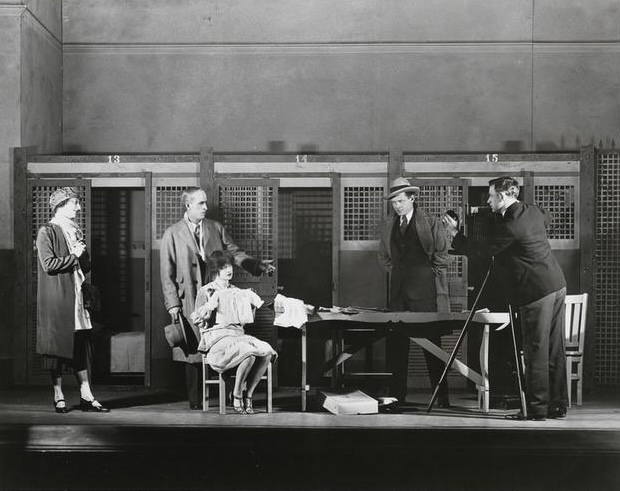
Thoughts: Kander and Ebb’s 1975 musical adaptation is the best version of Roxie Hart’s story because it uses the unique opportunities of its genre to better emphasize the original author’s central point about our personal and institutional commodification of scandal for the purposes of entertainment. That is, it’s the most showbiz-about-showbiz take on the idea and it’s therefore the most effective. However, Maurine Dallas Watkins’ initial play is fascinating in its own right, as it inspired everything that followed — not just the stage musical or its movie adaptation, but also the original silent film (played more earnestly) and a minor screwball remake (with Ginger Rogers as a genuinely innocent Roxie). Notably, Watkins’ text is more about the media ecosystem at large, with Roxie at the center of the plot, yes, but a reporter named Jake weaving in and out as a sort of plain-talking narrator and proxy for the author. And this makes sense, as the entire play was based on her personal reporting, so the process by which these real-life crimes became presented to the public, and the outcomes that were derived as a result, was the focus of her satire. The musical’s broader “everything-is-showbiz” angle was more acutely extrapolated later (with Velma rising in prominence as a rival for Roxie), and although that has since come to be more appreciated by our society, the 1926 play doesn’t miss it, for it’s such a full, well-crafted sendup of American culture that the criticism endures as sharply resonant. It’s also very funny — Roxie Hart, from the jump, is a believable mess of hilarious contradictions, and this is the most authentic version you’ll find of her, wonderfully rooted in the voice and attitudes of the 1920s. This authenticity elevates the entire play — it really feels like scathing social commentary, expertly told with fun characters. I wish it more often got its due; the musical, as I noted, is uber-effective, but the play is the compelling reason for it all.
Jackson’s Verdict: The strong foundation for everything great that’s followed.

Come back next week for another Wildcard! And stay tuned Tuesday for more sitcom fun!